
Monomorium anderseni
- Sci. Name
- Monomorium anderseni
- Tribe
- Solenopsidini
- Subfamily
- Myrmicinae
- Author
- Heterick, 2001
- Distribution
- Found in 1 countries
Introduction
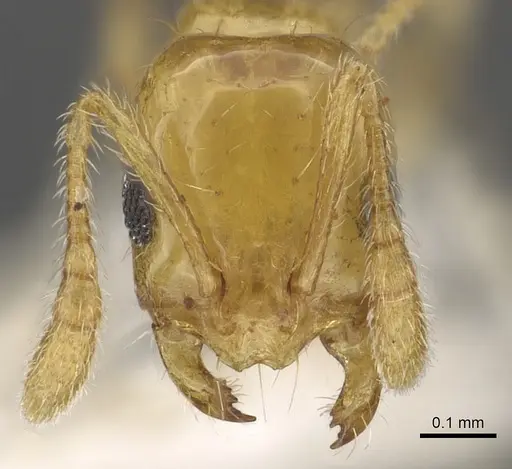
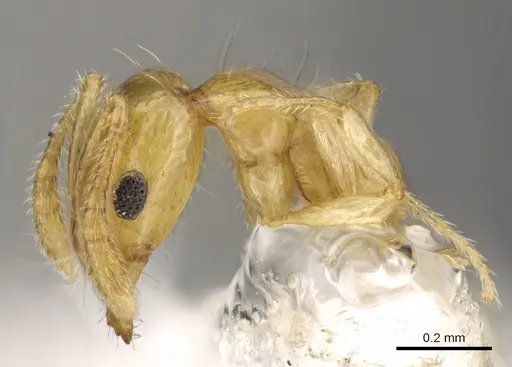
Monomorium anderseni is a tiny yellow ant species native to tropical northern Australia, specifically found in the Northern Territory and Western Australia around the Katherine area. Workers are a distinctive bright gamboge yellow color, making them one of the more brightly colored Monomorium species. This species belongs to the monomorium group within the genus and can be identified by its flattened, squamiform petiolar nodes and relatively large propodeal spiracle compared to similar species like Monomorium laeve. Nothing is known about the biology of this species in the wild, including its colony structure, founding behavior, or specific dietary needs. It has been recorded in both laterite and sandstone habitats in the Mitchell Falls area of tropical northwestern Australia, where it is considered a Generalised Myrmicinae with Eyrean biogeographic affiliations.
Quick Summary
- Difficulty: Unknown, no established care data available
- Origin & Habitat: Tropical northern Australia (Northern Territory, Western Australia) around Katherine. Found in laterite and sandstone habitats in the Mitchell Falls region. [2][1]
- Colony Type: Unconfirmed colony structure
- Size & Growth:
- Antkeeping:
- Temperature: Unknown, likely warm given tropical distribution
- Humidity: Unknown, likely moderate based on general Monomorium preferences
- Diapause: Likely minimal or no diapause given tropical distribution
- Nesting: Use test tube setups or small nests scaled to their small size
- Behavior: These are tiny, bright yellow ants. Escape prevention is critical due to their very small size, they can squeeze through the tiniest gaps. As Generalised Myrmicinae, they are likely generalist foragers. [2]
- Common Issues: no specific biological data available, care is largely unconfirmed, escape prevention critical due to tiny size, no established care guidelines in antkeeping hobby, wild-caught colonies may have unknown health issues given lack of captive breeding data
Appearance and Identification
Monomorium anderseni workers are tiny ants with a distinctive bright gamboge yellow coloration, which stands out compared to many other Monomorium species that tend toward darker browns or reds. The species can be identified by its flattened, squamiform (scale-like) petiolar nodes and a relatively large propodeal spiracle. The eyes are notably large, with eye width greater than 1.5 times the greatest width of the antennal scape. The head capsule is narrow. Workers are monomorphic, meaning all workers are roughly the same size rather than having major and minor castes. The original description provides mesosoma length measurements (1.24-1.50mm) but total body length is not specified. [1]
Natural Habitat and Distribution
This species is endemic to tropical northern Australia, specifically found in the Northern Territory and Western Australia in the Katherine region. Type specimens were collected from Manbulloo (southwest of Katherine) and various sites 10-23km southwest of Katherine between 1977-1978. In the Mitchell Falls area of tropical northwestern Australia, the species has been recorded at both laterite and sandstone sites, with a significant association with laterite habitats. The species is classified as a Generalised Myrmicinae with Eyrean biogeographic affiliations, meaning it is adapted to the arid to semi-arid conditions of inland Australia. [2][1]
Housing and Nest Setup
Due to their very small size, Monomorium anderseni requires careful housing setup. Test tube setups work well for founding colonies and small established colonies. For larger colonies, a Y-tong (AAC) nest with narrow chambers or a small plaster nest scaled to their tiny size is appropriate. Escape prevention is critical, these ants can squeeze through very small gaps. Use fine mesh on any ventilation holes and ensure lids fit tightly.
Feeding and Diet
As a Generalised Myrmicinae, Monomorium anderseni likely has a generalist diet similar to other Monomorium species. They probably accept sugar sources (honey water, sugar water) and protein sources (small insects, mealworms, fruit flies). Since nothing is specifically documented about this species diet, start with standard ant foods and observe acceptance. Feed small amounts frequently rather than large prey items that may go uneaten. [2]
Temperature and Humidity
Being a tropical Australian species from the Katherine region, Monomorium anderseni likely prefers warmer temperatures. Keep the nest area in the low-to-mid 20s Celsius with a slight gradient allowing workers to move between warmer and cooler areas. For humidity, aim for moderate levels. The test tube water reservoir provides humidity through the cotton, but monitor for condensation and mold.
Colony Development and Growth
Nothing is documented about the colony development of Monomorium anderseni. Founding colonies should be left undisturbed for the first few months, queens sealed in their founding chamber should not be disturbed until workers emerge. Once workers are present, you can begin offering food and gradually expand the colony space as the population grows.
Frequently Asked Questions
How long does it take for Monomorium anderseni to produce first workers?
Unknown, no development data is available for this species.
What do Monomorium anderseni ants eat?
As Generalised Myrmicinae, they likely accept both sugar and protein. Start with a drop of honey water or sugar water and small prey like fruit flies or tiny mealworm pieces. Since no specific dietary data exists for this species, observe what your colony accepts. [2]
Are Monomorium anderseni good for beginners?
This species is not well-documented in the antkeeping hobby and has no established care guidelines. It may not be the best choice for beginners who need established care guides. The main challenges are escape prevention due to their tiny size and the lack of species-specific biological data.
How big do Monomorium anderseni colonies get?
Colony size is not documented for this species.
Do Monomorium anderseni need hibernation?
Likely no significant hibernation is required. This species comes from tropical northern Australia where temperatures remain warm year-round.
What temperature should I keep Monomorium anderseni at?
Keep them warm, aim for low-to-mid 20s Celsius. A temperature gradient is ideal so workers can self-regulate.
Why are my Monomorium anderseni escaping?
Their tiny size makes them excellent escape artists. Use fine mesh, ensure all lids fit tightly, and apply barrier coatings to the edges of the outworld. Check all tubing connections and any gaps around the nest setup.
Can I keep multiple Monomorium anderseni queens together?
The colony structure is unconfirmed for this species. Combining unrelated foundress queens is not recommended since this has not been documented for this specific species.
Is Monomorium anderseni a difficult species to keep?
The difficulty level is not well-established since this species is rarely kept. The main challenge is the lack of species-specific biological data, so you may need to experiment with care conditions.
Report an Issue
The current care sheet is based fully on literature. See inconsistencies, or something that's incorrect? Please , it will be resolved after review from an admin. Contributing to the blogs tab also helps providing information, to make us be able to further improve the caresheets. Thank you for your support!
References

This caresheet is licensed under CC BY-SA 4.0 .
Community Blogs
CASENT0902289
View on AntWeb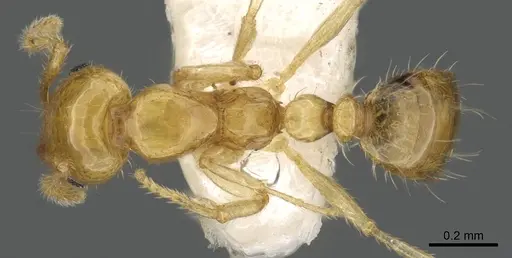
Literature
Loading distribution map...Loading products...