
Meranoplus curvispina
- Sci. Name
- Meranoplus curvispina
- Tribe
- Crematogastrini
- Subfamily
- Myrmicinae
- Author
- Forel, 1910
- Distribution
- Found in 1 countries
Introduction
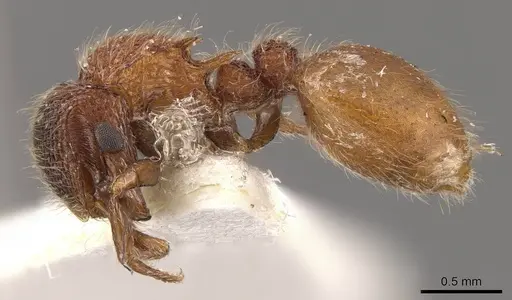
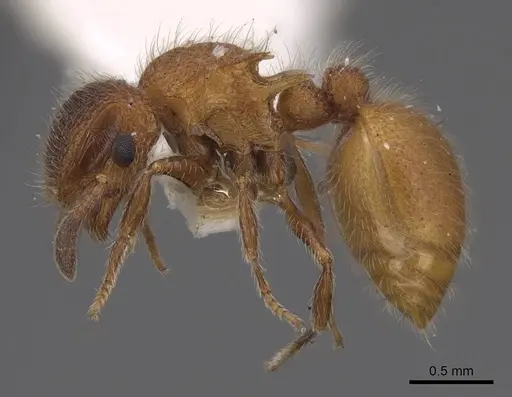
Meranoplus curvispina is a small myrmicine ant native to southern Australia, ranging from Western Australia through South Australia, Tasmania, Victoria, and up through New South Wales to southern Queensland . Workers are tiny at around 3mm total length, with a distinctive appearance featuring a promesonotal shield with multiple projections and long, curved propodeal spines that spread outward in an arc . The body is typically rusty ferrugineous in color, often with the head or head and mesosoma darker than the abdomen . This species was originally described as a variety of M. puryi but was elevated to full species status in 2004 after taxonomic review . It belongs to the M. curvispina species complex, which contains six closely related species . These ants nest in the ground according to label data from collected specimens . As with other Meranoplus species, they have a smear-type defense using a flattened stinger to wipe venom onto enemies rather than piercing.
Quick Summary
- Difficulty: Medium, limited care data available
- Origin & Habitat: Southern Australia, from Western Australia through South Australia, Tasmania, Victoria, and north through New South Wales to southern Queensland. Found in Tasmania as one of only three known Tasmanian Meranoplus species [1][2]. Ground-nesting based on specimen collection data [2].
- Colony Type: Colony structure is unconfirmed. No data available on whether they are single-queen (monogyne) or multi-queen (polygyne) colonies.
- Size & Growth:
- Queen: Approximately 4.3mm total length based on gyne measurements [2]
- Worker: Approximately 3mm total length (TL 3.44mm average) [2]
- Colony: Unknown, no colony size data available
- Growth: Unknown, no development data available
- Development: Unconfirmed, no direct measurements exist. Based on typical small Myrmicinae patterns, estimate 6-10 weeks at warm temperatures. (Development timeline has not been studied in this species.)
- Antkeeping:
- Temperature: Temperature requirements are unconfirmed. Based on southern Australian distribution (Tasmania to Queensland), they likely tolerate a range from roughly 18-26°C. Start around 22-24°C and observe colony activity.
- Humidity: Humidity preferences are unconfirmed. Based on ground-nesting behavior and southern Australian range, they likely prefer moderate humidity. Keep substrate moist but not waterlogged.
- Diapause: Unknown, no specific data on overwintering requirements. Southern Australian distribution suggests they may tolerate cooler temperatures in winter months.
- Nesting: Ground-nesting based on label data [2]. A naturalistic setup with soil or a Y-tong/plaster nest with narrow chambers would likely work well.
- Behavior: Behavior is poorly documented. Based on genus-level knowledge of Meranoplus, these ants are likely relatively docile and not aggressive. Workers are small (around 3mm) so escape prevention should be taken seriously, they can squeeze through small gaps. Foraging style is unknown but likely involves ground foraging for small prey and honeydew.
- Common Issues: no specific colony size data makes it difficult to plan for long-term housing, development timeline is unknown so keepers cannot track progress accurately, temperature and humidity preferences are unconfirmed requiring experimentation, ground-nesting behavior may require specific substrate setup not well documented, limited availability in the antkeeping hobby, rarely available from breeders
Appearance and Identification
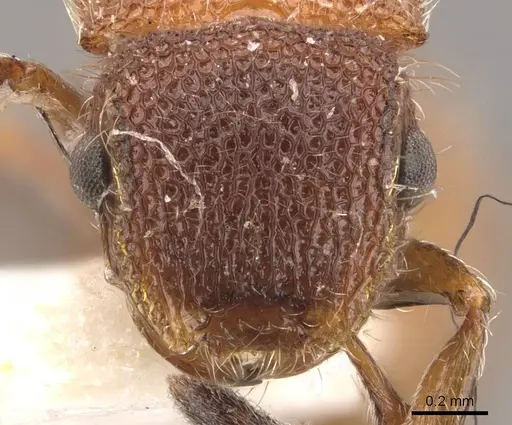
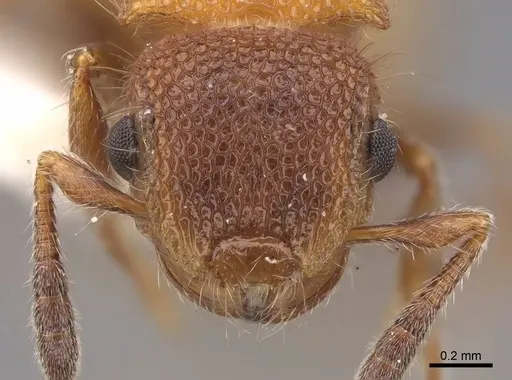
Meranoplus curvispina workers are small ants measuring around 3mm in total length [2]. They have a distinctive appearance with a promesonotal shield (the middle body section) that has multiple projections, four projections at the hind margin, with the outer ones pointing backward and sideways, and inner ones pointing backward but shorter and blunter [2]. The most striking feature is the propodeal spines, these are robust, long, and curve inward in an arc when viewed from above [2]. The body color is uniformly rusty ferrugineous, though often the head or head and mesosoma are darker than the gaster (abdomen) [2]. Queens are larger at about 4.3mm with medium-sized eyes and similarly colored but with the antennal club and top of the head being darker [2]. This species is part of a complex of six closely related species, so identification to species level requires careful examination of the spines and sculpturing [1].
Distribution and Habitat
This species has an extremely wide distribution across southern Australia, found from southern Western Australia through South Australia to Tasmania and Victoria, then north through New South Wales to southern Queensland, reaching as far north as Townsville [1][2]. It is one of only three known Meranoplus species in Tasmania [1]. Based on label data from collected specimens, these ants appear to nest in the ground [2]. The southern Australian distribution (including Tasmania) suggests they are adapted to temperate conditions and may tolerate cooler temperatures than tropical species.
Housing and Nesting
Since this species likely nests in the ground, a naturalistic setup with a soil-filled container or a Y-tong/plaster formicarium with narrow chambers would be appropriate [2]. The workers are small (around 3mm) so chambers should be appropriately scaled. Keep the substrate moist but allow some areas to dry out to prevent mold. Since escape prevention is important for small ants, ensure any setup has tight-fitting lids and consider using fluon on container edges. No specific data exists on what nest types work best in captivity for this species, so keepers may need to experiment with different setups.
Feeding and Diet
The specific diet of Meranoplus curvispina has not been documented in scientific literature. Based on typical Meranoplus behavior and related Myrmicinae, they likely are omnivorous, feeding on small insects, honeydew from aphids, and possibly nectar. Keepers should offer a varied diet including sugar sources (honey water or sugar water) and protein sources (small insects like fruit flies, pinhead crickets, or mealworms). Start with small prey items appropriate for their tiny worker size.
Temperature and Seasonal Care
Temperature requirements are not specifically documented for this species. Based on their wide distribution from Tasmania (cool temperate) to Queensland (subtropical), they likely tolerate a broad temperature range of roughly 18-26°C. Keep them in the low-to-mid 20s°C range (around 22-24°C) as a starting point and observe colony behavior. No specific data exists on diapause or overwintering requirements. Given their southern Australian distribution including Tasmania, they may benefit from a cooler period in winter months, but the specifics are unknown. [1]
Growth and Development
The development timeline for Meranoplus curvispina has not been studied, so no specific data exists on egg-to-worker development time. Based on typical patterns for small Myrmicinae ants, a reasonable estimate would be 6-10 weeks from egg to first worker at optimal warm temperatures (around 24°C). Queens measure about 4.3mm while workers are around 3mm [2]. The first workers (nanitics) will likely be smaller than normal workers. Since colony size data is also unavailable, keepers should expect relatively slow growth typical of smaller ant species.
Frequently Asked Questions
How long does it take for Meranoplus curvispina to produce first workers?
The exact development timeline is unconfirmed for this species. Based on typical small Myrmicinae patterns, expect roughly 6-10 weeks from egg to first worker at warm temperatures around 24°C. This is an estimate since no specific research exists on their development.
What do Meranoplus curvispina ants eat?
Specific diet is not documented, but based on typical Meranoplus behavior, they likely accept small insects, honeydew, and sugar sources. Offer small prey items like fruit flies or pinhead crickets, plus sugar water or honey water.
Are Meranoplus curvispina good for beginners?
This species is not recommended for complete beginners due to lack of available care information and limited availability in the hobby. If you can obtain a colony, expect to experiment with care conditions.
Do Meranoplus curvispina ants sting?
Stinging behavior is not documented for this species. Most small Myrmicinae have stingers but are too small to penetrate human skin effectively. Based on typical Meranoplus behavior, they are likely docile and not aggressive.
What temperature should I keep Meranoplus curvispina at?
Temperature requirements are unconfirmed. Based on their southern Australian distribution, a range of 18-26°C is likely acceptable. Start around 22-24°C and adjust based on colony activity.
How big do Meranoplus curvispina colonies get?
Colony size is unknown, no research data exists on maximum colony size. Based on their small worker size, colonies likely reach dozens to a few hundred workers rather than thousands.
Can I keep multiple Meranoplus curvispina queens together?
Colony structure (monogyne vs polygyne) is unconfirmed for this species. No data exists on whether they accept multiple queens or how they establish colonies. Do not attempt combining unrelated queens without documented evidence that this works.
Do Meranoplus curvispina need hibernation or diapause?
Diapause requirements are unknown. Their distribution includes Tasmania, which has cold winters, so they may tolerate or require a cooler period. However, specific overwintering requirements have not been documented.
What type of nest should I use for Meranoplus curvispina?
Based on label data indicating ground-nesting [2], a naturalistic setup with soil or a Y-tong/plaster nest with appropriately sized chambers would be suitable. Keep substrate moist but allow some drying. The workers are about 3mm so chambers should be small to medium in size.
Where is Meranoplus curvispina found in the wild?
This species is widely distributed across southern Australia, from southern Western Australia through South Australia, Tasmania, Victoria, and north through New South Wales to southern Queensland [1][2].
Report an Issue
The current care sheet is based fully on literature. See inconsistencies, or something that's incorrect? Please , it will be resolved after review from an admin. Contributing to the blogs tab also helps providing information, to make us be able to further improve the caresheets. Thank you for your support!
References

This caresheet is licensed under CC BY-SA 4.0 .
Community Blogs
CASENT0908948
View on AntWeb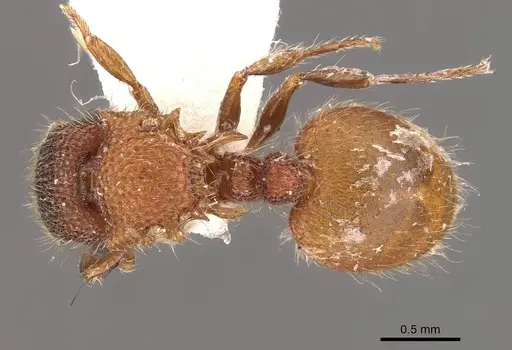
CASENT0922920
View on AntWeb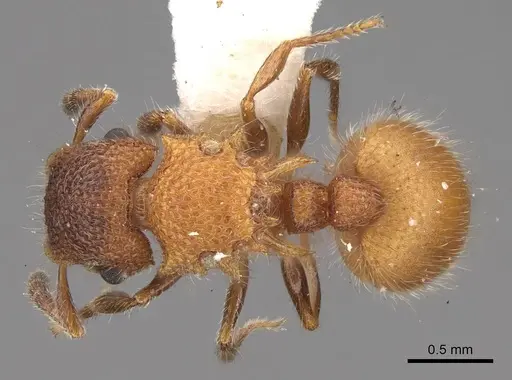
Literature
Loading distribution map...Loading products...