
Leptomyrmex geniculatus
- Sci. Name
- Leptomyrmex geniculatus
- Tribe
- Leptomyrmecini
- Subfamily
- Dolichoderinae
- Author
- Emery, 1914
- Distribution
- Found in 1 countries
Introduction
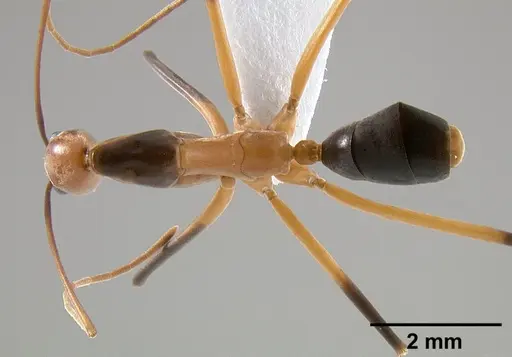
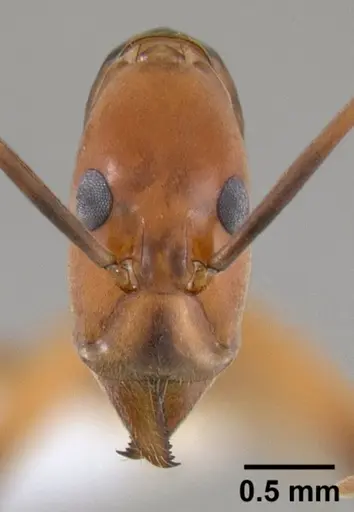
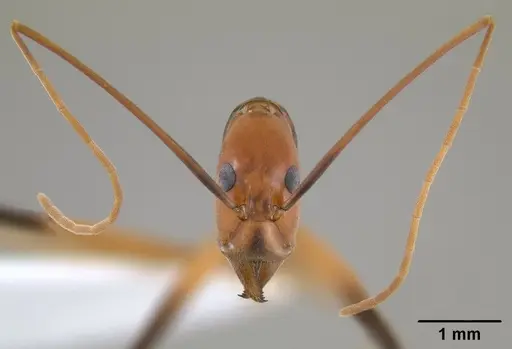
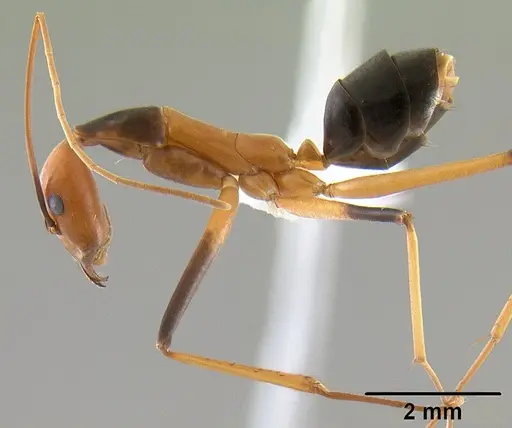
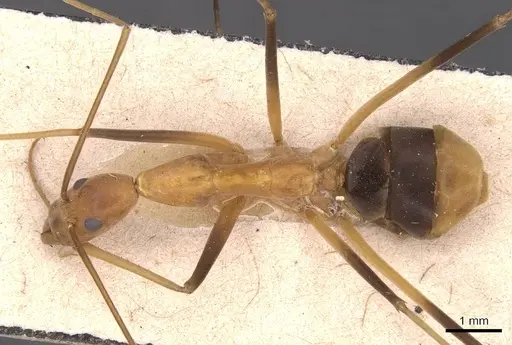
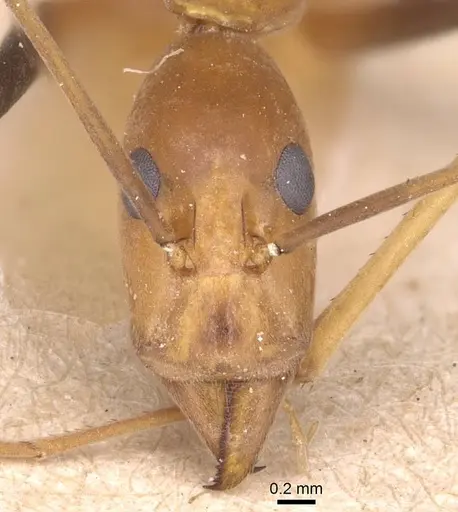
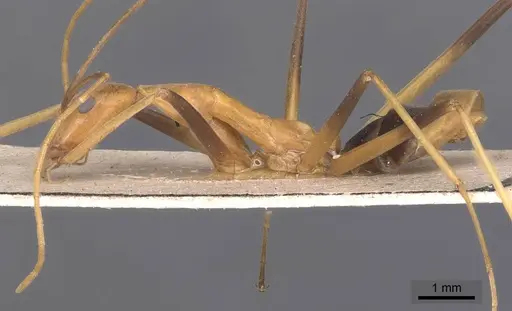
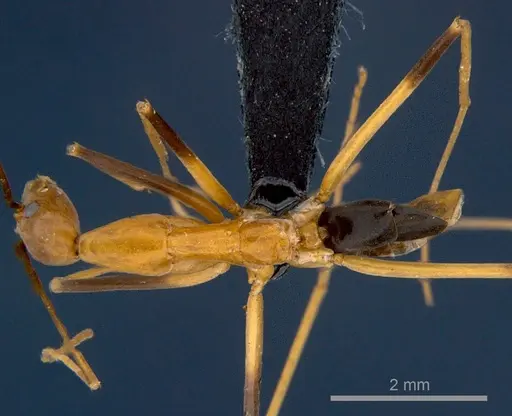
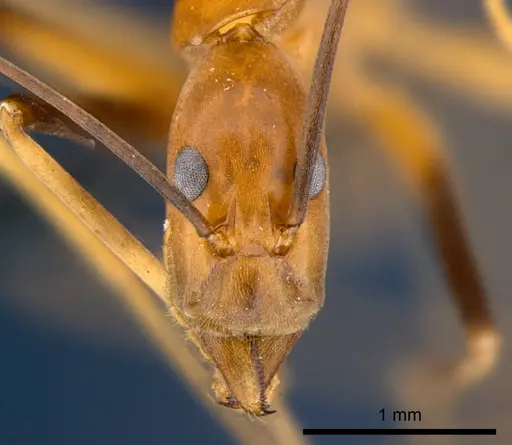
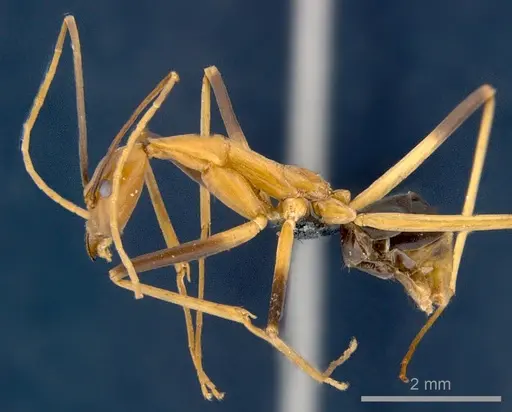
Leptomyrmex geniculatus is a slender, elongated ant from New Caledonia. Workers have a head width of about 1 mm and a mesosoma length of 3.2–3.5 mm, with extremely long legs and antennae that extend well past the back of the head . The most noticeable feature is its color: a pale orange body with a black abdomen (first two gaster segments) and black lower portions of the legs (femora). This species is one of three Leptomyrmex found on New Caledonia, the others being L. pallens and L. nigriceps, all of which it closely resembles apart from the dark patches . It lives in both rainforest and dry forest but is less common than L. pallens . The queen and male have never been described, nesting habits are unknown, and the species is not kept in captivity.
Quick Summary
- Difficulty: Expert – species not kept in captivity, queen unknown
- Origin & Habitat: Endemic to New Caledonia, found in rainforest and dry forest throughout the island [1][3]
- Colony Type: Unknown – only workers have been described, queen and male unknown [2]
- Size & Growth:
- Queen: Unknown – queen has never been described
- Worker: Body length unknown, head width ~1 mm, mesosoma length 3.2–3.5 mm [1]
- Colony: Unknown – no colony size data available
- Growth: Unknown
- Development: Unknown – development has not been studied (No data exists. Related Leptomyrmex species may take several months, but this is speculative for L. geniculatus.)
- Antkeeping:
- Temperature: Unknown – no thermal studies. Given New Caledonia's tropical climate, a starting range of 22–28°C is reasonable. Adjust based on observed activity.
- Humidity: Unknown – no recorded humidity data. Given its rainforest habitat, moderate to high humidity (60–80%) is likely appropriate. Provide a water source and keep substrate slightly moist.
- Diapause: Unknown – New Caledonia has a mild tropical climate without true winter, so diapause may not be required. Observe colony for seasonal slowdowns.
- Nesting: Nesting habits are completely unknown [1]. Based on related Leptomyrmex, they may nest in soil, rotting wood, or under stones. Start with a test tube and later offer a Y-tong or plaster nest.
- Behavior: Behavior is unstudied. Related Leptomyrmex are generally non‑aggressive, moderate foragers that feed on honeydew and small insects. Workers are very slender with long legs, so escape prevention is critical – use fine mesh or fluon barriers, as they can squeeze through standard test tube cotton. No established captive care exists.
- Common Issues: queen and male have never been described – colony founding from wild specimens is currently impossible, nesting habits are unknown, making captive housing entirely speculative, no information on diet or feeding behavior exists for this species, extremely slender workers pose a high escape risk, standard barriers may not hold them, no captive reports or care protocols are available – any attempt is experimental
Species Overview and Identification
Leptomyrmex geniculatus is one of three Leptomyrmex species found in New Caledonia. The genus name means 'slender thigh', referring to its characteristically long, thin legs. Workers are small but remarkably elongated: head width about 1 mm and mesosoma length 3.2–3.5 mm. The most distinctive feature is the color pattern: a pale orange body with a black abdomen (first two gaster segments) and black lower portions of the femora. The head is nearly twice as long as wide, and the antennae extend past the back of the head by about two‑thirds their length [1]. This species is less common than its relative L. pallens and has been found living in the same areas. Identification from other New Caledonian Leptomyrmex relies primarily on the dark gaster and dark leg patches [2].
Distribution and Habitat
Leptomyrmex geniculatus is endemic to New Caledonia, an island in the South Pacific about 1,200 km east of Australia. It has been collected from rainforest and dry forest across the island [1][3]. Phylogenetic studies show it belongs to a New Caledonian clade that split from Australian Leptomyrmex around 10.3 million years ago [4]. The fact that it occurs in both wet and drier forests suggests some habitat flexibility, but microhabitat preferences (e.g., nesting sites, foraging conditions) remain completely unknown.
Current State of Knowledge
This is one of the least studied ant species. Leptomyrmex geniculatus represents a major knowledge gap: only the worker caste has been formally described. The queen and male have never been collected or described, so there is no information on queen size, color, founding behavior, or colony structure. Colony size, development time, foraging patterns, and most basic biology are unstudied [1][2]. The species is not kept in captivity, and no established care protocols exist. Any husbandry advice is speculative and extrapolated from better‑known Leptomyrmex species.
Related Species and Genus Characteristics
Leptomyrmex is a genus of Dolichoderinae commonly called 'spider ants' because of their very long legs. They are distributed across Australia, New Guinea, and New Caledonia. While L. geniculatus is poorly known, other Leptomyrmex species give some general guidance: workers are slender, long‑legged, often pale, and generally docile. They forage for honeydew and small insects. New Caledonian Leptomyrmex form a distinct clade that diverged from Australian relatives around 10 million years ago [4][5]. The two other New Caledonian species are L. pallens (more common) and L. nigriceps, both of which share the elongated morphology.
Captive Care Considerations
Since this species is not kept in captivity, any attempt to keep it would be entirely experimental. If queens were available (they are not described), a test tube setup might work for founding. The extremely slender and small workers (head width ~1 mm) mean escape prevention must be excellent – standard cotton barriers may be insufficient, fine mesh or fluon barriers would be necessary. Temperature and humidity are speculative but likely align with tropical conditions (22–28°C,60–80% humidity). This species should be considered an expert‑level species for research purposes only, not for hobby keeping.
Frequently Asked Questions
Can I keep Leptomyrmex geniculatus in captivity?
This species is not currently kept in captivity and no care protocols exist. The queen caste has never been described, so wild‑caught founding is impossible. Even if queens were found, there are no established guidelines for their care.
How big do Leptomyrmex geniculatus colonies get?
Colony size is completely unknown. No research has documented colony sizes for this species.
What do Leptomyrmex geniculatus eat?
Diet preferences are unstudied for this species. Related Leptomyrmex feed on honeydew and small insects. Without confirmed data, offering sugar water and small live prey would be speculative.
What is the difficulty level for keeping Leptomyrmex geniculatus?
This species cannot be kept in captivity at this time because the queen has never been described. Even if queens became available, the complete lack of biological data would make this an expert‑only research species.
Where does Leptomyrmex geniculatus live?
This species is endemic to New Caledonia, an island in the South Pacific. It has been found in both rainforest and dry forest habitats throughout the island.
How long do Leptomyrmex geniculatus workers live?
Worker lifespan is completely unstudied for this species. Typical ant workers live several months to a few years, but specific data does not exist for L. geniculatus.
Do Leptomyrmex geniculatus need hibernation?
Diapause requirements are unknown. New Caledonia has a mild tropical climate without true winter, so hibernation may not be required. No research has been done on seasonal behavior for this species.
What makes Leptomyrmex geniculatus different from other Leptomyrmex?
Leptomyrmex geniculatus is distinguished by its combination of dark gaster (abdomen) and dark distal portions of the femora on an otherwise pale orange body. It is less commonly encountered than L. pallens, its closest relative on New Caledonia.
Can I find Leptomyrmex geniculatus queens for sale?
No, queens of this species are not available in the antkeeping hobby. The queen caste has never been scientifically described, so no one has been able to identify or sell them.
Report an Issue
The current care sheet is based fully on literature. See inconsistencies, or something that's incorrect? Please , it will be resolved after review from an admin. Contributing to the blogs tab also helps providing information, to make us be able to further improve the caresheets. Thank you for your support!
References

This caresheet is licensed under CC BY-SA 4.0 .
Community Blogs
Literature
Loading distribution map...Loading products...