
Leptanilla japonica
- Sci. Name
- Leptanilla japonica
- Tribe
- Leptanillini
- Subfamily
- Leptanillinae
- Author
- Baroni Urbani, 1977
- Distribution
- Found in 1 countries
Introduction
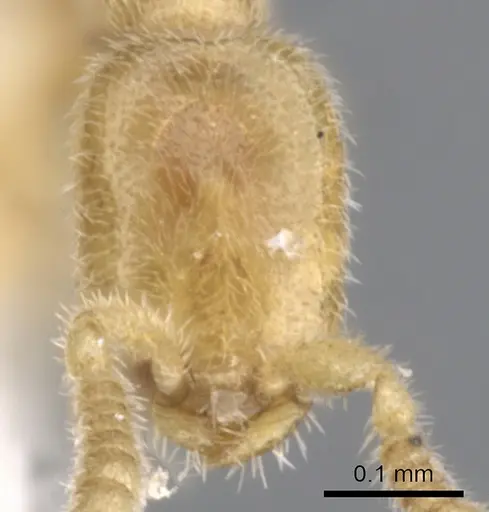
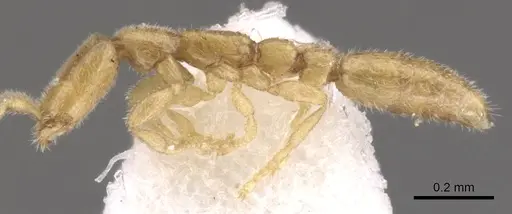
Leptanilla japonica is one of the smallest ants you can keep, with workers just 1.2 mm and queens 1.8 mm . These pale yellow to light reddish-yellow ants belong to the subfamily Leptanillinae, a group of rare, subterranean ants mostly found in Asia . They were first described from Honshu Island, Japan, and a possible record exists from Hong Kong, making them one of the better‑known Leptanilla species . The most unusual thing about this ant is how the queen feeds. She cannot eat on her own – she has never been seen eating prey, even when offered . Instead, she survives entirely by drinking hemolymph (the insect equivalent of blood) directly from her larvae through special duct organs on the 4th abdominal segment. This behaviour is called larval hemolymph feeding (LHF) and workers do it too . The colony produces brood in strict cycles: all larvae grow together, and when they mature the queen feeds heavily, her abdomen swells dramatically within days, and she lays 100–200 eggs in a short burst . This synchronized breeding is more like army ants than typical ants.
Quick Summary
- Difficulty: Expert
- Origin & Habitat: Japan (Honshu Island) with a possible record from Hong Kong. Nests in small hollows in the soil in evergreen broadleaf forests [4][3][5].
- Colony Type: Monogyne (single‑queen colonies). Queens are dichthadiiform (ergatoid, permanently wingless) and feed exclusively on larval hemolymph. Workers cannot produce eggs [1][5][6][7].
- Size & Growth:
- Queen: 1.8 mm [1]
- Worker: 1.2 mm [1]
- Colony: 100–200 workers [1][3]
- Growth: Moderate – synchronized brood development means growth comes in distinct pulses, not continuously
- Development: Unknown – the exact time has not been documented in research (Brood development is strictly synchronized: all larvae develop together and pupate together. This phasic pattern is unlike most ants [1].)
- Antkeeping:
- Temperature: Unknown – no specific thermal studies exist for this species. Based on its Japanese origin, try moderate room temperatures (20–24 °C). A gentle gradient allows the ants to choose [4].
- Humidity: High humidity is essential – these are subterranean ants from moist forest soils. Keep the nest substrate consistently damp but not waterlogged. Provide a water tube [5].
- Diapause: Likely required. Masuko observed that larvae of some Leptanilla species overwinter, so a winter rest period is probable [8]. Provide 2–3 months at 10–15 °C during winter.
- Nesting: Test tubes work for founding, but established colonies need custom setups with very narrow passages (scaled to 1.2 mm workers). Soil or plaster nests that mimic their natural small soil cavities are ideal. Naturalistic setups encourage natural nest‑emigration behaviour [1].
- Behavior: Workers are active group hunters that specialise on geophilomorph centipedes, foraging in trails like miniature army ants [1]. They are harmless to humans – far too small to sting or bite. Escape prevention is critical: at 1.2 mm they can slip through tiny gaps. Colonies regularly move nests when local food runs out [1].
- Common Issues: extremely specialised diet requires live geophilomorph centipedes – hard to find and culture, tiny size (1.2 mm) makes escape prevention very difficult – even standard test‑tube cotton can have gaps, queen cannot feed herself, if larvae die, the entire colony collapses because she depends solely on larval hemolymph, synchronized brood cycles mean any disruption to larvae can break the colony's reproductive rhythm, subterranean lifestyle makes them sensitive to drying out – humidity must stay consistently high, wild colonies are rare and fragile, collection often damages them (Masuko reported only 11 live colonies from extensive fieldwork) [8]
The Unique Larval Hemolymph Feeding System
This is the most remarkable part of Leptanilla japonica biology. The queen cannot eat normal food – she has never been observed feeding on prey, even when prey was supplied to the colony [1]. Instead, she drinks hemolymph directly from her larvae through specialized duct organs called 'larval hemolymph taps' located on the 4th abdominal segment of the larva [1]. When larvae mature, the queen performs extensive LHF: she strokes and nips the larva, then attaches her mouthparts to that specific spot. She uses her pharyngeal pump to draw up the hemolymph, and sometimes presses the larva with her legs to increase flow [1]. This feeding triggers her physogastry (abdomen swelling), after which she lays 100–200 eggs within a few days [1]. Workers also perform LHF, and larvae are central to the colony – they act both as brood and as living food source for adults [1]. For you as a keeper, this means: you must always have healthy larvae in the colony, otherwise the queen will starve.
Feeding and Diet – The Centipede Challenge
Leptanilla japonica is a specialist predator of geophilomorph centipedes (small, slender soil‑dwelling centipedes, typically 1–2 cm long) [1][9]. Workers hunt in groups, using trail systems to attack prey cooperatively [1]. In the lab, they accept geophilomorph centipedes but reject other prey, such as Strigamia centipedes [10]. This extreme dietary specialisation is the biggest difficulty for any keeper. You will need to regularly obtain live centipedes or culture them yourself – far harder than feeding most ants. Workers are only 1.2 mm (compared to 4–5 mm in the related Amblyopone), and with just 100–200 workers in a colony their hunting success is limited [1]. Unlike most ants, they lack oral trophallaxis (mouth‑to‑mouth food sharing), so all feeding happens at the prey site or through LHF [1]. Sugar sources are not accepted – these are strict carnivores.
Cyclical Brood Production
Most ants produce brood continuously, but Leptanilla japonica has strictly synchronized (phasic) brood development [1]. All larvae develop together through their entire larval and pupal stages, then emerge as workers in a single cohort [1]. This 'army ant syndrome' means the colony grows in distinct pulses, not steadily [11]. After workers emerge, the cycle starts again. In colony 83‑14 studied by Masuko, there were about 130 workers and 100 larvae, all at the same developmental stage [1]. This system lets the queen time her egg‑laying precisely to when larvae mature, maximizing the LHF opportunity [1]. For you as a keeper: expect long periods with no visible brood, then a sudden appearance of many larvae that all grow in sync.
Housing and Escape Prevention
At just 1.2 mm, Leptanilla japonica workers are among the smallest ants ever kept. Escape prevention is non‑negotiable – they can squeeze through gaps you would not notice. Use tight‑fitting test‑tube stoppers, fine mesh on any ventilation, and consider coating edges with fluon or PTFE. Ordinary cotton in test tubes may not be enough, use tightly wound cotton or rubber septa. For established colonies, plaster or soil nests with chambers scaled to their tiny size work best. They naturally nest in small soil hollows [4], so a naturalistic setup with moist substrate can encourage normal behaviour. Keep the nest dark and still – these are shy, subterranean ants that dislike disturbance.
Colony Dynamics and Behavior
Leptanilla japonica shows army ant‑like behaviours: group foraging using trail systems and regular nest emigration [1][2]. Workers hunt centipedes cooperatively and carry prey back to the nest [1]. When food runs low in an area, the entire colony picks up and moves – a rare behaviour outside of army ants [1]. Colonies are monogynous with a single ergatoid (wingless) queen [5][6]. Workers have no ovaries and cannot produce eggs [1], so reproduction depends entirely on the queen. The small colony size (100–200 workers) and specialised lifestyle make them vulnerable to disturbance. Handle as little as possible and keep them in a quiet, dark place.
Frequently Asked Questions
Can I keep Leptanilla japonica in a standard test‑tube setup?
Test tubes can work for small colonies, but escape prevention must be impeccable because workers are only 1.2 mm. Use tightly wound cotton or rubber septa, and consider applying fluon around the tube opening. Once the colony grows, you will need a custom nest with tiny chambers and corridors.
What does Leptanilla japonica eat?
It only eats live geophilomorph centipedes (small, slender soil‑dwelling centipedes,1–2 cm long) [1][9]. It will not accept sugar water, mealworms, or common feeder insects. You will need to regularly collect or culture these centipedes – this is the biggest challenge of keeping this species.
How long does it take for the first workers to appear?
The exact egg‑to‑worker time has not been recorded. Based on its phasic brood development and related species, expect several months. The critical point is to keep larvae healthy, because the queen relies on them for food.
Can I keep more than one queen?
No. Leptanilla japonica is monogyne – each colony has a single queen [5][6]. Multiple unrelated queens would almost certainly fight. The queen is ergatoid (wingless) and never leaves the nest.
Do these ants sting?
No. At 1.2 mm they are far too small to penetrate human skin. They are completely harmless to the keeper. Their main defence is staying hidden and hunting in groups.
Are Leptanilla japonica a good beginner ant?
No. This is an expert‑level species because of its specialised diet (live centipedes), tiny size (escape risk), unusual queen nutrition (depends on larvae), and likely need for winter diapause. Only very experienced keepers with access to live centipedes should attempt it.
Does Leptanilla japonica need hibernation?
Very likely. As a species from temperate Japan, it probably needs a winter rest period. Give 2–3 months at 10–15 °C during winter, similar to other Japanese ants [8].
Why is my queen dying?
The queen can only feed on larval hemolymph [1]. If your colony has no larvae, she will starve. Also check humidity – these subterranean ants dry out easily. Any disruption to the synchronized brood cycle can also be fatal.
How big does a colony get?
Mature colonies reach about 100–200 workers [1][3]. That is small compared to many ants, but typical for Leptanilla. Growth is not continuous – expect periodic pulses.
When should I move them to a proper formicarium?
Move to a custom setup (plaster or soil nest with tiny chambers) once the colony reaches about 50 workers. Test tubes become impractical for larger colonies. Keep the nest humid and dark.
Report an Issue
The current care sheet is based fully on literature. See inconsistencies, or something that's incorrect? Please , it will be resolved after review from an admin. Contributing to the blogs tab also helps providing information, to make us be able to further improve the caresheets. Thank you for your support!
References

This caresheet is licensed under CC BY-SA 4.0 .
Community Blogs
CASENT0902775
View on AntWeb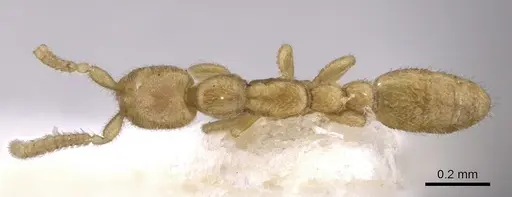
Literature
Loading distribution map...Loading products...