
Lachnomyrmex haskinsi
- Sci. Name
- Lachnomyrmex haskinsi
- Tribe
- Attini
- Subfamily
- Myrmicinae
- Author
- Smith, 1944
- Distribution
- Found in 2 countries
Introduction
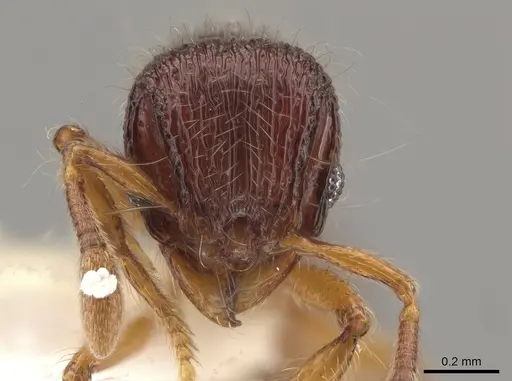
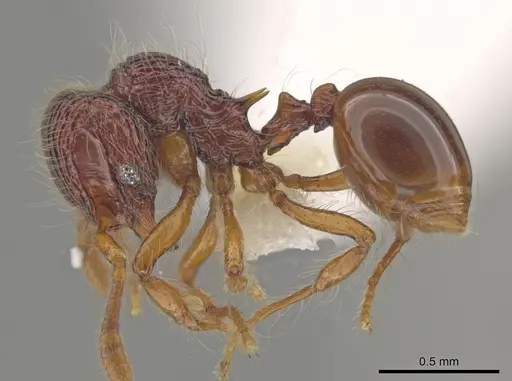
Lachnomyrmex haskinsi is a tiny Neotropical ant native to the wet forests of Costa Rica and Panama, found at elevations between 200-800 meters. Workers measure 2.65-2.94mm in total length, with a distinctive reddish-ferruginous to brown body covered in fine, wavy rugae and featuring an unusually elevated, subtriangular petiolar node. The postpetiole has a raised bump in the center and sports about six long hairs, while the first segment of the abdomen is notably bare of long hairs - a key identification feature. These ants belong to the Stenammini tribe and form relatively small colonies with a single queen. They nest in the ground, among rotting leaves, and inside fallen logs, with workers foraging alone through leaf litter without recruiting nestmates. One unusual aspect of this species is an observation by Dr. John Longino, who found workers and a larva scattered throughout debris inside a Brachymyrmex nest beneath rotten wood. While inquilinism was suspected, it was never confirmed. The species was named in honor of Dr. Caryl Parker Haskins, a prominent ant researcher.
Quick Summary
- Difficulty: Medium
- Origin & Habitat: Costa Rica and Panama,200-800m elevation wet forests [1][2]. Found in leaf litter of submontane wet forests, typically nesting in ground, among rotten leaves, and inside fallen logs [3].
- Colony Type: Apparently monogynic, colonies have a single queen [3]. Small colony size with workers foraging individually.
- Size & Growth:
- Queen: Size data unavailable, the gyne (queen) was described by Feitosa & Brandão 2008 with eyes having about 12 facets, but total length measurements were not provided [1].
- Worker: 2.65-2.94mm total length [2][1].
- Colony: Relatively small colonies, specific worker counts not documented [3].
- Growth: Growth rate is unconfirmed.
- Development: Timeline is unconfirmed for this species. (Development time may vary based on temperature conditions.)
- Antkeeping:
- Temperature: Keep at 24-26°C. As a wet forest species from Costa Rica and Panama, they prefer warm, stable conditions. Avoid temperatures below 20°C or above 30°C.
- Humidity: High humidity is essential, these ants come from wet tropical forests. Keep nest substrate consistently moist but not waterlogged. The substrate should feel damp to the touch with condensation visible on nest walls.
- Diapause: No, as a tropical species from wet forests, they do not require hibernation. Maintain consistent temperatures year-round.
- Nesting: Plaster nests or soil nests work well for these tiny ants. The nest should have small chambers and narrow passages scaled to their tiny size. Naturalistic setups with rotting wood pieces and moist leaf litter can also work.
- Behavior: Workers are solitary foragers that search for food alone through leaf litter rather than recruiting nestmates or forming pheromone trails [3]. They are not aggressive and pose no sting threat to humans due to their tiny size. They are primarily ground-dwelling and rarely climb. Founding behavior is unconfirmed.
- Common Issues: high humidity is critical, dry conditions will kill colonies quickly since they're adapted to wet forest habitats, their cryptic lifestyle (foraging alone in leaf litter) means you may not see much activity, this is normal, not a problem, possible inquilinism relationship with Brachymyrmex means wild-caught colonies could have social parasite complications, growth rate is unconfirmed so colonies may develop slowly, patience is required, escape prevention is important since they can squeeze through small gaps
Housing and Nest Setup
Lachnomyrmex haskinsi is a tiny ant that needs appropriately scaled housing. Plaster nests or soil nests work well because they hold humidity well and provide the small chambers these ants prefer. The chambers should be small and the passages narrow, avoid large, open spaces that can stress these small ants. A naturalistic setup can also work: use a container filled with moist substrate (a mix of soil and rotting wood pieces) with pieces of decaying wood or leaves on top for cover. This mimics their natural habitat in forest leaf litter. Whatever setup you choose, ensure excellent escape prevention, while not the smallest ants, they can still squeeze through small gaps. Use tight-fitting lids and consider barrier methods like fluon on container edges. [3][2]
Feeding and Diet
As a member of the Stenammini tribe, L. haskinsi likely forages for small prey and scavenges. Feed them small protein sources like fruit flies, pinhead crickets, small mealworms, and other tiny insects. They may also accept sugar water or honey as an energy source, though this is not confirmed. Given their tiny size and solitary foraging behavior, food items should be appropriately small. Offer protein roughly twice weekly and sugar sources constantly if accepted. Remove uneaten prey after 24-48 hours to prevent mold. Since workers forage alone in leaf litter, they may prefer hunting live prey. [3]
Temperature and Humidity
These ants come from the wet forests of Costa Rica and Panama, so they need warm, humid conditions. Keep temperatures in the range of 24-26°C, avoiding drops below 20°C or spikes above 30°C. A heating cable on one side of the nest can create a temperature gradient if needed. Humidity is critical: maintain consistently moist substrate without waterlogging. The nest should show condensation on walls, and the substrate should feel damp to the touch. Mist occasionally but rely more on water tubes or reservoirs to maintain stable humidity. Poor humidity will kill colonies quickly. [1][2]
Colony Dynamics and Behavior
L. haskinsi forms relatively small colonies with a single queen (monogynic) [3]. Workers are solitary foragers that search for food alone rather than recruiting nestmates, they do not form pheromone trails [3]. This means you'll often see just one or two workers active at a time, which is normal for this species. The observation of workers in a Brachymyrmex nest suggests possible inquilinism (temporary social parasitism), but this was never confirmed [1][2]. Founding behavior has not been documented for this species.
Growth and Development
Workers measure only 2.65-2.94mm total length, making them among the smaller ant species kept in captivity [2][1]. The queen has eyes with about 12 facets while workers have only 5-7 facets [1]. Colony growth is not well documented, you can expect several months for the first workers to emerge. Colonies remain relatively small compared to many Myrmicinae. This species is not a fast-growing one, so keepers should be patient and avoid overfeeding which causes mold issues in small colonies.
Frequently Asked Questions
How long does it take for Lachnomyrmex haskinsi to produce first workers?
The egg-to-worker timeline is not documented for this species. Development time will depend on temperature, warmer conditions (within their safe range) may speed development. First workers will likely be smaller than normal workers.
Can I keep multiple Lachnomyrmex haskinsi queens together?
No. This species is apparently monogynic, meaning colonies have a single queen [3]. Multiple unrelated queens will likely fight. Only introduce a queen to an established colony if you're combining a fertile queen with her workers from the same founding attempt.
What do Lachnomyrmex haskinsi ants eat?
Based on their genus and tribe (Stenammini), they are likely predators and scavengers. Feed small protein sources like fruit flies, tiny crickets, small mealworms, and other micro-insects. They may accept sugar water or honey. Offer protein twice weekly and sugar sources constantly if accepted. Remove uneaten food after 24-48 hours.
Are Lachnomyrmex haskinsi good for beginners?
They are rated as Medium difficulty. While not the easiest species, they are manageable for keepers who can maintain high humidity and have experience with small tropical ants. Their slow growth and small colony size require patience. They are not recommended as a first ant species.
What temperature do Lachnomyrmex haskinsi need?
Keep them at 24-26°C. As a wet forest species from Costa Rica and Panama, they prefer warm, stable conditions. Avoid temperatures below 20°C or above 30°C.
Do Lachnomyrmex haskinsi need hibernation?
No. As a tropical species from wet forests, they do not require hibernation or winter diapause. Maintain consistent temperatures year-round (24-26°C) and humidity.
Why are my Lachnomyrmex haskinsi not very active?
This is normal behavior. Workers are solitary foragers that search for food alone in leaf litter rather than recruiting nestmates or forming trails [3]. You may only see one or two workers active at a time. They are not a highly visible, active species, this is typical for litter-dwelling ants.
When should I move Lachnomyrmex haskinsi to a formicarium?
Wait until the colony has at least 20-30 workers before considering a formicarium. For small colonies, a test tube setup with a moist cotton ball works well. Move to a larger setup only when the colony clearly outgrows its current housing. Plaster or soil nests work well for this species.
How big do Lachnomyrmex haskinsi colonies get?
Colonies remain relatively small, specific worker counts are not documented but colonies are described as relatively small [3]. They are not a fast-growing or large colony species. Expect slow, steady growth over months rather than rapid expansion.
Report an Issue
The current care sheet is based fully on literature. See inconsistencies, or something that's incorrect? Please , it will be resolved after review from an admin. Contributing to the blogs tab also helps providing information, to make us be able to further improve the caresheets. Thank you for your support!
References

This caresheet is licensed under CC BY-SA 4.0 .
Community Blogs
CASENT0633608
View on AntWeb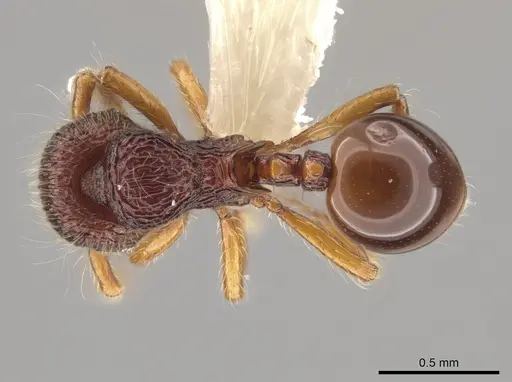
Literature
Loading distribution map...Loading products...