
Brachymyrmex antennatus
- Sci. Name
- Brachymyrmex antennatus
- Tribe
- Myrmelachistini
- Subfamily
- Formicinae
- Author
- Santschi, 1929
- Distribution
- Found in 3 countries
Introduction
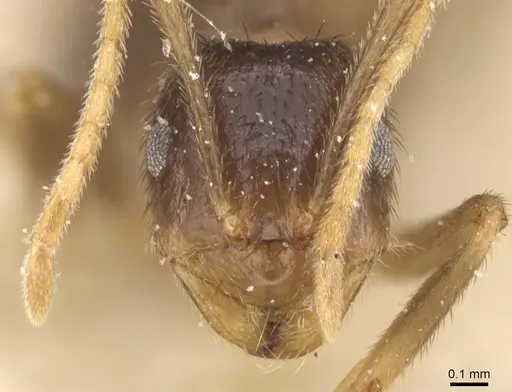
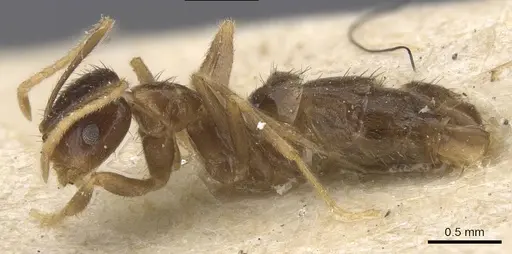
Brachymyrmex antennatus is a tiny Neotropical ant native to northern South America, found in Argentina, Brazil, Colombia, Ecuador, French Guiana, Peru, and Suriname . Workers have a distinctive light brown to yellowish body with suberect hairs on their legs and antennae, and dense fine hairs covering their gaster. The second segment of their antenna is as long as or longer than the first, which helps distinguish them from similar species . This species is part of the Brachymyrmex genus, which contains some of the smallest ants in the Formicinae subfamily. Almost nothing is known about their biology in the wild - no studies have documented their colony structure, founding behavior, or specific care requirements [AntWiki]. This makes them a challenging species to keep, as you will be largely pioneering their captive care.
Quick Summary
- Difficulty: Expert
- Origin & Habitat: Neotropical region, found in Argentina, Brazil, Colombia, Ecuador, French Guiana, Peru, and Suriname. They are ground-dwelling ants that have been captured using subterranean baits in Argentina's Iguazú National Park [4][1].
- Colony Type: Colony structure is completely unconfirmed, no research has documented whether they are single-queen or multi-queen colonies.
- Size & Growth:
- Queen: Size data unavailable, only one queen was described in the original 1929 description but full measurements were not published [1].
- Worker: Size data unavailable, the research provides head width (0.54-0.71mm) and mesosoma length (0.60-0.87mm) but not total body length [2].
- Colony: Unknown, no colony size data exists for this species.
- Growth: Unknown, no development data exists.
- Development: Unconfirmed, no direct observations of development exist. (Development timeline has not been studied for this species.)
- Antkeeping:
- Temperature: No specific data exists. Based on their Neotropical distribution and ground-dwelling habits, they likely prefer warm conditions around 24-28°C. Use a heating cable on one side of the nest to create a gradient.
- Humidity: No specific data exists. As ground-dwelling Neotropical ants, they likely need moderate to high humidity. Keep the nest substrate consistently moist but not waterlogged.
- Diapause: Unknown, no research has examined seasonal behavior. As a Neotropical species from regions near the equator, they may not require a true hibernation.
- Nesting: No specific nesting data exists. Based on being captured with subterranean baits, they likely nest in soil or small cavities in the ground. In captivity, a small test tube setup with moist cotton works well for founding colonies. For established colonies, a small plaster or soil nest with chambers scaled to their tiny size is appropriate. Their extremely small size means escape prevention must be excellent, use fine mesh barriers.
- Behavior: No specific behavioral studies exist for this species. Based on genus patterns, they are likely relatively docile and not aggressive. Their tiny size means they are not capable of stinging humans. They are ground-dwelling and likely forage for small particles of food. Their very small size means they are excellent escape artists, escape prevention is critical.
- Common Issues: their extremely small size makes them prone to escaping through standard barrier setups, fine mesh is essential., almost no biological data exists, so you are pioneering their captive care with no established guidelines., their tiny size makes feeding challenging, standard ant foods may be too large., wild-caught colonies may not establish well due to unknown requirements., slow or nonexistent colony growth due to unknown optimal conditions.
Appearance and Identification
Brachymyrmex antennatus workers are among the smallest ants you will encounter. Their body is typically uniformly light brown, though some specimens may have a darker head and gaster [2]. The most distinctive features are the suberect hairs on their legs and antennae, and the dense fine hairs covering their gaster. Their antennae have a unique feature: the second segment of the funiculus is as long as or longer than the first segment [2][1]. They have three small eyes (ocelli) on top of their head, and their main eyes have only 7-9 tiny lenses each. These ants can be distinguished from similar species like Brachymyrmex gaucho by their lighter yellowish color and the abundant suberect hairs on their head and mesosoma.
Housing and Setup
Because of their extremely small size, Brachymyrmex antennatus requires specialized housing. For a founding queen, a small test tube setup works well, use a small diameter tube with a water reservoir at one end, packed with cotton to hold moisture. The tube should be small enough that the queen can easily walk across it. For established colonies, a small plaster nest or soil nest with chambers scaled to their tiny size is appropriate. The chambers should be narrow, these are not ants that need wide open spaces. Escape prevention is critical: their small size means they can squeeze through gaps that larger ants cannot. Use fine mesh on any openings, and consider applying fluon to the edges of the nest. Keep the nest in a quiet location away from direct sunlight and vibrations.
Feeding and Diet
No specific dietary studies exist for Brachymyrmex antennatus. Based on typical Brachymyrmex behavior and their tiny size, they likely are generalists that collect small particles of nectar, honeydew, and tiny insects. In captivity, you can offer small amounts of sugar water or honey diluted with water in a tiny container. For protein, offer tiny prey items like fruit fly fragments, springtails, or other microscopic arthropods. Their small size means standard ant foods may be too large, you may need to crush or finely chop larger foods. Feed small amounts every few days and remove any uneaten food to prevent mold.
Temperature and Seasonal Care
No specific temperature requirements have been documented for this species. Based on their Neotropical distribution (Argentina to Suriname), they likely prefer warm conditions in the range of 24-28°C. Use a heating cable placed on one side of the nest to create a temperature gradient, allowing the ants to choose their preferred temperature. Monitor colony activity, if workers cluster near the heat source, increase slightly, if they avoid heated areas, reduce temperature. Regarding winter care, no data exists on diapause or hibernation requirements. As a species from regions near the equator, they may not need a true hibernation, but a slight reduction in temperature during winter months may be appropriate.
Challenges and Why This Species Is Expert-Level
Brachymyrmex antennatus is rated Expert difficulty for several important reasons. First, almost nothing is known about their biology, no studies have documented their colony structure, founding behavior, development time, or specific care requirements. You will be essentially pioneering their captive care with no established guidelines. Second, their extremely small size creates practical challenges: standard ant foods are too large, escape prevention requires specialized fine mesh barriers, and they can easily be lost or crushed during colony maintenance. Third, wild-caught colonies may fail to establish because we do not know what conditions they need. This species is best suited for experienced antkeepers who are comfortable experimenting with care conditions and documenting their observations carefully.
Frequently Asked Questions
How long does it take for Brachymyrmex antennatus queens to produce their first workers?
This is completely unconfirmed, no research has documented their development timeline. Without species-specific data, development time cannot be reliably estimated.
What do Brachymyrmex antennatus ants eat?
No specific dietary studies exist for this species. Based on genus patterns, they likely accept small amounts of sugar and tiny protein sources. Their tiny size means standard ant foods may be too large, crush or finely chop foods before offering.
Are Brachymyrmex antennatus good for beginners?
No, this species is rated Expert difficulty. Almost nothing is known about their biology in the wild, meaning you will be pioneering their captive care with no established guidelines. Their extremely small size also creates practical challenges that make them difficult for beginners.
What temperature do Brachymyrmex antennatus need?
No specific data exists. Based on their Neotropical distribution, start around 24-28°C and observe colony behavior. Use a heating cable on one side of the nest to create a gradient, allowing the ants to self-regulate.
How big do Brachymyrmex antennatus colonies get?
Colony size is completely unknown, no research has documented maximum colony sizes for this species. Based on their tiny worker size and typical Brachymyrmex patterns, colonies are likely modest.
Do Brachymyrmex antennatus need hibernation?
This is unknown. As a Neotropical species from regions near the equator, they may not require a true hibernation. Some form of cooler rest period in winter may be beneficial, but this has not been studied.
Can I keep multiple Brachymyrmex antennatus queens together?
This is unconfirmed, no research has documented their colony structure or whether they accept multiple queens. Without data on their natural colony structure, combining unrelated queens is not recommended.
How do I prevent Brachymyrmex antennatus from escaping?
Escape prevention is critical due to their extremely small size. Use fine mesh barriers on all openings. Apply fluon or similar barrier products to the edges of nest openings. Ensure any connections between the nest and outworld are sealed tightly, these tiny ants can squeeze through the smallest gaps.
When should I move my Brachymyrmex antennatus to a formicarium?
Wait until the colony is well-established with a decent number of workers before moving from a test tube to a formicarium. Their tiny size means they do well in small nests, you do not need a large formicarium even for established colonies.
Report an Issue
The current care sheet is based fully on literature. See inconsistencies, or something that's incorrect? Please , it will be resolved after review from an admin. Contributing to the blogs tab also helps providing information, to make us be able to further improve the caresheets. Thank you for your support!
References

This caresheet is licensed under CC BY-SA 4.0 .
Community Blogs
CASENT0911606
View on AntWeb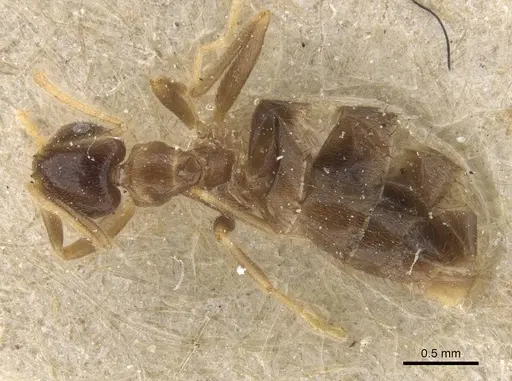
Literature
Loading distribution map...Loading products...