
Aenictus leptotyphlatta
- Sci. Name
- Aenictus leptotyphlatta
- Subfamily
- Dorylinae
- Author
- Jaitrong & Eguchi, 2010
- Distribution
- Found in 1 countries
Introduction
Aenictus leptotyphlatta is a tiny army ant species from northern Thailand, with workers measuring just 2.35-2.45 mm in total length . The species gets its name from the faint "typhlatta spot" on its head - "leptotyphlatta" is Latin for "weak typhlatta" . Workers have a reddish-brown to dark brown head and gaster, with a black or dark brown mesosoma (middle body section) . Scientists discovered this species in 2001 in a secondary forest on the Chiang Mai University campus, an area connected to Doi Suthep National Park . Currently, only workers have been documented - no queens, males, or colony founding stages have ever been found . This fundamental gap in knowledge makes captive keeping currently impossible.
Quick Summary
- Difficulty: Expert
- Origin & Habitat: Northern Thailand, specifically secondary forest on the Chiang Mai University campus, which is continuous with Doi Suthep National Park [1].
- Colony Type: Unknown, only the worker caste has been documented [2].
- Size & Growth:
- Queen: Unknown, no queens have ever been documented [2].
- Worker: 2.35-2.45 mm total length [1].
- Colony: Unknown, colony size has not been studied.
- Growth: Unknown, no developmental data available.
- Development: Unknown, no developmental data available for this species. (Development timing is unconfirmed. Related army ants may have varying timelines depending on caste and colony phase, but specific data for Aenictus leptotyphlatta does not exist.)
- Antkeeping:
- Temperature: Likely warm tropical conditions typical of northern Thailand, but specific requirements are unconfirmed.
- Humidity: Likely high humidity given the forest habitat, but exact needs are unknown.
- Diapause: No, this is a tropical species from Thailand that likely remains active year-round [1].
- Nesting: Unknown. Army ants are typically nomadic with no permanent nest structure.
- Behavior: Army ant behavior, likely nomadic and predatory with high food requirements, but specific behaviors are unstudied in this species. Their extremely small size (under 2.5 mm) means escape prevention would be extraordinarily difficult.
- Common Issues: no queens are known to science, making it impossible to start a captive colony., extremely small worker size (2.35-2.45 mm) means they can escape through the tiniest gaps in standard enclosures., army ant biology requires constant food supply and large foraging areas not provided by standard formicarium setups., nomadic lifestyle means they do not build permanent nests and will stress in fixed enclosures.
Why This Species Is Not Currently Viable for Captivity
You cannot keep Aenictus leptotyphlatta in a standard ant setup because scientists have only ever found workers, no queens, males, or even colony founding stages have been documented [2]. Without a queen, a colony cannot reproduce or sustain itself long-term. Additionally, this is an army ant species, which means wild colonies likely live a nomadic lifestyle with high food demands and no fixed nest site. Standard ant farms and formicariums are designed for ants that build permanent nests and can tolerate confined spaces. Army ants need extensive foraging areas and constant access to prey, making them unsuitable for typical home setups even if queens were available.
Identification and Appearance
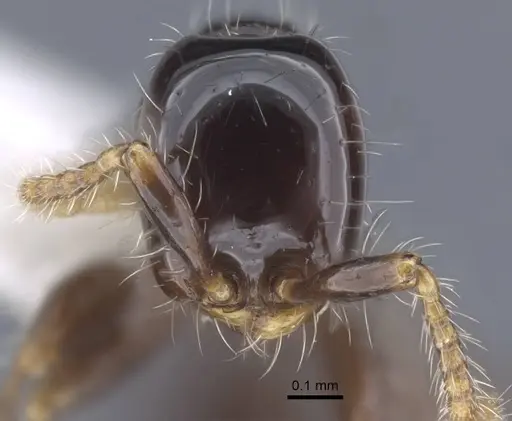
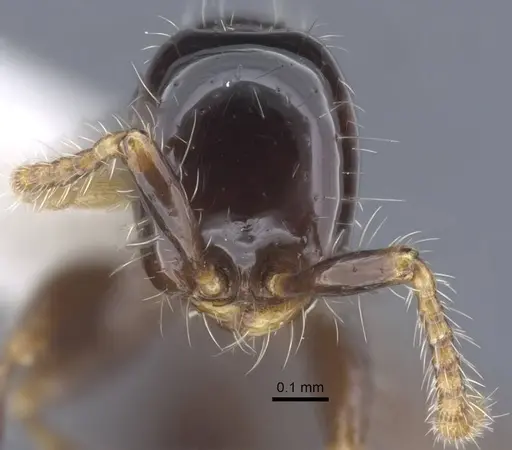
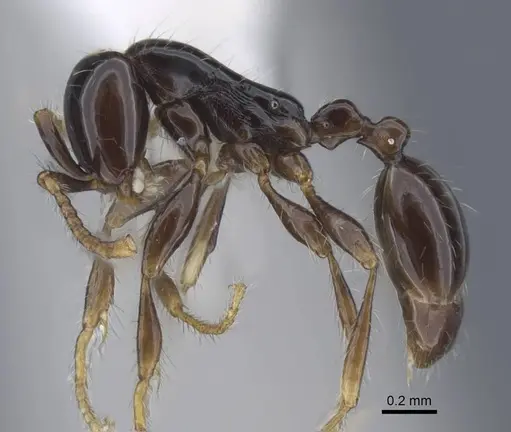
Workers are among the smallest army ants in their group, measuring just 2.35-2.45 mm in total length [1]. They have 10-segmented antennae with short scapes that only reach about halfway along the head [1]. The head is subrectangular (longer than wide) with a weakly convex posterior margin [1]. Their most notable feature is the "typhlatta spot", a pale marking on the head, but in this species it is much less developed and paler than in related species [1]. The head and antennae are reddish-brown to dark brown, the middle body section (mesosoma) is black or dark brown, and the waist segments and gaster are dark brown to reddish-brown [1]. The subpetiolar process (a projection under the waist) is well-developed and triangular with the tip pointing downward [1].
Natural Habitat and Climate
The type series was collected in a secondary forest on the Chiang Mai University campus in northern Thailand [1]. This forest is continuous with Doi Suthep National Park, suggesting the species can inhabit both disturbed regrowing forest and natural forest areas [1]. Northern Thailand has a tropical climate with warm temperatures year-round and distinct wet and dry seasons. You can expect this species prefers warm, humid conditions typical of tropical forest floors, though specific temperature and humidity tolerances have not been studied. The collection date was June (10 June 2001), during the wet season in Thailand, but this does not necessarily indicate nuptial flight timing [1].
Army Ant Biology Considerations
Aenictus leptotyphlatta belongs to the army ant genus Aenictus. Army ants are characterized by nomadic phases where the entire colony moves regularly to new locations, and stationary phases where they remain in a temporary bivouac while raiding for food. They are specialized predators with high metabolic rates requiring frequent feeding. Unlike many ants that can survive on sugar water and occasional protein, army ants need constant access to live prey or they will starve quickly. They also lack the permanent nest structures that most ant keepers provide. If you were to somehow obtain these ants, you would need an enormous foraging arena with constant prey introduction and no fixed nest structure, essentially a research-level setup, not a hobby formicarium. [2]
Frequently Asked Questions
Can I keep Aenictus leptotyphlatta in a test tube or formicarium?
No. Currently you cannot keep this species because only workers have been documented by scientists, no queens are known [2]. Even if queens were available, army ants like Aenictus require specialized setups with large foraging areas and constant food supply, not standard test tubes or formicariums.
How big do Aenictus leptotyphlatta workers get?
Workers are very small, measuring 2.35-2.45 mm in total length [1]. This makes them among the smallest army ants in the group that have typhlatta spots [1].
Where are Aenictus leptotyphlatta found in the wild?
They are found in northern Thailand, specifically in secondary forest on the Chiang Mai University campus which connects to Doi Suthep National Park [1].
Do Aenictus leptotyphlatta need a queen?
Yes, like all ant colonies, they need a queen to reproduce and sustain the colony. However, no queens have ever been documented for this species, so starting a colony is currently impossible [2].
What do Aenictus leptotyphlatta eat?
Their specific diet is unknown, but as army ants they are likely specialized predators. Related Aenictus species prey on other social insects and small arthropods. They would require constant access to live prey, not just sugar water.
Do Aenictus leptotyphlatta need hibernation?
No, they come from tropical northern Thailand and do not require hibernation (diapause) [1]. They likely remain active year-round.
Are Aenictus leptotyphlatta good for beginners?
No. Even if available, army ants are considered expert-level due to their nomadic lifestyle, extreme escape risk from their tiny size (2.35-2.45 mm), and massive food requirements [1].
How can I identify Aenictus leptotyphlatta?
Look for the very small size (under 2.5 mm), the reddish-brown head with a faint pale typhlatta spot, the black or dark brown middle body, and the triangular subpetiolar process pointing downward [1]. They lack teeth on the front of the clypeus (the plate above the jaws) [1].
Report an Issue
The current care sheet is based fully on literature. See inconsistencies, or something that's incorrect? Please , it will be resolved after review from an admin. Contributing to the blogs tab also helps providing information, to make us be able to further improve the caresheets. Thank you for your support!
References

This caresheet is licensed under CC BY-SA 4.0 .
Community Blogs
CASENT0917240
View on AntWeb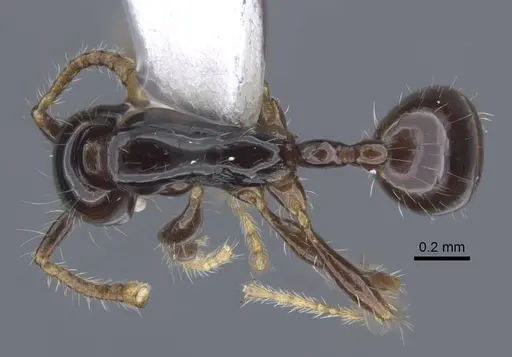
Literature
Loading distribution map...Loading products...