
Acropyga dubitata
- Sci. Name
- Acropyga dubitata
- Tribe
- Plagiolepidini
- Subfamily
- Formicinae
- Author
- Wheeler & Mann, 1914
- Distribution
- Found in 1 countries
Introduction
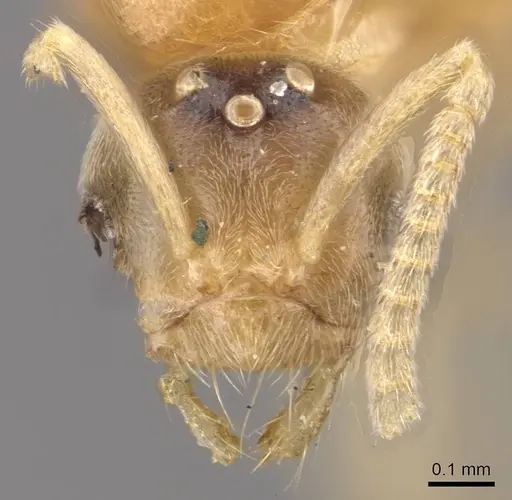
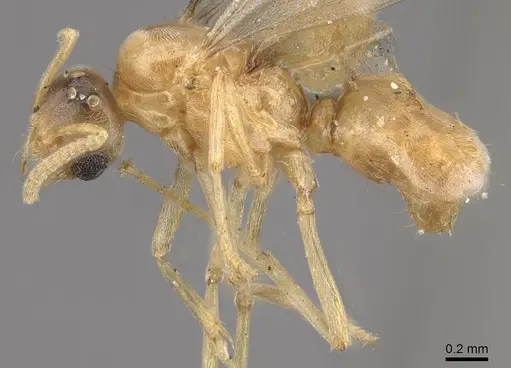
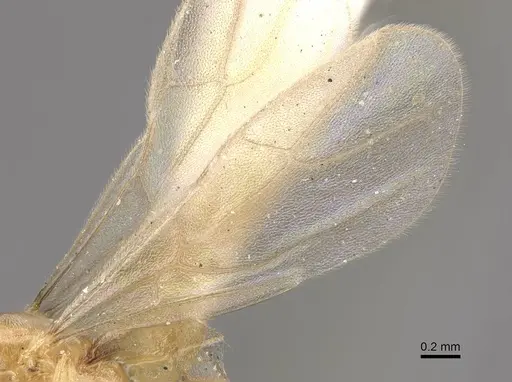
Acropyga dubitata is one of the rarest ant species in the world, known only from male specimens collected in September 1905 in the San Francisco Mountains of the Dominican Republic . These tiny ants measure approximately 2 mm in total length and have never been observed alive by scientists . Only males exist in museum collections; no queens or workers have ever been documented, making it impossible to establish a captive colony . Some researchers suspect this species may actually be synonymous with Acropyga parvidens, but this remains unresolved . The genus Acropyga is known for obligate mealybug symbiosis, but this has never been confirmed specifically for A. dubitata .
Quick Summary
- Difficulty: Expert
- Origin & Habitat: Endemic to the Dominican Republic (Hispaniola), specifically the San Francisco Mountains, which likely represents a section of the Cordillera Septentrional north of San Francisco de Macoris [2][3][1]. No elevation data is available for this species.
- Colony Type: Unknown, only male specimens have ever been collected [2][3].
- Size & Growth:
- Queen: Unknown, no queens have ever been documented [2].
- Worker: Unknown, no workers have ever been documented [2]. Males measure approximately 2 mm in total length [1].
- Colony: Unknown, no colonies have ever been observed [2].
- Growth: Unknown [2].
- Development: Unknown, no breeding data exists for this species [2]. (No developmental data available.)
- Antkeeping:
- Temperature: Unknown for this specific species. The type locality in the Dominican Republic mountains suggests a tropical to subtropical climate, but no specific data exists [2].
- Humidity: Unknown.
- Diapause: Unknown, likely no diapause given the tropical distribution, but unconfirmed [2].
- Nesting: Unknown.
- Behavior: Behavior is completely unknown for this species. Males were collected in September, suggesting possible nuptial flight activity during that month [1]. The genus Acropyga is known for obligate mealybug symbiosis where queens carry mealybugs during mating flights, but this has not been confirmed for A. dubitata specifically [4]. The genus has a mandibular tooth count of 4 and is associated with Rhizoecus mealybugs [4].
- Common Issues: only males are known, no queens have ever been found, making captive colonies impossible to establish., species identity is uncertain, may be synonymous with Acropyga parvidens., type locality is imprecise, exact habitat requirements unknown., extreme rarity, the species has not been observed alive in over 100 years.
Taxonomic Status and The Type Series
Acropyga dubitata exists only as a type series of male specimens collected by Aug. Busck in September 1905 in the San Francisco Mountains of San Domingo (now Dominican Republic) [1][2]. The labels on these specimens contain cryptic handwritten numbers suggesting multiple collection dates, possibly representing flight intercept samples [1]. Since only males were collected, nothing is known about the queen or worker castes, colony structure, or biology [2][3]. The species is considered endemic to Hispaniola, though some taxonomists suspect it may be conspecific with Acropyga parvidens [1]. The lectotype and 16 paralectotype males are housed in the Museum of Comparative Zoology [1].
Genus Biology: Mealybug Tending
While A. dubitata itself remains a mystery, the genus Acropyga is famous for an obligate symbiosis with mealybugs in the genus Rhizoecus [4]. Acropyga queens carry mealybugs in their mandibles during mating flights and establish new colonies with these insects [1]. The ants feed entirely on honeydew produced by their mealybug partners and cannot survive without them [4]. The genus has a mandibular tooth count of 4 [4]. If A. dubitata follows this pattern, it would likely require Rhizoecus mealybugs to establish a colony. However, this has never been observed for this specific species.
Why You Cannot Keep This Species
You cannot keep Acropyga dubitata because no queens or workers have ever been collected [2][3]. All available specimens are males from a 1905 collection, and the species has not been seen alive by scientists since [1]. Even if you traveled to the Dominican Republic, you would not know what to look for, the workers and queens remain undescribed and might be identical to Acropyga parvidens [1]. This species exists only in museum drawers, not in the antkeeping hobby.
Frequently Asked Questions
Can I keep Acropyga dubitata in captivity?
No. This species is only known from male specimens collected in 1905. No queens or workers have ever been documented, so it is impossible to establish a colony [2][3].
How do I find an Acropyga dubitata queen?
You cannot. Queens of this species have never been collected or observed. The species may be extremely rare, possibly extinct, or synonymous with Acropyga parvidens [1][2].
What do Acropyga dubitata eat?
Unknown for this specific species. Other Acropyga species feed exclusively on honeydew from Rhizoecus mealybugs they tend underground, but this has never been confirmed for A. dubitata [4].
How big do Acropyga dubitata colonies get?
Unknown. No colonies have ever been observed [2].
Where does Acropyga dubitata nest?
Unknown. The only specimens were collected as males in the San Francisco Mountains of the Dominican Republic, likely in the Cordillera Septentrional range [2][3].
Is Acropyga dubitata the same as Acropyga parvidens?
Possibly. Some researchers suspect they are the same species, but this has not been confirmed [1].
Why is Acropyga dubitata so rare?
It may be extremely cryptic, living underground with mealybugs, or it may actually be Acropyga parvidens under a different name. Only male specimens from 1905 exist in museums [1][2].
Report an Issue
The current care sheet is based fully on literature. See inconsistencies, or something that's incorrect? Please , it will be resolved after review from an admin. Contributing to the blogs tab also helps providing information, to make us be able to further improve the caresheets. Thank you for your support!
References

This caresheet is licensed under CC BY-SA 4.0 .
Community Blogs
CASENT0911126
View on AntWeb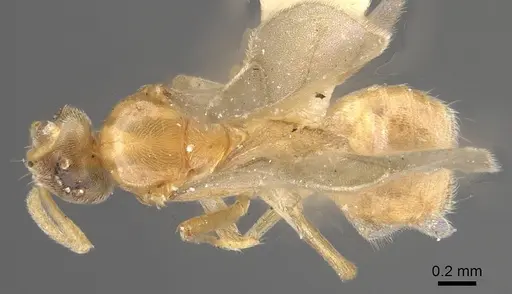
Literature
Loading distribution map...Loading products...