
Strumigenys subtilis
- Науч. назв.
- Strumigenys subtilis
- Триба
- Attini
- Подсемейство
- Myrmicinae
- Автор
- Booher, 2021
- Распространение
- Встречается в 0 странах
Введение
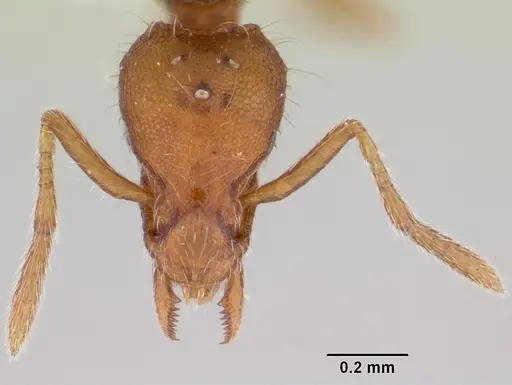
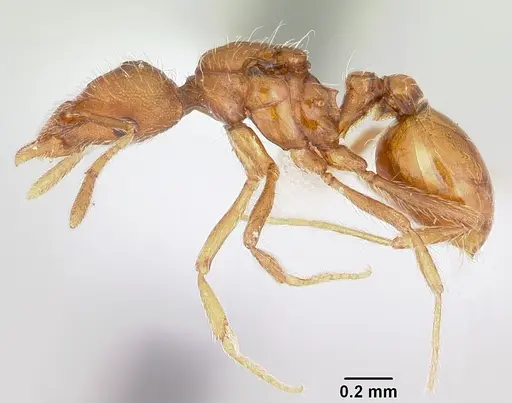
Strumigenys subtilis is an extremely rare North American ant species known from a single queen collected in California's Mojave National Preserve . This tiny ant has a total body length that has not been directly measured, only head (0.69mm) and mesosoma (0.72mm) lengths are known, but it is clearly one of the smallest ants in the region . It is distinguished by a narrow peripheral groove along the clypeus (the area around the mouth) and highly reduced spongiform appendages, soft, sponge-like structures that most Strumigenys species have on their body . Based on its morphology, researchers believe S. subtilis is likely an inquiline or social parasite, meaning it probably lives within the nests of other ant species rather than founding its own colony . This would make it similar to other suspected Strumigenys parasites like S. inopina and S. inquilina, which share reduced body features and simple setae .
Quick Summary
- Difficulty: Expert
- Origin & Habitat: Known only from Mohave National Preserve, San Bernardino County, California, USA. Collected in blackbush scrub habitat at approximately 4600 feet elevation [1]. This is a desert scrub environment in the eastern Mojave Desert.
- Colony Type: Likely an inquiline or social parasite, no independent colony has ever been documented. The single known specimen was a queen, suggesting this species depends on a host colony for survival [1]. Colony structure and host species are unknown.
- Size & Growth:
- Queen: Size data unavailable, total length (TL) was not measured, only head length (0.69mm) and mesosoma length (0.72mm) are recorded. Based on these, the queen is very small, likely under 1.5mm in total length [1].
- Worker: No workers have ever been collected or described [1].
- Colony: Unknown, no colony has ever been observed [1].
- Growth: Unknown
- Development: Unknown, no developmental data exists for this species [1]. (Development timeline is unconfirmed. Non-parasitic Strumigenys species typically take several weeks to develop, but this cannot be assumed for S. subtilis.)
- Antkeeping:
- Temperature: Unknown for this species. Related Strumigenys from similar habitats are often kept at 24-28°C, but S. subtilis comes from a cooler desert elevation. Start with room temperature (20-24°C) and be prepared to adjust based on observation [2].
- Humidity: Unknown. Most Strumigenys prefer humid conditions, but S. subtilis was found in a desert scrub habitat. Provide a gradient: keep the nest substrate moderately moist in one area and drier in others [2].
- Diapause: Unknown, the Mojave Desert experiences seasonal temperature shifts, but no biological data confirms whether this species requires a dormant period [1].
- Nesting: No nesting data exists. As a likely social parasite, it would require a host colony's nest. In captivity, this would mean introducing the queen to an established colony of a suitable host species, but no host has been identified [1].
- Behavior: Behavior is unstudied. As a likely social parasite, it would be dependent on a host colony and unlikely to forage independently [1]. Strumigenys species typically have a functional sting (subfamily Myrmicinae, tribe Attini), but no workers have been observed to confirm defensive behavior. Escape prevention is critical given its tiny size (under 1.5mm), even fine-mesh barriers may be insufficient [1].
- Common Issues: this species has never been kept in captivity, no care protocols exist, likely social parasite requires a host colony, which has never been identified, no workers have ever been collected, making captive establishment essentially impossible, extreme rarity means even finding a queen is nearly impossible, if it is a social parasite, introducing it to a wrong host species would result in death
Species Identification and Distinction
Strumigenys subtilis is the only western North American Strumigenys species possessing a narrow peripheral groove along the free margin of the clypeus combined with highly reduced spongiform appendages [1]. In dorsal view, the spongiform appendages that normally appear on the petiolar and postpetiolar nodes are completely absent, replaced by smooth cuticular lamellae on the lateral and posterior borders of these nodes [1]. This makes it easily distinguishable from all eastern USA species that have a peripheral groove, those species all have well-developed lateral petiolar and post-petiolar spongiform appendages [1]. The species superficially resembles Strumigenys inopina, a southeastern USA species known only from a few queens and also suspected to be a social parasite, but S. subtilis can be distinguished by the presence of short basigastral costulae (fine ridges on the gaster) which are absent in S. inopina [1].
Taxonomic Position and Inquiline Characters
S. subtilis shares several characters with other presumed or known Strumigenys inquilines including S. inopina, S. inquilina, and S. subnuda [2]. These shared characters include reduced sculpture on the body, small or absent spongiform appendages, and simple non-expanded setae (hair-like structures) [2]. However, researchers believe these expected inquiline species are not closely related to each other, the inquiline lifestyle appears to have evolved independently multiple times within the genus [2]. The unusual peripheral groove and similar dentition suggest S. subtilis may be related to the clypeata group, though it differs from typical clypeata group species in having short basal gastral costulae and the clypeata group members typically range no further west than eastern Texas [2].
Captive Care and Challenges
Keeping Strumigenys subtilis in captivity is extraordinarily challenging and likely impossible for several reasons. First, this species has never been documented in captivity, no one has ever collected a colony or attempted to keep it [1]. Second, if it is indeed a social parasite as suspected, it cannot establish an independent colony and would require identification of a suitable host species [1]. Third, the host species for S. subtilis has never been identified, making it impossible to provide appropriate housing even if a queen were to be found [1]. Fourth, only a single queen specimen has ever been collected (in 2006), meaning the species is either extremely rare or perhaps even extinct [1]. For these reasons, S. subtilis is not a species that can be purposefully kept, it remains a species of scientific interest rather than an antkeeping target [1].
Related Strumigenys Species as Reference
While S. subtilis specifically has no care history, the genus Strumigenys provides some general context. Most Strumigenys species are predatory, feeding primarily on springtails (Collembola) and other small arthropods [2]. They are small ants with distinctive trap-jaw mechanisms in some species. Many prefer humid, forested habitats and are found in tropical and subtropical regions worldwide [2]. However, S. subtilis was found in the Mojave Desert scrub habitat, suggesting it may have different environmental requirements than typical rainforest-dwelling Strumigenys [1]. The desert habitat at 4600 feet elevation experiences hot summers and cool winters with moderate rainfall, this is very different from the constantly humid tropical environments many Strumigenys species prefer [2].
Frequently Asked Questions
Can I keep Strumigenys subtilis in my ant farm?
No. This species has never been kept in captivity and likely cannot be established. It is probably a social parasite requiring a host colony, and no host species has ever been identified. Additionally, only a single specimen has ever been collected [1].
What does Strumigenys subtilis eat?
Unknown, no feeding observations exist. Most Strumigenys are predatory on springtails, but as a likely social parasite, S. subtilis would likely be fed by host colony workers rather than forage for itself [2].
How big do Strumigenys subtilis colonies get?
Unknown. No colony has ever been documented. The only known specimen is a single queen collected in 2006 [1].
Is Strumigenys subtilis a queen ant?
Yes. The only known specimen is a queen (holotype). No workers have ever been collected [1]. Total body length was not reported, but head and mesosoma measurements indicate it is very small, probably under 1.5mm.
Where does Strumigenys subtilis live?
Only known from a single specimen collected in the Mohave National Preserve, San Bernardino County, California, in blackbush scrub habitat at approximately 4600 feet elevation [1].
Is Strumigenys subtilis a parasite?
Yes, it is likely an inquiline or social parasite based on its morphology, reduced sculpture, small/absent spongiform appendages, and simple setae are characteristics shared with other known Strumigenys parasites [1].
How do I find a Strumigenys subtilis queen?
Extremely unlikely to find. Only one specimen has ever been collected despite extensive ant surveys in western North America. The species appears to be either extremely rare or possibly already extinct [1].
Does Strumigenys subtilis need hibernation?
Unknown. The Mojave Desert habitat experiences seasonal temperature variations, but no biological data exists for this species to confirm diapause requirements [1].
Are Strumigenys subtilis ants dangerous?
No. At less than about 1.5mm in size, these ants pose no danger to humans. Additionally, no workers have ever been documented, and the species is likely unable to survive independently [1].
Why is Strumigenys subtilis so rare?
Unknown. It may always have been rare, or it could be a parasitic species that was never common because it depended on host colonies. The single known specimen was collected in a pitfall trap in 2006,and despite subsequent surveys, no additional specimens have been found [1].
Report an Issue
The current care sheet is based fully on literature. See inconsistencies, or something that's incorrect? Please , it will be resolved after review from an admin. Contributing to the blogs tab also helps providing information, to make us be able to further improve the caresheets. Thank you for your support!
References

Эта инструкция по уходу лицензирована по CC BY-SA 4.0 .
Блоги сообщества
CASENT0104307
Посмотреть на AntWeb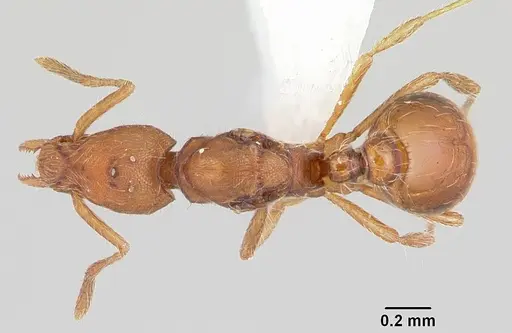
Литература
Загрузка карты распределения...Загрузка товаров...