
Strumigenys royi
- Науч. назв.
- Strumigenys royi
- Триба
- Attini
- Подсемейство
- Myrmicinae
- Автор
- Sosa-Calvo <i>et al.</i>, 2010
- Распространение
- Встречается в 0 странах
Введение
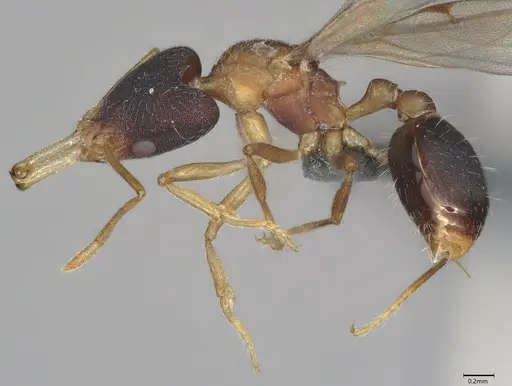
Strumigenys royi is a dacetine ant species from Guyana, measuring 3.53 mm in total length (large for a Strumigenys) . It has a striking color pattern: whitish mandibles, yellowish antennae and legs, a rusty red-brown (ferruginous) thorax, light brown waist segments, and a dark brown to black head and gaster . This species was found living in a small dirt tunnel on an upright living tree trunk, likely originally made by termites . Named in honor of ant taxonomist Roy Snelling, it belongs to the tribe Attini (though it does not grow fungus). Strumigenys are specialized trap-jaw predators that use their long, linear mandibles to capture tiny prey like springtails . So far, only the worker caste has been described - the queen is unknown . This species is rarely kept in captivity, and most of its biology remains unstudied. Based on typical Strumigenys behavior, it is cryptic, slow-moving, and prefers to hunt live prey rather than scavenge. It is not aggressive and will flee from disturbance rather than fight. Because of its specialized needs and unknown queen biology, Strumigenys royi is best suited for expert antkeepers only.
Quick Summary
- Difficulty: Expert
- Origin & Habitat: Guyana (Neotropical region). Found in forest habitat, nesting in small dirt tunnels on living tree trunks, likely humid and shaded conditions [1].
- Colony Type: Unknown, only the worker caste has been described, queen biology and social structure are unstudied [1]. Probably small colonies like other Strumigenys.
- Size & Growth:
- Queen: Unknown, queen not yet described [1]
- Worker: 3.53 mm total length [1]
- Colony: Unknown, no wild colony data available, likely under 100 workers based on related species
- Growth: Unknown, development timeline has not been studied
- Development: Unknown, estimated 6-10 weeks based on related Strumigenys species in tropical conditions (No direct development data exists. Estimate based on genus-level patterns for small tropical Myrmicinae.)
- Antkeeping:
- Temperature: Keep warm and stable, roughly 24-26°C. This is a tropical species from Guyana, use a heating cable on one side of the nest to create a gentle gradient if room temperature falls below this range. Avoid sudden drops below 20°C [1].
- Humidity: High humidity is essential, aim for the nest substrate to be consistently moist but not waterlogged. A test tube with a water reservoir or a plaster nest with an integrated water chamber works well. Balance with ventilation to prevent mold [1].
- Diapause: No, being a tropical species from Guyana, it probably does not require a diapause period. Maintain warm temperatures year-round, if you want to simulate a dry season, a slight reduction in temperature can be tried, but it is not necessary.
- Nesting: Provide a small, humid nest space. Test tubes with a water reservoir are good for founding groups. For larger colonies, use Y-tong (AAC) or plaster nests, never acrylic. The chambers should be small and tight to match their tiny size. A thin layer of damp soil can also work, mimicking their natural tunnels in tree trunks [1].
- Behavior: Extremely cryptic and non-aggressive. Workers move slowly and spend most of their time hunting small live prey or waiting in ambush. They are trap-jaw ants, their elongated mandibles snap shut rapidly on prey, but they pose no threat to keepers. When disturbed, they flee rather than fight. Activity level is low. Escape prevention is critical due to their 3.53 mm size, fine mesh and tight seals are required [1].
- Common Issues: escape prevention is critical due to tiny 3.53 mm size, use fine mesh barriers and tight-fitting lids, obligate predators requiring live small prey, springtails are essential, they will not accept dead food or sugar sources, slow growth and small colony sizes mean colonies can easily be lost if neglected, high humidity requirements can lead to mold if ventilation is poor, wild-caught colonies may carry parasites or nematodes that are difficult to treat in captivity
Housing and Nest Setup
Strumigenys royi needs a small, humid nest. Test tubes with a cotton-stoppered water reservoir are ideal for small colonies and allow you to control humidity easily. For larger groups, use a Y-tong (AAC) or plaster nest with a built-in water chamber. The chambers must be small and tight, these ants feel exposed in large open spaces. A naturalistic setup with a thin layer of damp coconut fiber or soil also works, mimicking the tree trunk tunnels of their native habitat. Whatever nest you choose, make sure escape prevention is top-notch: use fine mesh on ventilation holes and seal any gaps. These 3.53 mm ants can squeeze through cracks you wouldn't think possible [1].
Feeding and Diet
This is the most critical aspect of keeping Strumigenys royi. They are specialized predators and require live small prey. In the wild, they hunt springtails (Collembola) and other tiny arthropods. In captivity, you must provide live springtails as a staple food. Other small live prey may be accepted, such as booklice (psocids) or flightless fruit flies (Drosophila hydei). They will NOT accept sugar water, honey, or dead insects, these are obligate predators that only respond to live movement. Feed small prey items every 2-3 days, adjusting to the colony's needs. A hungry colony will have workers actively hunting in the outworld, a well-fed one will be more sedentary [1].
Temperature and Humidity
As a tropical species from Guyana, Strumigenys royi needs warm, humid conditions year-round. Keep the nest temperature between 24-26°C for optimal activity and brood development. Use a heating cable on one side to create a gradient. Humidity should be high, keep the nest substrate consistently moist but not waterlogged. In a test tube, the water reservoir provides enough humidity. In a plaster or soil nest, you may need to mist occasionally, but ensure good ventilation to prevent mold. Aim for a balance where the substrate feels damp to the touch but no standing water is present [1].
Behavior and Temperament
Strumigenys royi is an extremely docile and cryptic species. Workers are slow-moving and spend most of their time hunting or waiting in ambush. They are trap-jaw ants, their elongated mandibles (MI 57-60) snap shut rapidly to capture tiny prey. However, they pose no threat to humans and will only use their mandibles defensively against other arthropods. When disturbed, they flee rather than fight. They are not territorial across colonies. Their activity is low, and they may hide for long periods. Patience is key, these are subtle ants that reward quiet observation. They have a functional sting (typical of Myrmicinae), but it is so small it cannot penetrate human skin effectively. [1]
Colony Establishment
Since only workers have been described in the scientific literature, obtaining a colony of Strumigenys royi will likely depend on acquiring an existing colony from another keeper rather than catching a queen. If you obtain a colony, handle it gently, these are fragile insects. Start with a simple test tube setup with a water reservoir. Let the colony settle for a week before offering food. Once established, you can move them to a larger nest if needed. Growth will likely be slow, Strumigenys colonies typically remain small. Do not disturb the nest frequently, as stress can cause workers to stop hunting or even die. Patience and minimal interference are essential [1].
Frequently Asked Questions
What do Strumigenys royi ants eat?
They are obligate predators that need live small prey. Springtails (Collembola) are the best staple food. They may also accept booklice, flightless fruit flies, and other micro-arthropods. They will not take sugar water, honey, or dead insects.
How big do Strumigenys royi colonies get?
Colony size is unknown but likely remains small, probably under 100 workers. Strumigenys species typically form small, cryptic colonies rather than large supercolonies.
What temperature do Strumigenys royi need?
Keep them at 24-26°C year-round. This is a tropical species from Guyana, so they need consistently warm conditions. A heating cable on one side of the nest creates a useful gradient.
Are Strumigenys royi good for beginners?
No. This is an expert-level species because of their specialized diet (live prey only), tiny size making escape prevention tricky, high humidity needs, and the fact that queen biology is unknown, colonies are hard to start. They are also rarely available in the hobby.
How do I set up a nest for Strumigenys royi?
Use a small, humid setup like a test tube with a water reservoir or a small Y-tong (AAC) or plaster nest. Keep chambers small and tight. Maintain high humidity (substrate moist but not waterlogged) and excellent escape-proofing, these 3.53 mm ants can slip through tiny gaps.
Do Strumigenys royi need hibernation?
No. Being a tropical species from Guyana, they do not require a diapause period. Keep warm year-round. If you want to simulate a dry season, you can lower temperatures slightly, but it is not necessary.
Why are my Strumigenys royi dying?
Common causes include: lack of live prey (they starve on dead food), low humidity, temperatures below 20°C, escape through tiny gaps, or stress from frequent disturbance. Check all these factors first.
Can I keep multiple queens together?
Unknown, queen biology has not been studied for this species. Do not attempt to combine unrelated queens without evidence of polygyny.
How long until first workers?
The development timeline is unconfirmed. Based on related Strumigenys species, expect 6-10 weeks from egg to worker at optimal tropical temperatures, but this is a rough estimate.
Report an Issue
The current care sheet is based fully on literature. See inconsistencies, or something that's incorrect? Please , it will be resolved after review from an admin. Contributing to the blogs tab also helps providing information, to make us be able to further improve the caresheets. Thank you for your support!
References

Эта инструкция по уходу лицензирована по CC BY-SA 4.0 .
Блоги сообщества
CASENT0766081
Посмотреть на AntWeb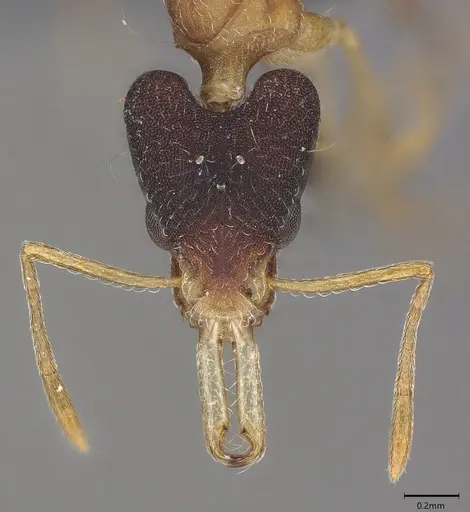
Литература
Загрузка карты распределения...Загрузка товаров...