
Strumigenys monstra
- Науч. назв.
- Strumigenys monstra
- Триба
- Attini
- Подсемейство
- Myrmicinae
- Автор
- Bolton, 2000
- Распространение
- Встречается в 0 странах
Введение
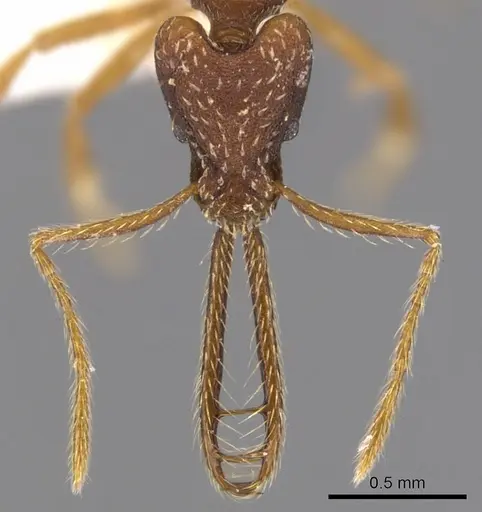
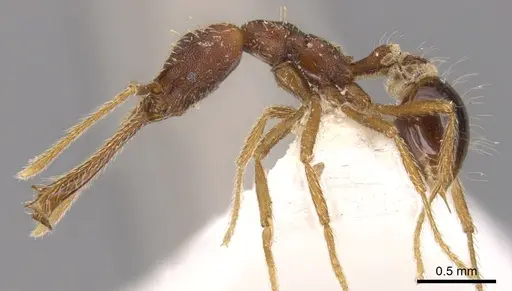
Strumigenys monstra is a tiny predatory ant from the dacetine tribe (Attini), found in the Putumayo region of Colombia and possibly in Rondônia, Brazil . Workers measure 3.4mm in total length, making them one of the smaller ant species you'll encounter . What sets this species apart is its extraordinary hairiness – it has more stiff standing hairs on its head and body than any other species in the cordovensis-complex, and its abdomen is covered in long fine hairs from the base rather than just the basal third . The most distinctive feature is its extremely long trap-jaw mandibles with a mandibular index over 120,giving it a unique silhouette . This species belongs to the Strumigenys mandibularis group, known for their elongated mandibles used to snap shut on prey. Nothing is known about the specific biology of Strumigenys monstra , but like other Strumigenys, it is likely a specialized predator of tiny arthropods in humid forest habitats.
Quick Summary
- Difficulty: Hard
- Origin & Habitat: Known from the Putumayo region in southern Colombia and also collected in Rondônia, Brazil [2][1]. Both areas are humid tropical forests, so this ant almost certainly lives on the forest floor among leaf litter and decaying wood [4].
- Colony Type: Unknown – no colony data exists for this species. Based on genus patterns, Strumigenys colonies are typically small with a single queen (monogyne), though some species can have multiple queens [4].
- Size & Growth:
- Queen: Unknown – queen has not been described for this species
- Worker: 3.4mm total length (TL) [3]
- Colony: Unknown – likely small based on typical Strumigenys colony sizes of 50–200 workers [4]
- Growth: Unknown
- Development: Unknown – genus-level estimates suggest 6–10 weeks at warm temperatures based on related dacetine ants [4] (Development timeline is unconfirmed for this species, estimates based on typical Strumigenys patterns)
- Antkeeping:
- Temperature: Keep at 24–28°C – these are tropical ants that need warm, stable conditions. A gentle heat gradient allows them to regulate [4].
- Humidity: High humidity is essential – aim for 70–85% relative humidity. Keep the nest substrate consistently moist but not waterlogged, mimicking damp forest floor conditions [4].
- Diapause: No – this is a tropical species that does not require hibernation. Maintain warm conditions year-round [4].
- Nesting: In captivity, they do well in small test tubes or tight chambers. They prefer dark, humid conditions. A naturalistic setup with damp soil and leaf litter can work, but avoid acrylic or open nests that dry out quickly [4].
- Behavior: These are extremely small, cryptic ants that spend most of their time hunting in the dark. They have a functional sting but it is negligible to humans – their main defense is speed and tiny size. They are skilled escape artists due to their size, so excellent escape prevention is critical. They are obligate predators that hunt tiny arthropods like springtails and mites [4].
- Common Issues: escape prevention is critical – they are tiny and will squeeze through the smallest gaps, humidity management is tricky – too dry and they desiccate, too wet and they drown, they refuse sugar and honey – protein-only diet makes feeding difficult for beginners, slow colony growth can lead to impatience and overfeeding, which causes mold, nothing is known about their specific biology – keepers are essentially pioneering captive care
Appearance and Identification
Strumigenys monstra workers are tiny at just 3.4mm total length, but their most striking feature is their extraordinarily long mandibles that give them a unique silhouette [3]. The mandibular index (mandible length divided by head width multiplied by 100) exceeds 120,placing them among the longest-mandibulated species in the genus [3]. What truly sets this species apart is its dense covering of stiff hairs – it has more standing hairs on the head and alitrunk than any other species in the cordovensis-complex, and the first abdominal segment (gaster) has long fine hairs covering the entire surface rather than just the basal portion [3]. The body is typically dark brown to black, and the long curved mandibles are a defining characteristic for identification [3].
Natural History and Habitat
This species is known from the Putumayo region in southern Colombia and from Rondônia, Brazil, both areas of humid tropical forest [2][1]. Nothing has been documented about its specific biology, including nesting habits, colony size, or exact diet [4]. However, as a member of the Strumigenys mandibularis group within the dacetine tribe (Attini), it almost certainly shares the ecological preferences of its relatives: these are cryptic ground-dwelling ants that inhabit humid forest floors, typically nesting in rotting wood, under stones, or in leaf litter. They are specialized predators that use their trap-jaw mandibles to capture tiny arthropods, primarily springtails (Collembola) and other micro-arthropods [4].
Feeding and Diet
Strumigenys ants are obligate predators and do not accept sugar sources, honey, or plant materials – they require a protein-based diet of live prey [4]. For Strumigenys monstra, you should offer tiny live prey items appropriate to their size: springtails are the ideal food source, as they are the natural prey of dacetine ants in the wild [4]. Other suitable foods include fruit flies (Drosophila), tiny mealworms, and other small insects. Feed small amounts 2–3 times per week, removing any uneaten prey after 24 hours to prevent mold. Because they are so tiny, even a single fruit fly is a substantial meal for a small colony. Never attempt to feed them honey or sugar water – they will simply ignore it and the sugars will mold in the nest [4].
Temperature and Care
As a tropical species from Colombia and Brazil, Strumigenys monstra requires warm conditions year-round. Maintain temperatures between 24–28°C in the nest area, with a slight gradient allowing the ants to choose their preferred temperature [4]. Room temperature is often insufficient – use a small heating cable or heat mat on one side of the nest to achieve these temperatures. Place the heating element on top of the nest, not underneath, to prevent excessive drying and moisture evaporation. Temperature stability is more important than hitting an exact number – avoid major fluctuations. Since this is a tropical species, no hibernation or winter cooling is required [4].
Humidity and Nest Setup
High humidity is absolutely critical for this species – aim for 70–85% relative humidity in the nest environment [4]. Use a test tube setup with a water reservoir, keeping the cotton consistently moist but not flooded. The nest should be kept in a dark location, as Strumigenys are cryptic ants that avoid light. Foraging areas can be slightly drier, but the nest itself must remain humid. Watch for condensation on the test tube walls – this is a good indicator of adequate humidity. Avoid using open formicariums that dry out quickly, a closed test tube setup or acrylic nest with tight-fitting chambers works best. The substrate should feel damp to the touch but never waterlogged [4].
Colony Establishment
Since nothing is known about the founding behavior of Strumigenys monstra, care recommendations are based on typical Strumigenys patterns [4]. Queens likely seal themselves in a small chamber (claustral founding) and survive on stored fat reserves while raising their first workers, just like other dacetine ants. The first workers (nanitics) will be smaller than normal workers and may take 6–10 weeks to develop at optimal temperatures. Colony growth is typically slow – do not expect rapid expansion. A founding queen should be housed in a small setup with high humidity and offered her first prey items once workers emerge. Do not disturb the colony during the founding phase [4].
Frequently Asked Questions
How long does it take for Strumigenys monstra to produce first workers?
The exact timeline is unknown for this species since nothing has been documented about its biology. Based on typical Strumigenys development, expect 6–10 weeks from egg to first worker at optimal temperatures (24–28°C). The first workers will be smaller than normal workers (nanitics) and the colony will grow slowly after that [4].
What do Strumigenys monstra ants eat?
They are obligate predators that only accept live protein prey. Springtails are the ideal food, as these are their natural prey in the wild. You can also offer fruit flies, tiny mealworms, and other small insects. They do NOT eat sugar, honey, or any plant-based foods – these will simply be ignored and cause mold problems [4].
Can I keep Strumigenys monstra in a test tube?
Yes, a test tube setup works well for this species. Use a small test tube with a water reservoir, keeping the cotton consistently moist to maintain high humidity. The tube should be kept in darkness or covered to reduce light exposure. This setup works best for founding colonies and small groups up to about 50 workers [4].
Are Strumigenys monstra good for beginners?
No – this species is not recommended for beginners. Almost nothing is known about its specific care requirements, making it a challenging species even for experienced antkeepers. They require high humidity, specific protein-only diets, and excellent escape prevention due to their tiny size. Start with more common species like Lasius or Camponotus before attempting Strumigenys [4].
How big do Strumigenys monstra colonies get?
Colony size is unknown for this species, but based on typical Strumigenys patterns, colonies likely reach 50–200 workers at maturity. They are not large colony producers – expect slow growth and relatively small colony sizes compared to more common ant species [4].
Do Strumigenys monstra need hibernation?
No – this is a tropical species and does not require hibernation. Keep them warm year-round at 24–28°C. Attempting to hibernate them or cooling them down significantly will likely stress or kill the colony [4].
Why are my Strumigenys monstra dying?
The most common causes are: low humidity (they desiccate easily), wrong food (they will not eat sugar or dead insects – only live tiny prey), and escape (they are so small they can slip through tiny gaps). Check your humidity levels, ensure you are offering live springtails or fruit flies, and examine your setup for any gaps. Poor colony establishment from stressed or wild-caught queens is also common [4].
When should I move Strumigenys monstra to a formicarium?
Move them only when the colony reaches 50+ workers and the test tube is becoming cramped. Strumigenys prefer small, tight spaces and do poorly in large open formicariums. A small acrylic nest or continued test tube setup works best even for established colonies [4].
Can I keep multiple queens together?
This is unknown for Strumigenys monstra specifically. Based on typical Strumigenys behavior, they are likely single-queen (monogyne) species. Do not attempt to keep multiple unrelated queens together as fighting and colony failure is likely. If you acquire multiple foundress queens, house them separately [4].
Report an Issue
The current care sheet is based fully on literature. See inconsistencies, or something that's incorrect? Please , it will be resolved after review from an admin. Contributing to the blogs tab also helps providing information, to make us be able to further improve the caresheets. Thank you for your support!
References

Эта инструкция по уходу лицензирована по CC BY-SA 4.0 .
Блоги сообщества
CASENT0900431
Посмотреть на AntWeb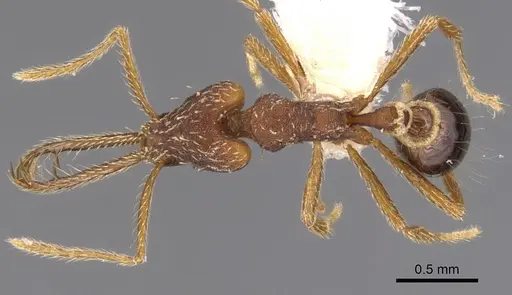
Литература
Загрузка карты распределения...Загрузка товаров...