
Probolomyrmex procne
- Науч. назв.
- Probolomyrmex procne
- Триба
- Probolomyrmecini
- Подсемейство
- Proceratiinae
- Автор
- Brown, 1975
- Распространение
- Встречается в 0 странах
Введение
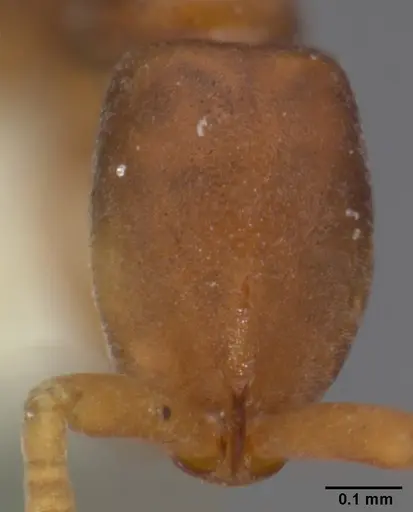
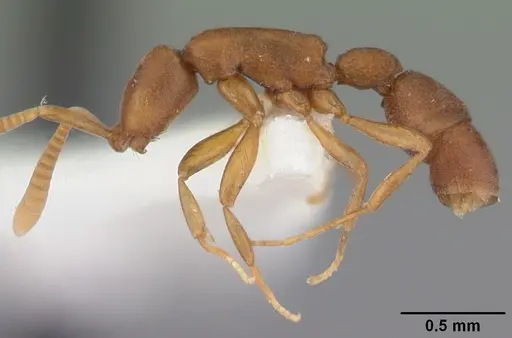
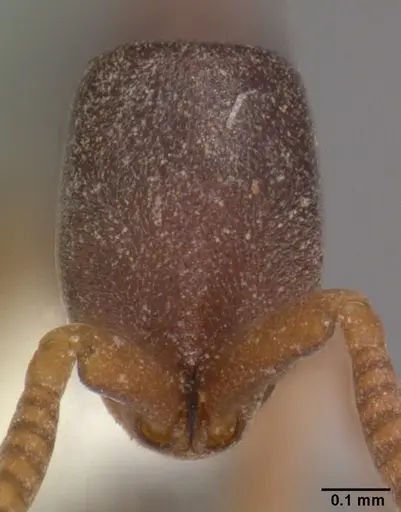
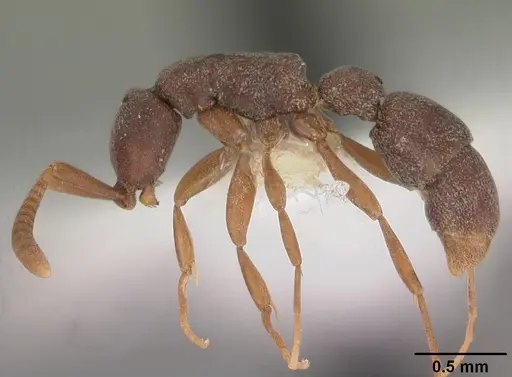
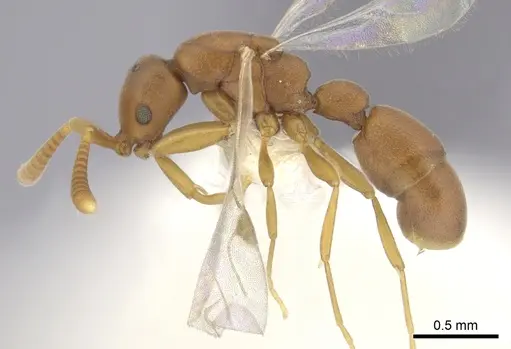
Probolomyrmex procne is an ant species endemic to India, specifically found in Karnataka and Tamil Nadu states . Workers are tiny with a total length of approximately 2.4 mm , featuring a narrow head with convex sides, no visible eyes, and a uniquely shaped petiole that widens toward the rear and ends in paired acute angles when viewed from above . The body is medium ferruginous with yellowish antennae and legs . This species was only known from four worker specimens until 2024,when the dealate queen was described . Colonies are small, with up to 20 workers nesting in rotten logs, empty snail shells, and soil cavities .
Quick Summary
- Difficulty: Expert
- Origin & Habitat: Endemic to India, found in Karnataka and Tamil Nadu states at elevations around 650 m [1][2]. Natural nesting occurs in rotting wood, empty snail shells, and soil cavities [2].
- Colony Type: Colony structure is unconfirmed. Only single queens have been documented in the few known colonies [2].
- Size & Growth:
- Antkeeping:
- Temperature: Temperature requirements are unconfirmed. Based on the species' distribution in southern India at elevations around 650 m [2], room temperature (22-28°C) is likely suitable. Start in this range and observe colony activity.
- Humidity: Based on nesting in rotting wood and leaf litter [2], keep the nest substrate consistently moist but not waterlogged, with a humidity gradient.
- Diapause: Unknown, no research on seasonal behavior.
- Nesting: In captivity, use small naturalistic setups with Y-tong, plaster, soil, or 3D-printed nests that provide dark, enclosed spaces [2]. Avoid acrylic nests.
- Behavior: Workers are blind with no visible eyes, so they rely heavily on chemical and tactile senses [3][2]. They are not known to be aggressive and their tiny colony size suggests a peaceful, cryptic lifestyle. Escape prevention is critical due to their very small size (2.4 mm) [2].
- Common Issues: extreme rarity means virtually no captive colonies exist, this species is not available in the antkeeping hobby., tiny colony size (max 20 workers) means any losses have major impact on the colony., complete lack of documented biology means all care is speculative., blind workers may have difficulty finding food in open spaces., escape prevention is essential due to their minute size.
Why Probolomyrmex procne Is So Challenging
This species presents extraordinary challenges for antkeepers. Probolomyrmex procne was described in 1975 but remained known from only four worker specimens for nearly 50 years. The dealate queen was only described in 2024,making this one of the most recently documented ant species in India [2]. There is zero scientific literature on any aspect of its biology, we don't know what they eat, how they found colonies, when they have nuptial flights, or any basic husbandry requirements. Every piece of advice for keeping this species must be inferred from related species in the Proceratiinae subfamily. This means successful keeping requires extensive experience with difficult species and significant willingness to experiment. Unless you have a source for wild-caught colonies, this species is essentially unavailable in the antkeeping hobby [2][3].
Natural History and Distribution
Probolomyrmex procne is endemic to India, making it one of the rarest ant species in the country. The type locality is the Palni Hills in Tamil Nadu,39 km east of Kodaikanal at 650 m elevation, where the holotype was collected in 1972 [3][2]. Additional specimens have been collected from Coimbatore and Mysore, Karnataka. The 2024 study from the Indian Institute of Science campus in Bangalore represents only the fourth documented occurrence on the Indian subcontinent [2]. The species belongs to the P. longinodus species group, characterized by a petiole that is clearly longer than high [2].
Morphology and Identification
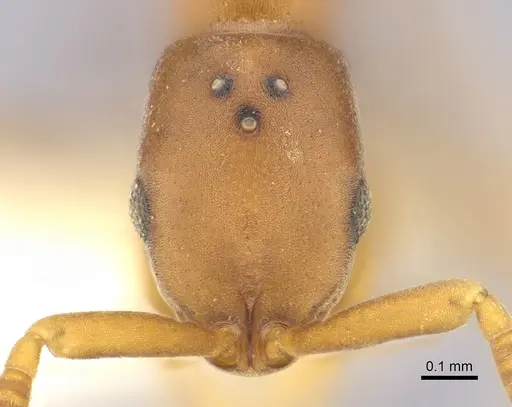
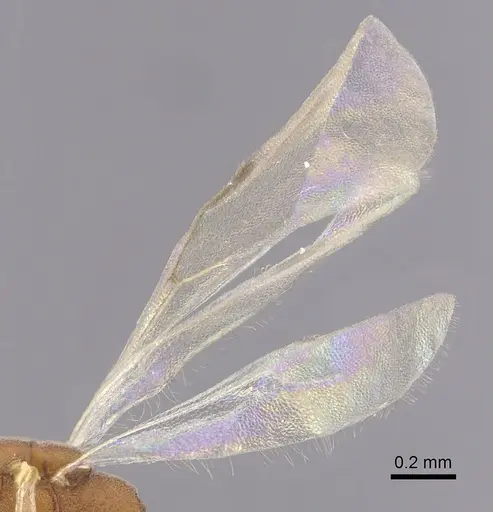
Workers are tiny at just 2.4 mm total length, making them among the smallest ants in India [2]. The most distinctive feature is the petiolar node: when viewed from above, it has almost perfectly straight sides that diverge toward the rear and end in a pair of acute angles, with the posterior border broadly and deeply concave [3]. Workers are completely blind with no eyes visible even at 50× magnification [3][2]. They have medium ferruginous coloration with noticeably more yellowish antennae and legs [3]. The recently described queen measures 2.68 mm and has well-developed eyes, three ocelli, and wings [2].
Housing and Nesting
Based on collection data, wild colonies nest in rotting wood, empty snail shells, and small cavities in soil and leaf litter [2]. In captivity, you should replicate these conditions with a naturalistic setup featuring small dark spaces. Use Y-tong, plaster, soil, or 3D-printed nests that provide tight cavities. The nest should be kept humid since their natural habitat involves moist forest floor microhabitats [2]. Given their blind workers and tiny size, they likely prefer dark, enclosed spaces and would be stressed by bright lighting. Keep the entire setup in a quiet, vibration-free location.
Feeding and Diet
Diet is completely unconfirmed for this species. Based on typical Proceratiinae biology, they are likely predatory on small arthropods [4]. Given their tiny size, they may prey on springtails, mites, or tiny insects. Offer small live prey items like springtails or fruit flies and observe acceptance.
Temperature and Seasonal Care
No research exists on temperature requirements or seasonal behavior. Their distribution in southern India at elevations around 650 m suggests they are adapted to warm, humid conditions year-round [2]. In captivity, maintain temperatures in the 22-28°C range, this covers typical room temperature in most homes. A slight temperature gradient allows the colony to self-regulate. For winter, you might reduce temperatures to 18-20°C for a few months, but true hibernation may not be necessary given their tropical origin.
Frequently Asked Questions
Is Probolomyrmex procne available in the antkeeping hobby?
No. This species is extremely rare in the wild with only a handful of documented specimens across 50+ years. There are no known captive breeding programs, and wild colonies have never been documented for sale. Even researchers have struggled to find specimens, the 2024 study noted this was only the fourth record in decades [2].
How big do Probolomyrmex procne colonies get?
Wild colonies reach a maximum of approximately 20 workers, this is one of the smallest colony sizes documented for any ant species. This was confirmed in the 2024 study which found colonies in rotten logs, empty snail shells, and leaf litter cavities [2].
What do Probolomyrmex procne ants eat?
Diet is completely unconfirmed. Based on related Proceratiinae ants, they are likely predatory on small arthropods. Their tiny size suggests they would need very small prey like springtails or mites. If you ever kept them, you would need to experiment with small live prey and observe acceptance.
Do Probolomyrmex procne ants have eyes?
No. Workers are completely blind with no eyes visible even under 50× magnification [3][2]. The recently described queen, however, has well-developed eyes and ocelli [2].
Are Probolomyrmex procne good for beginners?
Absolutely not. This species is expert-level even for specialists. There is zero documented biology, no one knows how to feed them, what temperature they need, how they found colonies, or any basic husbandry. They are also virtually unavailable [2].
Do Probolomyrmex procne ants sting?
Unknown. Proceratiinae ants have stingers but most species are too small to penetrate human skin effectively. Given their tiny size, any sting would be negligible even if they do possess functional stings [4].
What is the unique feature of Probolomyrmex procne?
The most distinctive feature is the petiolar shape: when viewed from above, the petiole has almost perfectly straight sides that widen toward the rear and end in a pair of acute angles, with a deeply concave posterior border. This is unique among all Probolomyrmex species and inspired the name 'procne' [3][2]. Workers are also completely blind, and colonies max out at just 20 workers [2].
Where does Probolomyrmex procne live?
This species is endemic to India, specifically found in Karnataka and Tamil Nadu states. Known localities include the Palni Hills (type locality at 650 m elevation), Coimbatore, Mysore, and Bangalore [1][2].
Report an Issue
The current care sheet is based fully on literature. See inconsistencies, or something that's incorrect? Please , it will be resolved after review from an admin. Contributing to the blogs tab also helps providing information, to make us be able to further improve the caresheets. Thank you for your support!
References

Эта инструкция по уходу лицензирована по CC BY-SA 4.0 .
Блоги сообщества
CASENT0101988
Посмотреть на AntWeb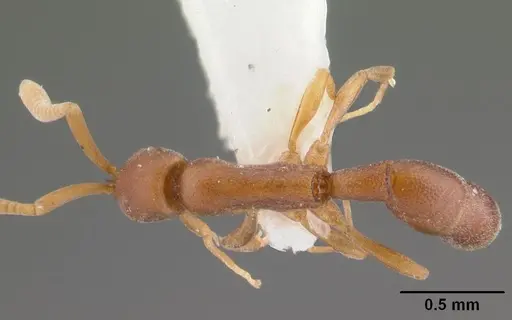
CASENT0102221
Посмотреть на AntWeb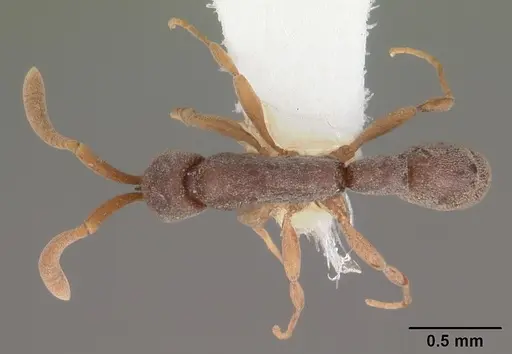
CASENT0249254
Посмотреть на AntWeb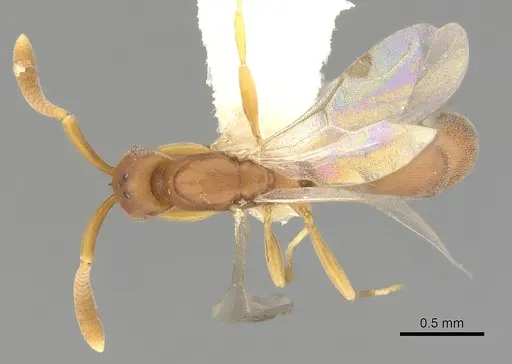
Литература
Загрузка карты распределения...Загрузка товаров...