
Polyrhachis pacifica
- Науч. назв.
- Polyrhachis pacifica
- Подрод
- Cyrtomyrma
- Триба
- Camponotini
- Подсемейство
- Formicinae
- Автор
- Kohout, 2006
- Распространение
- Встречается в 0 странах
Введение
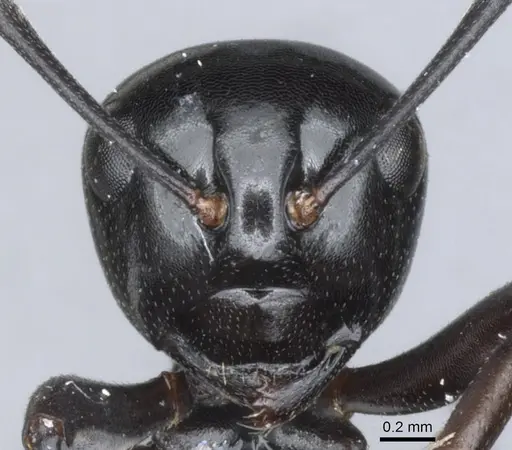
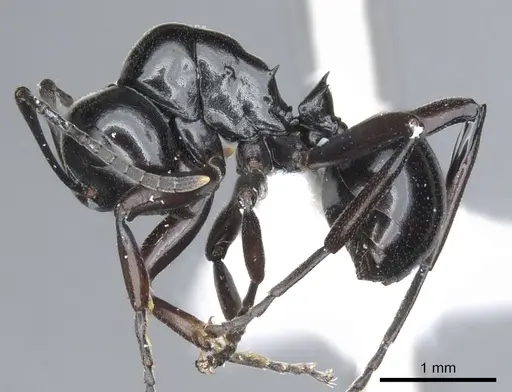
Polyrhachis pacifica is a small, dark ant species described from the Solomon Islands. Workers are approximately 5 mm in total length, with a black body and reddish-brown markings on the mandibles, leg tips, and gaster apex. The species has angular pronotal humeri and propodeal spines, distinguishing it from similar species . It is known only from Guadalcanal, Bougainville, and Makira in the Solomon Islands, at elevations of 720-800 m . Only two worker specimens have ever been documented, and no biological or ecological data is available for this species. As a member of the subgenus Cyrtomyrma, it may share traits with other Polyrhachis ants, but specific care requirements are unconfirmed .
Quick Summary
- Difficulty: Expert
- Origin & Habitat: Solomon Islands (Guadalcanal, Bougainville, Makira) at elevations of 720-800 m in forested tropical habitat [2][1].
- Colony Type: Unconfirmed, only two workers have been documented, with no queen or colony observations [1].
- Size & Growth:
- Antkeeping:
- Temperature: Unknown, no specific data available. Based on tropical habitat, start around 24-28°C and observe.
- Humidity: Unknown, no specific data available. Keep substrate moist but not waterlogged, based on humid tropical habitat.
- Diapause: No, tropical species from near-equator do not require diapause.
- Nesting: Unknown, no specific data. Based on genus patterns, may use decaying wood or under bark.
- Behavior: Not documented. Polyrhachis ants are generally docile. Defense mechanism: sprays formic acid from acidopore, as typical for Formicinae. Escape risk is moderate given worker size around 5 mm [1].
- Common Issues: No established care protocols exist for this species., Only two workers have ever been documented, making care highly experimental., Wild colonies are extremely difficult to obtain due to limited range., Maintaining tropical humidity levels may be challenging., Feeding behavior is unknown, requiring experimentation.
Species Identification and Discovery
Polyrhachis pacifica was described in 2006 by R.J. Kohout. The holotype was collected on Guadalcanal at Gold Ridge at 800 m elevation, and the paratype from Bougainville at 720 m. The species name refers to its Pacific Island distribution. It belongs to the subgenus Cyrtomyrma, characterized by small size and specific morphological features [1].
The species can be distinguished from similar relatives by its distinctly angular pronotal humeri and presence of propodeal spines. It is smaller than P. undulata and has angular shoulders compared to the rounded shoulders of P. emeryana [1].
Known Distribution
Polyrhachis pacifica is endemic to the Solomon Islands, recorded from Guadalcanal, Bougainville, and Makira. All collection sites are at moderate elevations of 720-800 m, suggesting a preference for forested highland habitats [2][1].
The Solomon Islands have a humid tropical climate with year-round warmth and high rainfall. Captive care should aim to replicate these stable, warm, and humid conditions.
Challenges of Keeping Rarely Documented Species
Polyrhachis pacifica is one of the most poorly documented ant species in the hobby. With only two worker specimens ever collected, there is essentially no biological data to guide captive care. This makes it an extremely challenging species to keep, as even genus-level assumptions may not apply [1].
For these reasons, this species cannot be recommended except for experienced keepers with ability to experiment. Obtaining a colony would be difficult due to the limited known range and lack of documented wild colonies.
Inferred Care Based on Genus Patterns
While no specific data exists for P. pacifica, Polyrhachis ants in general tend to be arboreal or semi-arboreal, often nesting in decaying wood, under bark, or in tree hollows. The Cyrtomyrma subgenus contains smaller species that may be more ground-nesting. Based on the tropical Solomon Islands habitat, these ants would likely require warm temperatures and high humidity. However, without direct observations, these are educated guesses rather than confirmed requirements.
Frequently Asked Questions
How do I care for Polyrhachis pacifica ants?
No established care protocol exists for this species [1]. Based on its tropical origin, it likely needs warm temperatures and high humidity, but this is speculative.
Where does Polyrhachis pacifica live in the wild?
This species is known only from the Solomon Islands, specifically Guadalcanal, Bougainville, and Makira. All specimens were collected at elevations of 720-800 m in forested tropical habitat [2][1].
How big do Polyrhachis pacifica workers get?
Workers are approximately 5 mm in total length [1].
Can I keep Polyrhachis pacifica in a test tube?
There is no documented successful captive husbandry for this species [1]. Given the lack of established protocols, attempting to keep this species would be highly experimental and is not recommended.
Do Polyrhachis pacifica ants make silk nests?
Whether P. pacifica exhibits silk nest weaving is completely unknown, no observations of nesting behavior have ever been documented [1].
What do Polyrhachis pacifica ants eat?
No feeding observations exist for this species [1]. Based on general Polyrhachis genus patterns, they may consume honeydew, nectar, and small insects, but this is unconfirmed.
Are Polyrhachis pacifica ants aggressive?
Polyrhachis ants are generally considered docile and non-aggressive [1]. However, no specific behavioral observations exist for P. pacifica.
How fast do Polyrhachis pacifica colonies grow?
Unknown, no colony has ever been documented, and no developmental data exists for this species [1].
Do Polyrhachis pacifica queens have wings?
No queen of this species has ever been described or documented [1]. All aspects of colony founding remain unknown.
Is Polyrhachis pacifica a good species for beginners?
No. This is not a beginner species. With zero captive husbandry data and extremely limited wild documentation, attempting to keep this species is risky and not recommended [1].
Report an Issue
The current care sheet is based fully on literature. See inconsistencies, or something that's incorrect? Please , it will be resolved after review from an admin. Contributing to the blogs tab also helps providing information, to make us be able to further improve the caresheets. Thank you for your support!
References

Эта инструкция по уходу лицензирована по CC BY-SA 4.0 .
Блоги сообщества
CASENT0903399
Посмотреть на AntWeb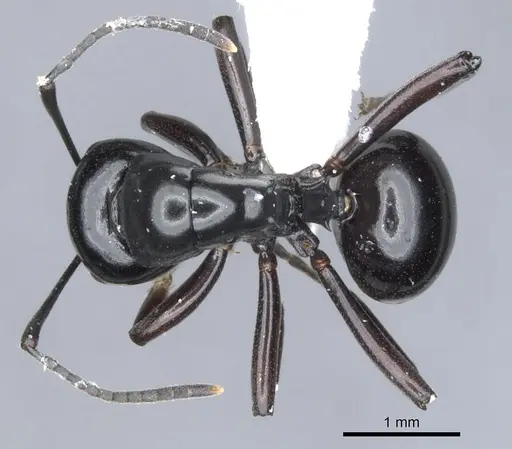
Литература
Загрузка карты распределения...Загрузка товаров...