
Monomorium hirsutum
- Науч. назв.
- Monomorium hirsutum
- Триба
- Solenopsidini
- Подсемейство
- Myrmicinae
- Автор
- Forel, 1910
- Распространение
- Встречается в 0 странах
Введение
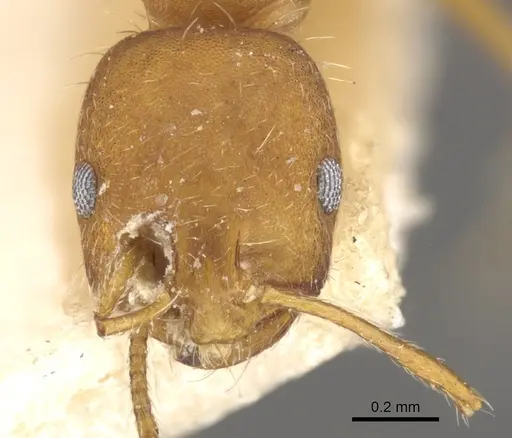
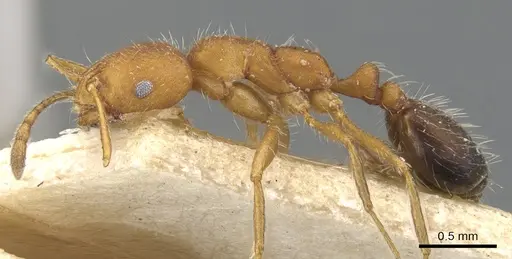
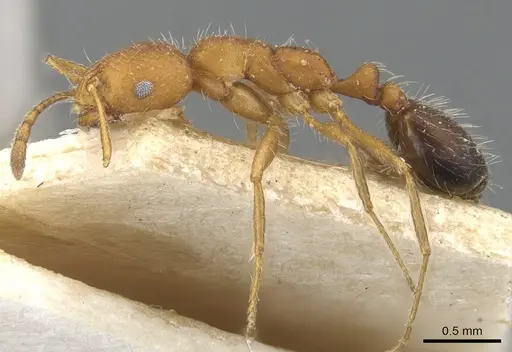
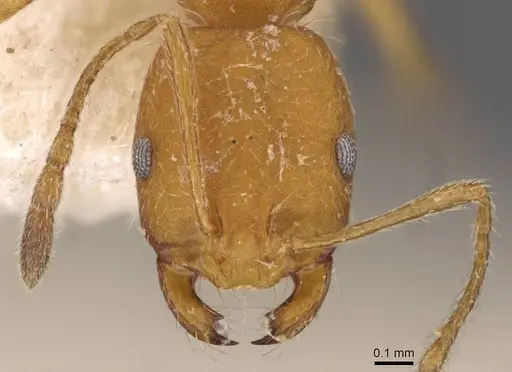
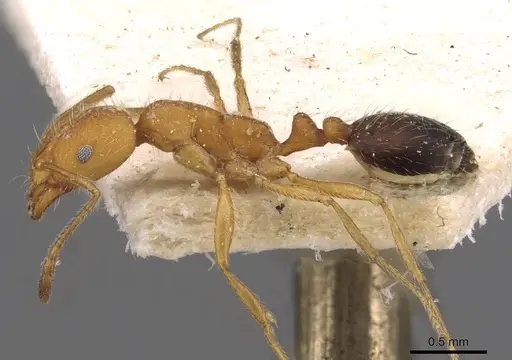
Monomorium hirsutum is a tiny ant species belonging to the Monomorium salomonis species group, specifically the bicolor-complex. Workers measure 3.2-3.4mm in total length and have a striking color pattern: orange-yellow to orange-red head, alitrunk, and petiole, contrasting with a blackish-brown to black gaster. The species gets its name from the dense covering of erect hairs on the dorsal surfaces, including the propodeum - a unique feature among related species in the bicolor-complex. This ant is known only from the highlands of Eritrea and Ethiopia, with only the original type series collected in 1906 ever documented .
Quick Summary
- Difficulty: Unknown, species has never been kept in captivity
- Origin & Habitat: Native to the highlands of Eritrea and Ethiopia in the Afrotropical region. The type locality is Nefassit (now part of Eritrea), collected at elevation in 1906. The highland location suggests rocky, semi-arid to subtropical conditions [1][2].
- Colony Type: Colony structure is unconfirmed. No data exists on queen number or colony organization for this species.
- Size & Growth:
- Antkeeping:
- Temperature: Likely prefers warm conditions similar to other Afrotropical Monomorium. Start around 24-28°C and observe colony activity.
- Humidity: Likely prefers moderate to dry conditions given the highland origin. Aim for 50-70% humidity with some dry areas in the nest.
- Diapause: Unknown, likely a tropical/subtropical species that does not require hibernation, but this is unconfirmed
- Nesting: No specific nesting data exists. Based on related species in the salomonis group, they likely nest in soil or under stones. For captivity, a small test tube setup or Y-tong nest with narrow chambers scaled to their tiny 3mm size would be appropriate.
- Behavior: Behavior is completely unstudied in captivity. Based on genus typical behavior, these are likely generalist omnivores that forage for sweets and small protein sources. Their small size suggests they may be more cryptic than aggressive. Escape prevention is critical due to their tiny 3mm size, they can squeeze through standard mesh. Use fine mesh barriers and tight-fitting lids. The subfamily Myrmicinae and tribe Solenopsidini typically have stinging ability, though their small size likely limits effectiveness.
- Common Issues: no captive husbandry data exists, this species has never been kept in captivity, tiny size makes escape prevention challenging, standard barriers may be insufficient, colony may be slow-growing or difficult to establish without proper founding conditions, wild-caught colonies may have parasites or diseases with no documented treatment, temperature and humidity requirements are unknown, requiring careful observation, species has only been documented from a single collection in 1906, acquisition is essentially impossible
Species Identification and Distinction
Monomorium hirsutum is a member of the Monomorium salomonis species group, specifically the bicolor-complex. It was originally described as a subspecies of Monomorium bicolor but was elevated to full species status by Bolton in 1987. The most distinctive feature is the dense covering of erect hairs on the propodeum, this is unique among Afrotropical members of the bicolor-complex. Related species like M. bicolor lack hairs on the dorsal alitrunk and have only sparse gastral pilosity. M. hirsutum also has shorter scapes and smaller eyes than its closest relatives. The color pattern is striking: orange-yellow to orange-red head, alitrunk, petiole and postpetiole contrasting with a blackish-brown to black gaster [1].
Distribution and Habitat
This species is known only from the highlands of Eritrea and Ethiopia in the Afrotropical region. The type locality is Nefassit (now part of Eritrea), collected in 1906 by K. Escherich. Only the original type series has ever been recorded, no additional specimens have been documented in over a century of ant collecting in the region. The highland location suggests this species prefers elevations with potentially cooler and drier conditions than lowland tropical areas. This limited distribution makes wild collection extremely difficult, and the species has never been documented in the antkeeping trade [2][1].
Challenges of Keeping Unstudied Species
Monomorium hirsutum presents a unique challenge: it is one of the least studied ant species in the hobby, with absolutely no documented captive husbandry. The AntWiki explicitly states 'Nothing is known about the biology of this species.' This means all care recommendations must be based on inference from related species in the Monomorium salomonis group, not on direct observation. If you obtain this species, expect a period of experimentation to determine optimal conditions. Start with moderate temperature (24-28°C) and humidity (50-70%), then adjust based on colony behavior. Watch for signs of stress: workers avoiding certain areas, excessive clustering, or mortality. Be prepared to try different setups. The bright coloration and tiny size make this an intriguing species if you can obtain a colony, but be prepared for a steep learning curve [1].
Housing and Setup Recommendations
Given the worker size of only 3.2-3.4mm, housing must be appropriately scaled. A small test tube setup works well for founding colonies, use a narrow diameter tube that allows the queen and workers to stay in close contact. For established colonies, a Y-tong nest with small chambers or a plaster nest with tight passages would be appropriate. The outworld should be small and simple, with minimal space to prevent the tiny workers from getting lost. Escape prevention is critical: standard test tube cotton plugs may need to be supplemented with finer barrier methods. Fluon applied to the edges of the outworld and fine mesh covering any ventilation holes will help prevent escapes. These ants are likely to be more cryptic than some of the more common Monomorium species, so provide dark, sheltered areas in the nest [1].
Feeding and Nutrition
Feeding requirements are completely unconfirmed for this species. Based on typical Monomorium diet, they are likely generalist omnivores that accept both sugar sources and protein. Start with a basic regimen of sugar water or honey offered on a cotton wick to prevent drowning and small protein sources like fruit flies, pinhead crickets, or other tiny arthropods. Related species in the salomonis group are often scavengers and foragers, so they likely will accept a variety of foods. Feed small amounts initially and remove any uneaten food after 24-48 hours to prevent mold. The tiny worker size means even small prey items may be too large, consider offering pre-killed or cut-up prey. Monitor whether workers show interest in sugar sources, if not, focus on protein offerings [1].
Frequently Asked Questions
Can I keep Monomorium hirsutum in a test tube?
Yes, a test tube setup is appropriate for this tiny 3.4mm species. Use a narrow-diameter tube and ensure proper escape prevention, their small size means they can squeeze through standard cotton plugs. Consider adding a fluon barrier at the tube opening.
How long does it take for Monomorium hirsutum to produce first workers?
This is completely unknown, the species has never been documented in captivity. There is no species-specific data on development time.
What do Monomorium hirsutum ants eat?
Diet is unconfirmed, but based on related Monomorium species, they likely accept sugar water or honey and small protein sources like fruit flies or tiny arthropods. Start with both and observe what they prefer.
Are Monomorium hirsutum good for beginners?
No. This species has never been kept in captivity and has no documented care requirements. There is no husbandry knowledge to draw upon. This is an expert-level species for those interested in pioneering care for unstudied species.
Do Monomorium hirsutum need hibernation?
Unknown, likely no. As a species from the Afrotropical highlands (Eritrea/Ethiopia), it is probably adapted to year-round warm conditions. However, this is unconfirmed and based only on geographic distribution.
How big do Monomorium hirsutum colonies get?
Colony size is completely unknown, no colony size data exists in scientific literature.
Can I keep multiple Monomorium hirsutum queens together?
Unknown, colony structure has not been documented. Some Monomorium are single-queen while others are multi-queen, but there is no data for this specific species. Without evidence, combining unrelated queens is not recommended.
What temperature should I keep Monomorium hirsutum at?
No specific data exists. Based on Afrotropical origin, start around 24-28°C and observe colony behavior. Related species from similar habitats do well in the mid-to-high room temperature range. Adjust based on activity levels.
Why is Monomorium hirsutum so rare in the antkeeping hobby?
This species has only ever been documented from a single collection in 1906 in Eritrea. It has never been rediscovered or documented in the wild since then. No wild colonies are known to exist, making acquisition essentially impossible.
Report an Issue
The current care sheet is based fully on literature. See inconsistencies, or something that's incorrect? Please , it will be resolved after review from an admin. Contributing to the blogs tab also helps providing information, to make us be able to further improve the caresheets. Thank you for your support!
References

Эта инструкция по уходу лицензирована по CC BY-SA 4.0 .
Блоги сообщества
CASENT0902188
Посмотреть на AntWeb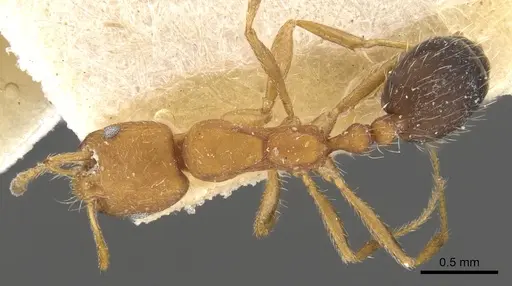
CASENT0908726
Посмотреть на AntWeb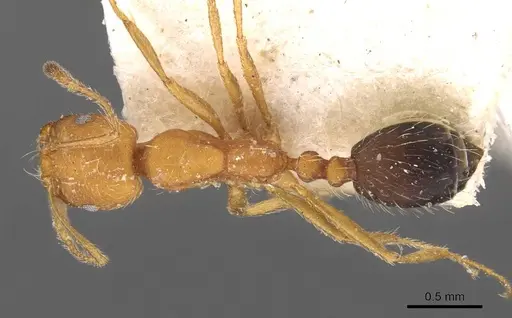
Литература
Загрузка карты распределения...Загрузка товаров...