
Leptogenys breviloba
- Науч. назв.
- Leptogenys breviloba
- Триба
- Ponerini
- Подсемейство
- Ponerinae
- Автор
- Arimoto, 2017
- Распространение
- Встречается в 0 странах
Введение
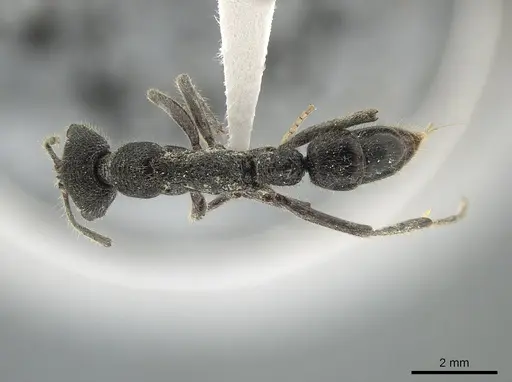
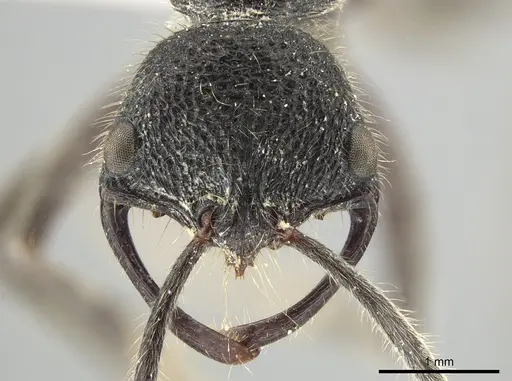
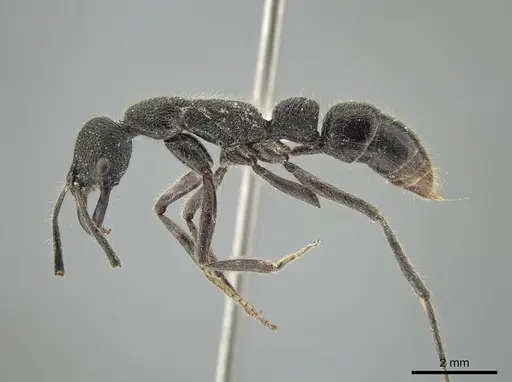
Leptogenys breviloba is a small predatory ant species from the Ponerinae subfamily, recently described in 2017. Workers are approximately 5-7mm total length with a distinctly elongated head and broadly curved mandibles. Their body is primarily black with reddish tinges, particularly on the clypeus, mandibles, antennae, legs, and the apical gaster segments. Queens are similar in size but have a shorter, higher petiole compared to workers. This species belongs to the Leptogenys modiglianii species group and is known only from a single collection in Peninsular Malaysia, making it one of the rarest ants in existence.
Quick Summary
- Difficulty: Expert
- Origin & Habitat: Ulu Gombak, Selangor, Malaysia (3.32°N,101.75°E) at 230-350m elevation in secondary rainforest [1]. The only known colony was collected under the bark of rotting wood.
- Colony Type: Colony structure is unconfirmed. Only one colony has ever been documented, and the male caste remains unknown.
- Size & Growth:
- Queen: ~5-7mm total length, inferred from Leptogenys genus patterns
- Worker: ~5-7mm total length, inferred from Leptogenys genus patterns
- Colony: Unknown, only one colony has ever been documented
- Growth: Unknown, no captive breeding data exists
- Development: Unknown, this species has never been bred in captivity (No development data exists for this species.)
- Antkeeping:
- Temperature: Keep warm, around 24-28°C. This species comes from tropical Malaysia where temperatures are consistently warm year-round.
- Humidity: High humidity required, think damp rainforest floor. Keep nest substrate consistently moist but not waterlogged. Provide a water source nearby.
- Diapause: Unlikely, being a tropical species from Malaysia, they probably do not require a diapause period.
- Nesting: In nature they nest under the bark of rotting wood in secondary rainforest. In captivity, they would likely accept wood-based nests (Y-tong, plaster nests) or test tubes with added humidity. Avoid dry, open setups.
- Behavior: Leptogenys ants are predatory and fast-moving. They likely hunt small invertebrates and would require live prey in captivity. Their elongated head and prominent eyes suggest active hunting behavior. Escape prevention is important, while not among the smallest ants, they are agile and may squeeze through small gaps. This species has a functional stinger typical of Ponerinae ants.
- Common Issues: This species has never been kept in captivity, there is no established care protocol, Only one wild colony has ever been documented, making basic biology largely unknown, Tropical humidity requirements may be difficult to maintain consistently, Predatory diet requirements mean you need a reliable source of small live prey, Male caste is unknown, so obtaining mated queens for breeding would be extremely difficult
Discovery and Rarity
Leptogenys breviloba is an extremely rare species, known from only a single colony ever collected. The holotype and colony (AK18) were collected in May 2012 by Taku Shimada from under the bark of rotting wood in secondary rainforest at Ulu Gombak, Selangor, Malaysia. Additional paratypes from the same general area were collected in August 1999 by Fuminori Itô. This species was formally described by Kôichi Arimoto in 2017 as part of a revision of the Leptogenys modiglianii species group. The species name 'breviloba' comes from Latin 'brevis' (short) and 'loba' (lobed), referring to the short clypeal lobe that helps distinguish it from related species. [1]
Identification and Morphology
Leptogenys breviloba can be identified by several distinctive features. Workers have a head that is distinctly longer than wide, with broadly curved mandibles throughout their length. The clypeus has a lateral lobe that smoothly curves inward between the lobe and the median extension. In profile, the petiole is longer than or almost as long as high, with the highest point near the middle and a subhorizontal dorsal face. The body is primarily black with a reddish tinge, with the clypeus, mandibles, antennae, legs, and ventral half of the petiole being dark red. The gaster's first segment has characteristic scalloped depressions. Queens are similar but have a shorter, higher petiole. [1]
Natural Habitat and Distribution
This species is known only from Peninsular Malaysia, specifically the Selangor region around Ulu Gombak (coordinates 3.32°N,101.75°E). The elevation range is 230-350 meters. The habitat is secondary rainforest, which is a tropical forest that has been disturbed and is regenerating. The sole collected colony was found under the bark of rotting wood, which is typical nesting behavior for many Leptogenys species. The climate in this region is tropical humid, with consistent warm temperatures year-round and high rainfall. [1]
Defense Mechanism
Leptogenys breviloba belongs to the Ponerinae subfamily and Ponerini tribe. Like other Ponerine ants, this species has a functional stinger capable of injecting venom. The venom is peptide-rich and can be painful to vertebrates. Exercise caution when handling this species.
Leptogenys Genus Characteristics
While specific behavior data for L. breviloba does not exist, the genus Leptogenys provides general guidance. Most Leptogenys species are predatory, using their long, slender bodies and rapid movement to chase down prey. They typically have well-developed eyes and are active hunters. Nests are commonly found in rotting wood, under bark, or in soil in forest environments. Colony sizes in the genus vary but are typically moderate. Based on genus patterns, queens of many Leptogenys species may be semi-claustral, but this specific behavior is unconfirmed for L. breviloba.
Captive Care Considerations
Because this species has never been kept in captivity, all care recommendations are speculative inferences from the genus and natural habitat. Provide warm temperatures around 24-28°C with high humidity. The nesting preference for rotting wood suggests a wood-based or plaster nest with good humidity retention would be appropriate. As predators, they will need a constant supply of small live prey such as fruit flies, pinhead crickets, or other small arthropods. Sugar sources may be accepted but should not be relied upon as a primary food. Given the extreme rarity of this species in the wild, it is unlikely that captive colonies are available to antkeepers.
Frequently Asked Questions
Is Leptogenys breviloba available for purchase?
No. This is one of the rarest ant species in existence, known from only a single wild colony ever collected. It is not available in the antkeeping hobby and likely not kept by any collector or institution.
How do I keep Leptogenys breviloba?
There is no established care protocol, this species has never been kept in captivity. Based on genus patterns, provide warm temperatures (24-28°C), high humidity, and a nest that retains moisture (wood-based or plaster). Feed small live prey. This species is not recommended for any keeper.
What does Leptogenys breviloba eat?
Not documented for this specific species, but Leptogenys ants are predatory. They likely hunt small invertebrates including micro-arthropods, springtails, and other tiny insects. In captivity, they would need a constant supply of small live prey.
How big do Leptogenys breviloba colonies get?
Unknown. Only one colony has ever been documented, and its size was not reported. Based on related species in the genus, colonies likely reach moderate sizes.
Does Leptogenys breviloba sting?
Like other Ponerinae ants, this species has a functional stinger. Exercise caution when handling.
Where is Leptogenys breviloba found?
Only known from Peninsular Malaysia, specifically the Selangor region around Ulu Gombak at 230-350m elevation. The type locality is secondary rainforest.
How long do Leptogenys breviloba queens live?
Unknown. No captive data exists for this species.
Can I breed Leptogenys breviloba?
Breeding this species would be extraordinarily difficult to impossible. The male caste is unknown, so obtaining mated queens would require finding them in the wild in Malaysia, an extremely unlikely prospect given only one colony has ever been documented in over 20 years of sampling.
Do Leptogenys breviloba need hibernation?
Unlikely. Being from tropical Malaysia, they probably do not require a diapause or hibernation period.
What makes Leptogenys breviloba special?
This species is one of the rarest ants in the world, known from a single collection. It was only formally described in 2017,making it a relatively new addition to scientific knowledge. Its entire global range appears to be a small area of secondary rainforest in Malaysia.
Report an Issue
The current care sheet is based fully on literature. See inconsistencies, or something that's incorrect? Please , it will be resolved after review from an admin. Contributing to the blogs tab also helps providing information, to make us be able to further improve the caresheets. Thank you for your support!
References

Эта инструкция по уходу лицензирована по CC BY-SA 4.0 .
Блоги сообщества
Литература
Загрузка карты распределения...Загрузка товаров...