
Leptanilla kunmingensis
- Науч. назв.
- Leptanilla kunmingensis
- Триба
- Leptanillini
- Подсемейство
- Leptanillinae
- Автор
- Xu & Zhang, 2002
- Распространение
- Встречается в 0 странах
Введение
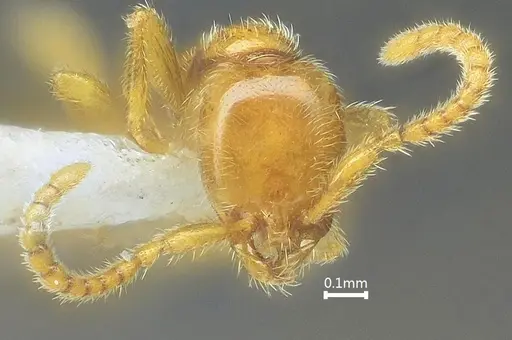
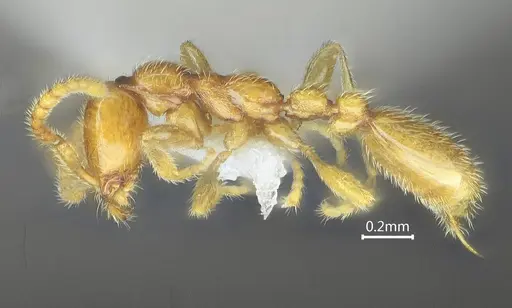
Leptanilla kunmingensis is an extremely rare and cryptic ant species from the subfamily Leptanillinae, discovered in Yunnan Province, China. Workers are tiny at just 2.1-2.2mm in total length, with a distinctive brownish-yellow coloration and unusually slender build . The genus Leptanilla contains some of the smallest and most secretive ants in the world, rarely encountered because they live almost entirely underground. This species was collected from a soil sample in an evergreen broadleaf forest at 2150m elevation in the Kunming area . The Leptanilla genus remains one of the most poorly studied ant groups globally, and L. kunmingensis is no exception. Only the worker caste has been described - no queens or males have ever been documented. Like other Leptanilla species, these ants have distinctive morphological features including a head that narrows toward the front, a protruding clypeus with a concave front margin, and a rounded petiolar node . Their cryptic lifestyle and minute size make them exceptionally challenging to study in the wild, let alone maintain in captivity.
Quick Summary
- Difficulty: Expert
- Origin & Habitat: Yunnan Province, China, collected from soil in evergreen broadleaf forest at 2150m elevation [1]
- Colony Type: Unknown, only workers have been described. No queens or males are known. Colony structure is entirely unconfirmed.
- Size & Growth:
- Queen: Unknown, queen caste has not been described
- Worker: 2.1-2.2mm total length [1]
- Colony: Unknown, only 30 workers described from type series
- Growth: Unknown
- Development: Unknown, no development data exists for this species (This is one of the least studied ant species in existence. No captive colonies have ever been established.)
- Antkeeping:
- Temperature: Unconfirmed, infer from habitat (evergreen broadleaf forest at 2150m in Yunnan). Likely prefers cool to moderate temperatures around 15-22°C. Avoid overheating.
- Humidity: Unconfirmed, soil-dwelling species from forest floor suggests need for consistently moist substrate. Provide damp soil conditions but avoid waterlogging.
- Diapause: Unknown, likely requires a winter rest period given the temperate location (Kunming at 2150m elevation)
- Nesting: Soil-nesting species. In captivity, a naturalistic setup with fine, moist soil and minimal disturbance would be most appropriate. Test tubes with cotton-plugged water reservoirs may work but these tiny ants are likely to escape through standard cotton.
- Behavior: Behavior is entirely unstudied. Leptanilla species are known to be hypogaeic (subterranean), rarely appearing on the surface. They likely forage through soil and leaf litter. Given their minute size, escape prevention must be excellent, these ants can likely pass through standard mesh barriers. Temperament is unknown but they are not known to be aggressive.
- Common Issues: no captive husbandry information exists, this species has never been kept in captivity, extreme escape risk due to tiny size (2mm workers), only known from 30 collected specimens, wild populations are exceptionally rare, no queen or male described, cannot establish colonies from wild-caught queens, soil-dwelling lifestyle makes them nearly impossible to locate in the wild
Why This Species Is Not Recommended for Captive Keeping
Leptanilla kunmingensis is one of the most poorly documented ant species in the world. It has never been successfully kept in captivity, and likely no one has ever attempted it. The fundamental problem is that we only know about this species from 30 worker specimens collected in 2001, no queens have ever been found, no males described, and no wild colonies observed [1]. Without a queen, you cannot establish a colony. Even if you found a colony in the wild (an extraordinarily difficult task given their subterranean lifestyle), the species' biology is so poorly understood that successful captive maintenance would be nearly impossible. This is a species for researchers with specialized equipment and funding, not hobbyist antkeepers. If you're interested in keeping rare ants, consider better-documented Leptanilla species or more established genera.
What We Know About the Genus Leptanilla
The genus Leptanilla contains some of the smallest and most cryptic ants on Earth. These hypogaeic (subterranean) ants live almost their entire lives underground, making them extremely difficult to study. Workers are typically 1.5-3mm, pale-colored, and have distinctive morphological features like a narrowed head and specialized petiole structure [2]. Leptanilla species are known from scattered locations across the Old World, but their actual distribution is poorly understood because they are so rarely encountered. Some Leptanilla species are suspected to be predators of other small arthropods, possibly using their three-toothed mandibles to capture prey in soil tunnels. However, even this is speculation, direct observations of feeding behavior in the wild are virtually nonexistent. The subfamily Leptanillinae itself is remarkable for having some of the most extreme cases of dwarfism in ants, with certain species among the smallest insects in the order Hymenoptera.
Natural History and Distribution
Leptanilla kunmingensis is known only from its type locality in Kunming, Yunnan Province, China. The type series was collected in May 2001 from a soil sample taken in an evergreen broadleaf forest at approximately 2150 meters elevation [1]. This highland forest environment suggests the species prefers cool, moist conditions with significant leaf litter cover. Yunnan Province is one of the most biodiverse regions in China, with varied topography and climate. The broader Leptanilla genus has been documented across the Oriental Region and Palaearctic Asia, with new species still being discovered [4][5]. However, L. kunmingensis itself has only been recorded from this single location. The species was described alongside Leptanilla hunanensis as one of only two Leptanilla species known from China at that time, though several more have since been described from China and neighboring regions [4][6].
Identification and Morphology
Leptanilla kunmingensis workers can be identified by their extremely small size (2.1-2.2mm total length) and distinctive body proportions. The head is longer than broad and distinctly narrowed toward the front, a characteristic shared with other Leptanilla species. The clypeus protrudes forward with an evenly concave anterior margin, this is a key diagnostic feature. In side view, the petiolar node has a roundly convex dorsum. In top view, the postpetiolar node is approximately as wide as the petiolar node. The mandibles have three teeth. The body is brownish-yellow and appears smooth and shining under magnification, with dense decumbent pubescence (short, flattened hairs) covering the head and body [1]. The antennae have 12 segments with an indistinct club. These morphological features distinguish L. kunmingensis from related species like Leptanilla hunanensis, which has a differently shaped clypeus and petiole.
Research Status and Knowledge Gaps
The scientific knowledge about Leptanilla kunmingensis is extraordinarily limited, this is not an exaggeration but a statement of fact. We have a single paper describing workers, measurements from 30 specimens, and location data. That is the entirety of published information. There are no papers on colony structure, queen biology, nuptial flights, feeding behavior, development, or any aspect of their natural history. The same applies to most Leptanilla species, they are among the most understudied ants in the world. This means any captive care advice would be pure speculation, not based on any evidence. Compare this to species like Camponotus or Lasius, where thousands of papers document every aspect of their biology. For L. kunmingensis, even basic questions like what do they eat and how do colonies reproduce have no documented answers. Anyone wishing to keep this species would essentially be conducting an uncontrolled experiment with no prior guidance. [1]
Frequently Asked Questions
Can I keep Leptanilla kunmingensis as a pet?
No. This species has never been kept in captivity and likely cannot be established. Only worker ants have ever been described, no queens are known, so you cannot start a colony. Even if you found a wild colony (exceptionally difficult given their subterranean lifestyle), their biology is too poorly understood for successful captive maintenance.
Where can I get Leptanilla kunmingensis?
You cannot obtain this species. No captive colonies exist, and no one is breeding them. They are known only from 30 specimens collected in 2001 in Yunnan, China. Even professional myrmecologists would struggle to locate them in the wild.
What do Leptanilla kunmingensis eat?
Unknown. No feeding observations have ever been documented for this species. Related Leptanilla species are suspected to be predators or scavengers in soil, but this is unconfirmed. There is no captive diet information.
How big do Leptanilla kunmingensis colonies get?
Unknown. Colony size has never been documented. The entire known population consists of 30 workers from the type series, we do not know if these were from one colony or multiple.
Do Leptanilla kunmingensis queens exist?
No queen of this species has ever been described or documented. The species is known only from worker ants collected in 2001. This is one of the fundamental reasons the species cannot be kept in captivity.
What is the difficulty level for keeping Leptanilla kunmingensis?
Expert is an understatement, this species is essentially unkeepable. There is no husbandry information, no described queen, and no documented captive colonies. This is a species for scientific research, not antkeeping.
What temperature and humidity do Leptanilla kunmingensis need?
Unconfirmed. Based on their collection location (evergreen broadleaf forest at 2150m in Yunnan), they likely prefer cool to moderate temperatures (15-22°C) and consistently moist soil conditions. However, this is a rough inference with no experimental validation.
Do Leptanilla kunmingensis need hibernation?
Unknown, but likely yes given the temperate location (Kunming at 2150m elevation experiences cold winters). However, no research exists on their seasonal biology or diapause requirements.
Are Leptanilla kunmingensis ants dangerous?
No. These are tiny (2mm), non-aggressive subterranean ants with no stingers of significance. However, they are far too rare and unstudied to ever encounter in captivity.
How long do Leptanilla kunmingensis workers live?
Unknown. No lifespan data exists for this or any Leptanilla species. Even basic longevity studies have not been conducted.
Can I help research Leptanilla kunmingensis by collecting them?
No. This species is known from a single location in a protected area in Yunnan, China. Collecting them would require permits and would not contribute to husbandry knowledge since captive maintenance is not possible without queen information. Consider studying more common, better-documented species instead.
What ants are similar but keepable?
If you are interested in small, soil-dwelling ants, consider better-documented genera like Temnothorax (North America/Europe), Stenamma (North America/Europe), or Strumigenys (worldwide, but require specialized prey). These have established captive protocols and available queens.
Report an Issue
The current care sheet is based fully on literature. See inconsistencies, or something that's incorrect? Please , it will be resolved after review from an admin. Contributing to the blogs tab also helps providing information, to make us be able to further improve the caresheets. Thank you for your support!
References

Эта инструкция по уходу лицензирована по CC BY-SA 4.0 .
Блоги сообщества
ANTWEB1060530
Посмотреть на AntWeb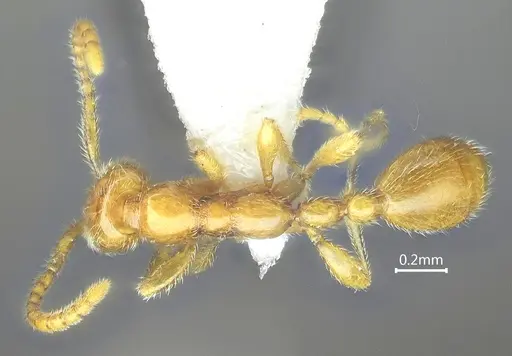
Литература
Загрузка карты распределения...Загрузка товаров...