
Leptanilla beijingensis
- Науч. назв.
- Leptanilla beijingensis
- Триба
- Leptanillini
- Подсемейство
- Leptanillinae
- Автор
- Qian <i>et al.</i>, 2024
- Распространение
- Встречается в 0 странах
Введение
Leptanilla beijingensis is a minute, pale yellow ant that lives deep underground in Beijing, China. Workers measure just 1.4 to 1.8 millimeters long and have smooth, shiny bodies with 12-segmented antennae and three teeth on each mandible . Scientists collected them using pitfall traps buried 30 to 55 centimeters deep in the soil of deciduous broadleaf forests and urban parks . This species was described in 2024 and was previously misidentified as Leptanilla taiwanensis . Despite being relatively common in soil samples, no queens have ever been found and nothing is known about how colonies start or grow .
Quick Summary
- Difficulty: Expert, Currently impossible to keep
- Origin & Habitat: Beijing, China, temperate deciduous broadleaf forest and urban green spaces, lives 30-55cm deep in soil [1][2]
- Colony Type: Unknown, only worker specimens have been collected [1]
- Size & Growth:
- Antkeeping:
- Temperature: Temperate climate, specific needs unknown. Likely requires moderate room temperatures typical of temperate species.
- Humidity: Likely requires high humidity to mimic deep soil conditions, but specific needs unconfirmed.
- Diapause: Likely required based on temperate Palearctic distribution, but unconfirmed [1].
- Nesting: Deep soil dweller, requires subterranean setup with 30cm+ of soil [1].
- Behavior: Subterranean and cryptic, surface activity unknown [1]. Extreme escape risk due to tiny size (under 2mm) [1].
- Common Issues: no queens have ever been documented, making colony founding impossible., subterranean lifestyle requires specialized deep-soil setups uncommon in ant keeping., extreme escape risk, workers at 1.4-1.8mm can pass through standard mesh and gaps., diet and feeding requirements are completely unknown.
Natural History and Habitat
Leptanilla beijingensis lives deep in the soil of China's capital. Researchers collected 116 workers from nine sampling plots across Beijing using subterranean pitfall traps set 30 to 55 centimeters below the ground surface [1]. They found these ants in deciduous broadleaf forests in the mountainous Badaling area, as well as in urban parks and green belts alongside roads [1][2]. The habitat spans elevations from 47 to 550 meters above sea level and experiences a temperate climate in the Palearctic region [1]. This species tolerates disturbed habitats, showing up in both natural forests and heavily human-impacted urban green spaces [1]. The type locality is in Yanqing County, Badaling Town, at approximately 550m elevation [1][2].
Physical Appearance and Identification
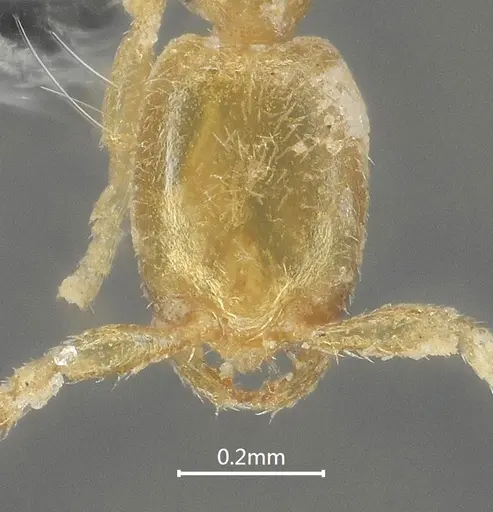
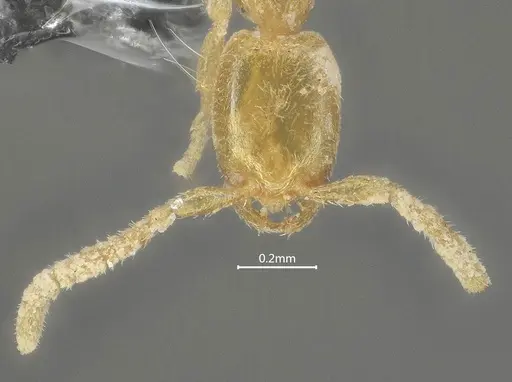
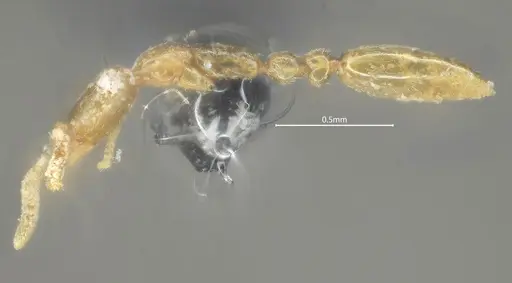
These are among the smallest ants you will encounter. Workers range from 1.4 to 1.8 millimeters in total length, with the holotype measuring exactly 1.6 millimeters [1]. Their bodies are smooth, shiny, and pale yellow, with antennae and legs appearing light yellow [1]. They have 12-segmented antennae and distinctive mandibles with three teeth arranged in three sections [1][3]. The waist segments show specific shapes: the petiole (first waist segment) is elongated, about 1.3 times as long as it is wide, and roughly rectangular when viewed from above [1]. You can tell them apart from the similar Leptanilla oceanica by looking at the face plate (clypeus): L. beijingensis has a broad protrusion with a narrow, deep notch in the center, while L. oceanica has a narrower protrusion with a wide, shallow notch [1].
Colony Biology and Reproduction
We know almost nothing about how these ants live in colonies. Every single specimen collected has been a worker. No queens, no males, and no brood have ever been found [1]. Scientists do not know if colonies have one queen or many, how new colonies start, or even what the queens look like [1]. This is typical for the genus Leptanilla, which are cryptic subterranean ants that rarely surface. Until researchers discover queens or observe founding behavior, the entire reproductive biology of this species remains a mystery [1].
Captive Keeping Reality
You cannot keep Leptanilla beijingensis in captivity with current knowledge. No queens are available in the ant trade or even in scientific collections, meaning you cannot start a colony [1]. Even if you obtained workers, you would not know how to feed them, what temperature triggers brood development, or how to replicate their deep soil habitat [1]. Their extremely small size means they would escape through the tiniest gaps in any standard formicarium. This species belongs to the realm of scientific research, not ant keeping [1].
Frequently Asked Questions
Can I keep Leptanilla beijingensis in captivity?
No. Only workers have been found, and no one knows what the queens look like or how to found colonies. There are no queens available, and their biology is too poorly understood for captive care [1].
How big are Leptanilla beijingensis workers?
Very small, workers measure just 1.4 to 1.8 millimeters in length, smaller than a grain of rice [1].
Where do Leptanilla beijingensis live?
They live deep in the soil of Beijing, China, specifically 30 to 55 centimeters underground in deciduous forests and urban parks [1][2].
Do Leptanilla beijingensis need hibernation?
Likely yes, since they live in a temperate climate region, but this has not been confirmed by research [1].
What do Leptanilla beijingensis eat?
Unknown. Their diet has not been studied, and scientists have not observed their feeding behavior [1].
How long until Leptanilla beijingensis get their first workers?
Unknown. No queens or brood have ever been observed, so there is no timeline for development [1].
Can I buy Leptanilla beijingensis?
No. They are only known from scientific collections in Beijing and are not available in the ant trade [1].
Do Leptanilla beijingensis ants sting?
Unknown, but unlikely to be noticeable due to their extremely small size (under 2mm) [1].
What is the colony size of Leptanilla beijingensis?
Unknown. Scientists have only collected individual workers, not entire colonies, so colony size remains a mystery [1].
How do Leptanilla beijingensis colonies start?
Unknown. The founding behavior has never been documented, and no queens have been collected [1].
Report an Issue
The current care sheet is based fully on literature. See inconsistencies, or something that's incorrect? Please , it will be resolved after review from an admin. Contributing to the blogs tab also helps providing information, to make us be able to further improve the caresheets. Thank you for your support!
References

Эта инструкция по уходу лицензирована по CC BY-SA 4.0 .
Блоги сообщества
ANTWEB1060528
Посмотреть на AntWeb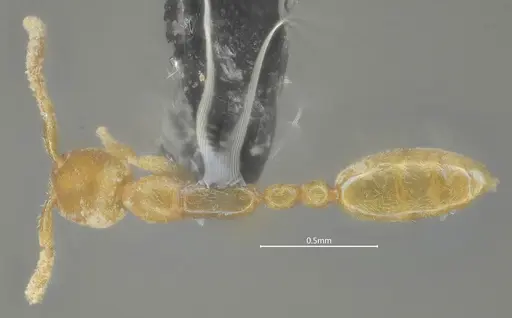
Литература
Загрузка карты распределения...Загрузка товаров...