
Hypoponera pulchra
- Науч. назв.
- Hypoponera pulchra
- Триба
- Ponerini
- Подсемейство
- Ponerinae
- Автор
- Bolton & Fisher, 2011
- Распространение
- Встречается в 0 странах
Введение
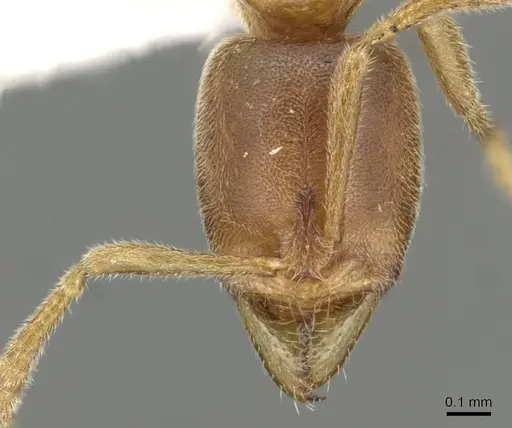
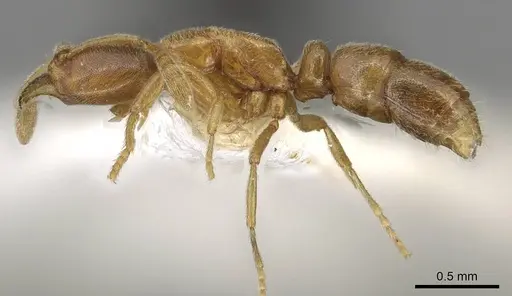
Hypoponera pulchra is an extremely small ponerine ant known from only a single worker specimen collected on Bioko Island in Equatorial Guinea. Workers are blind with no eyes, indicating a fully subterranean lifestyle living underground in darkness. The species was described in 2011 from a museum specimen that had been misidentified for decades. It belongs to the Hypoponera abeillei group, characterized by tiny size and reduced or absent eyes. The petiole node has almost parallel anterior and posterior faces, a distinguishing feature that separates it from similar species like H. coeca and H. fatiga. This is one of the rarest and least-studied ants in the world - no queens, males, or colonies have ever been documented.
Quick Summary
- Difficulty: Unknown
- Origin & Habitat: Bioko Island, Equatorial Guinea in the Afrotropical region. The island has a tropical rainforest climate with high humidity year-round [1].
- Colony Type: Unknown, only a single worker has ever been collected. Queens and males have never been documented [1].
- Size & Growth:
- Queen: Unknown, queens have never been collected
- Worker: Approximately 2-3mm, inferred from Hypoponera genus patterns
- Colony: Unknown, colony structure and size have not been documented
- Growth: Unknown
- Development: Unknown, no development data exists for this species (No brood has ever been documented in scientific collections)
- Antkeeping:
- Temperature: Unknown, no captive observations exist. Based on Bioko Island's tropical climate, room temperature (22-28°C) would be a reasonable starting point.
- Humidity: Unknown, Bioko Island is humid tropical rainforest, so high humidity is likely needed. Keep substrate consistently moist.
- Diapause: Unknown, no seasonal data exists for this species
- Nesting: No captive nesting data exists. In the genus Hypoponera, most species are subterranean and nest in soil or rotting wood. A naturalistic setup with moist substrate or a Y-tong nest would be speculative but potentially appropriate.
- Behavior: Unknown, the only known specimen was collected in 1940 and no behavioral observations have been documented. As a blind, subterranean ant, it likely forages underground and may be a predator of small soil arthropods, though this is speculative based on genus patterns. As a ponerine ant, it likely has a functional stinger, but given its tiny size, any sting would be negligible to humans.
- Common Issues: This species is virtually unknown in captivity, no established care protocols exist., Only one specimen has ever been collected, making even genus-level inferences uncertain., Queens and males have never been found, so captive breeding from wild colonies is not possible., The extremely small size creates significant escape prevention challenges., No legal framework exists for this species as it has never been commercially available.
Species Discovery and Rarity
Hypoponera pulchra was described in 2011 by Barry Bolton and Brian Fisher as part of a comprehensive taxonomic revision of Afrotropical Hypoponera species. The holotype worker was originally collected on January 16,1940,on Bioko Island (formerly called Fernando Poo) in Equatorial Guinea. The specimen had been misidentified as Hypoponera coeca and sat in museum collections for decades before being recognized as a new species. What makes this species extraordinary is that despite extensive ant collecting efforts across Equatorial Guinea and the surrounding region, no additional specimens have ever been found. This single worker represents everything we know about the species, there are no documented queens, males, or colonies. For antkeepers, this means there is no established care information and the species has never been available in the antkeeping hobby. [1]
Identification and Distinguishing Features
Hypoponera pulchra is among the smallest ants in the genus. It can be distinguished from similar species by several key features: its head is notably larger than the closely related H. coeca, the petiole node has almost parallel anterior and posterior faces rather than converging faces, and it has a pale yellow coloration. Like other members of the H. abeillei group, it lacks eyes entirely, a common adaptation in subterranean ants that live their entire lives underground in darkness. The metanotal groove is completely absent from the dorsum of the mesosoma, another distinguishing trait. These identification features are important because they help separate H. pulchra from more common Hypoponera species that might be encountered. [1]
Natural History and Speculation
Because only a single worker is known, all natural history information for Hypoponera pulchra must be considered speculative. The species was collected on Bioko Island, a volcanic island in the Gulf of Guinea with tropical rainforest vegetation. The complete absence of eyes indicates a fully subterranean lifestyle, these ants almost certainly live and forage underground in darkness, similar to other blind Hypoponera species. The genus Hypoponera contains predatory ants that hunt small soil arthropods, so H. pulchra likely fills a similar ecological niche. The single specimen was collected in January, which is a dry season month on Bioko Island, but this single data point tells us nothing about seasonal activity patterns or reproduction. Until additional specimens are found, much about this species will remain mysterious. [1]
Keeping This Species - Current State of Knowledge
It must be emphasized that Hypoponera pulchra has never been kept in captivity and no care protocols exist for this species. The species has never been commercially available in the antkeeping hobby, and with only a single known specimen in museum collections, there are no wild colonies to source. Any advice given here would be based entirely on genus-level patterns rather than species-specific data. If specimens ever become available, keeping them would require careful attention to escape prevention due to their extremely small size, maintenance of high humidity to mimic their tropical rainforest origin, and likely provision of small live prey items. However, until actual specimens are collected and studied, all captive care recommendations remain pure speculation. This species represents a frontier for antkeeping, there is simply nothing known about how to keep it alive.
Frequently Asked Questions
Can I keep Hypoponera pulchra in my ant farm?
No, this species has never been documented in the antkeeping hobby. Only a single worker has ever been collected (in 1940), and no one has successfully kept or bred this species in captivity. There are no established care protocols.
What do Hypoponera pulchra ants eat?
Unknown, no feeding observations exist for this species. Based on genus patterns, they likely prey on small soil arthropods like springtails or mites, but this is speculative.
How big do Hypoponera pulchra colonies get?
Unknown, colony size has never been documented. Only a single worker has ever been collected, and queens have never been found.
Where does Hypoponera pulchra live?
This species is known only from Bioko Island in Equatorial Guinea. The single known specimen was collected in 1940,and no additional specimens have been found despite extensive collecting efforts.
Are Hypoponera pulchra good for beginners?
This species is not available in the antkeeping hobby and cannot be recommended for any keeper. It is known only from a single museum specimen collected over 80 years ago.
What temperature do Hypoponera pulchra need?
Unknown, no captive observations exist. Bioko Island has a tropical climate with temperatures around 24-28°C year-round, so room temperature in this range would be a reasonable guess if specimens ever become available.
How long does it take for Hypoponera pulchra to develop from egg to worker?
Unknown, no brood has ever been documented for this species. Development timelines are completely unstudied.
Can I buy Hypoponera pulchra ants?
No, this species is not available in the antkeeping hobby. It is known from only a single specimen in a museum collection and has never been collected in sufficient numbers for commercial availability.
Do Hypoponera pulchra queens have wings?
Unknown, queens have never been collected or documented for this species. The species was described from a single worker, and no reproductive forms are known.
Report an Issue
The current care sheet is based fully on literature. See inconsistencies, or something that's incorrect? Please , it will be resolved after review from an admin. Contributing to the blogs tab also helps providing information, to make us be able to further improve the caresheets. Thank you for your support!
References

Эта инструкция по уходу лицензирована по CC BY-SA 4.0 .
Блоги сообщества
CASENT0915205
Посмотреть на AntWeb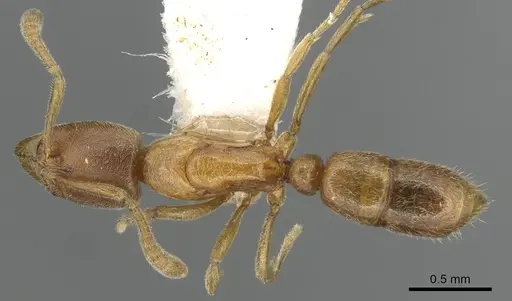
Литература
Загрузка карты распределения...Загрузка товаров...