
Colobopsis macarangae
- Науч. назв.
- Colobopsis macarangae
- Триба
- Camponotini
- Подсемейство
- Formicinae
- Автор
- Dumpert, 1996
- Распространение
- Встречается в 0 странах
Введение
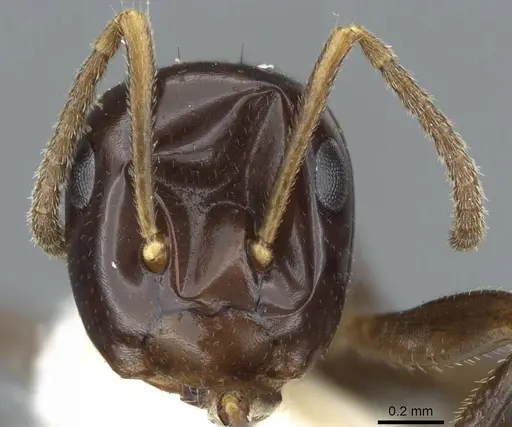
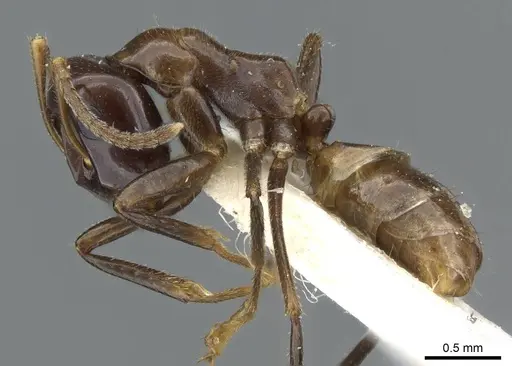
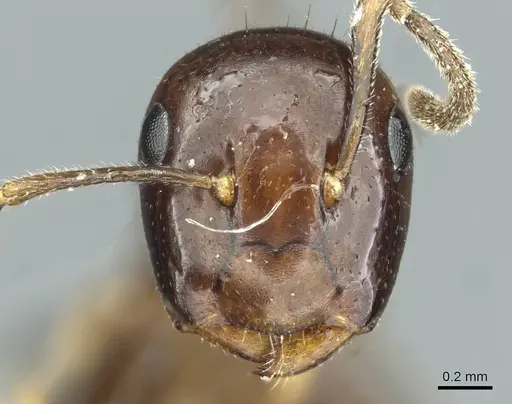
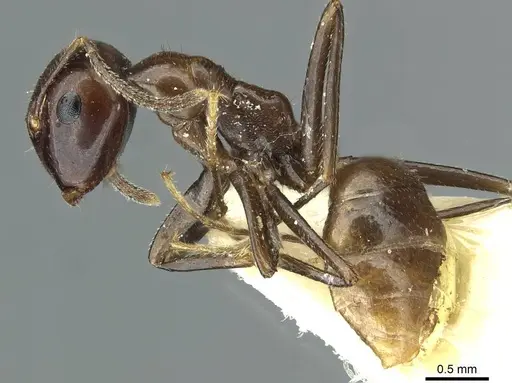
Colobopsis macarangae is a small, specialized myrmecophytic ant native to the rainforests of Borneo. Workers measure approximately 3.7-4.0mm and are dark brown to black with a shiny body surface. Unlike many ants, this species has no soldier caste - all workers are roughly the same size (monomorphic). Queens are larger at around 5.8mm and have distinctive yellow-brown coloring on their thorax and legs. This ant has an exclusive relationship with the Macaranga lamellata tree, one of the few plant species it can live in. The ants nest inside the tree's hollow stems (domatia) and protect their host from herbivores . What makes this species remarkable is its exclusive partnership with a single plant species. The ants cannot survive without their host tree, and the tree depends heavily on ant protection. When threatened, workers bite intruders and release a strong, pleasant citral-like smell from their mandibular glands as a defense mechanism . Colonies are always single-queen (monogyne), and queens found new colonies by biting into young tree stems, sealing themselves inside, and raising their first workers alone before the entrance reopens .
Quick Summary
- Difficulty: Expert
- Origin & Habitat: Borneo (Sarawak, Malaysia) and Indonesia, found exclusively in undisturbed rainforests where Macaranga lamellata trees grow [2][1]. This is a strict myrmecophyte that only nests in the hollow stems of Macaranga lamellata [1].
- Colony Type: Monogyne, colonies always contain a single queen [2].
- Size & Growth:
- Queen: ~5.8mm [3]
- Worker: ~3.7-4.0mm [3]
- Colony: Colonies remain relatively small, alates (winged reproductives) develop in colonies with fewer than 100 workers [2].
- Growth: Moderate, claustral founding takes several months, but colonies can produce alates while still small [2]
- Development: Exact development time unconfirmed. Based on related Camponotus patterns, expect several months. (Queens seal themselves in a chamber and raise first workers alone using body reserves. First workers (nanitics) are smaller than workers from mature colonies, which is typical for claustral founding ants [2].)
- Antkeeping:
- Temperature: Tropical species, keep warm and stable, roughly 24-28°C. Being a Borneo rainforest ant, it needs consistent warmth [1].
- Humidity: High humidity required, these ants live inside living tree stems in a humid rainforest environment. Keep substrate consistently moist but not waterlogged [1][2].
- Diapause: No, as a tropical species from Borneo, it does not require hibernation. Keep temperatures stable year-round [1].
- Nesting: This is the critical challenge, C. macarangae ONLY nests in live Macaranga stems or very similar hollow plant material. Standard test tubes and formicaria are NOT suitable. Requires a naturalistic setup with living or preserved Macaranga stems, or experimental setups with artificial stem equivalents. The ants create multiple chambers by building partial walls from carton material inside the stem [2].
- Behavior: Workers are defensive and will bite when threatened. They also release a citral-like terpene scent from their mandibular glands, this is a distinctive, pleasant smell that can help identify this species in the field [1]. Workers are mostly found on the youngest leaves of the host plant, where they tend scale insects and collect food bodies. They are not aggressive toward humans but will defend their nest vigorously. Escape risk is moderate, workers are 3-4mm so standard barrier methods work, but their association with plant material means they may not thrive in typical captive setups [1][2].
- Common Issues: host plant availability is the primary challenge, this species cannot be kept in standard nests and requires Macaranga stems or equivalent., very high failure rate for colony founding in the wild (40 out of 49 colonies failed) due to intraspecific competition between founding queens [2]., cannot be kept in test tubes or standard formicaria, requires specialized naturalistic setup., scale insect dependency, larger colonies tend Coccus scale insects for honeydew, which must be provided or substituted., deforestation threatens wild populations, only found in undisturbed forests [4].
The Myrmecophytic Relationship
Colobopsis macarangae represents one of the most specialized ant-plant relationships in the world. This species is an obligate myrmecophyte, it can ONLY live in Macaranga lamellata trees. The tree provides hollow stems (domatia) where ants nest, along with food bodies (small nutritious structures) that workers collect. In return, the ants protect the tree from herbivores and other threats [2][1].
This exclusive relationship is so specific that approximately 80% of M. lamellata trees in study areas are occupied by this species, and when present, they provide significant protection. Research shows that trees with Colobopsis have significantly less leaf damage from herbivores compared to trees without ant protection [1]. The ants actively patrol young leaves and attack any intruders they encounter.
For antkeepers, this specialization is both fascinating and challenging. Unlike most ants that can adapt to various nesting situations, C. macarangae has very specific requirements that make captive keeping extremely difficult without a host plant or equivalent setup [1][2].
Colony Founding Behavior
The colony founding process of C. macarangae is fascinating but challenging to replicate in captivity. A newly mated queen must find a young Macaranga lamellata sapling. She bites into a young internode (stem section), enters, and then seals the entrance hole with pith remains before laying eggs, this is classic claustral founding [2].
The queen raises her first workers alone, feeding them from her body reserves. These first workers (nanitics) are smaller than workers from mature colonies, which is typical for claustrally founding ants. After workers emerge, they must reopen the entrance hole, which has been sealed by plant growth [2].
In the wild, colony founding has a very high failure rate, researchers found that 40 out of 49 founding attempts failed. Dead queens were found in young saplings, likely killed by competing queens from other founding colonies. This intense intraspecific competition means only one queen typically succeeds per tree [2].
Defense Mechanisms
When threatened, Colobopsis macarangae workers have two powerful defense mechanisms. First, they bite intruders with their mandibles. Second, and more distinctive, they release a strong, pleasant-smelling citral-like terpene from their mandibular glands. This scent is so characteristic that researchers can identify which ant species is living in a tree simply by smelling it [1].
The ants also protect their host plant by chewing on young leaves, this might seem counterintuitive, but research shows that trees with more leaf chewing actually have better herbivore protection overall. The workers actively patrol leaves and attack herbivores like caterpillars and phasmids. Trees with Colobopsis colonies show significantly less severe leaf damage than unprotected trees [1].
Feeding and Tending
In the wild, C. macarangae workers collect food bodies directly from the Macaranga tree, these are specialized nutritious structures the plant produces for its ant partners. Workers also tend scale insects (Coccus macarangae) that live in the tree domatia. About 46% of larger colonies contain these scale insects, which provide honeydew as a sugar source [2].
For captive keeping, you would need to replicate this diet. Offer sugar water or honey as a substitute for honeydew. Protein can be provided through small insects. The scale insect relationship is optional, while present in many wild colonies, it is not strictly required. Food bodies would need to be substituted with appropriate alternatives [2][1].
Why This Species Is Not Recommended for Most Antkeepers
Colobopsis macarangae is one of the most difficult ants to keep in captivity precisely because of its extreme specialization. Unlike most ant species that can adapt to various nesting materials, this species absolutely requires living plant stems or a very close equivalent. Standard test tubes, acrylic nests, and Y-tong setups are not suitable [2].
The fundamental challenge is that these ants have evolved to live inside living plant stems where they build chambers separated by partial walls of carton material. They close old entrance holes and only maintain 2-3 openings in the youngest stem sections. Replicating this requires either access to Macaranga trees (which are not commercially available for antkeeping) or experimental artificial setups [2].
Additionally, this species is only found in primary (undisturbed) rainforests in Borneo, and deforestation has reduced its natural habitat. It is not a species that can be ethically or practically collected for the antkeeping hobby [4]. For these reasons, most antkeepers should consider alternative species that can thrive in standard setups.
Frequently Asked Questions
Can I keep Colobopsis macarangae in a test tube?
No. This species cannot be kept in standard test tubes or formicaria. It is an obligate myrmecophyte that only nests inside the hollow stems of Macaranga lamellata trees. You would need a naturalistic setup with living plant stems or artificial equivalents, which are extremely difficult to provide [2].
What do Colobopsis macarangae ants eat?
In the wild, they eat food bodies produced by their host Macaranga tree and honeydew from scale insects they tend. In captivity, you would need to provide sugar water or honey as a substitute for honeydew, plus small insects for protein. The specialized plant food bodies cannot be easily replicated [2][1].
How long does it take for first workers to appear?
Exact development time unconfirmed. The queen seals herself in and raises the first brood alone using her body reserves. First workers (nanitics) are smaller than normal workers [2].
Is Colobopsis macarangae good for beginners?
No. This is an expert-level species that requires specialized naturalistic setups with host plant material. Most antkeepers cannot provide the required conditions. Consider more adaptable species like Lasius, Camponotus, or Tetramorium for starting out [2].
Where does Colobopsis macarangae live in the wild?
Only in Borneo (Sarawak, Malaysia) and Indonesia, exclusively inside Macaranga lamellata trees in undisturbed rainforests. This is one of the most habitat-specific ant species known, approximately 80% of M. lamellata trees in suitable habitat are colonized by this species [1][2].
How big do Colobopsis macarangae colonies get?
Colonies remain relatively small compared to many common ants. Alates (winged reproductives) develop in colonies with fewer than 100 workers. Maximum colony size is likely a few hundred workers, not the thousands seen in species like Formica or Camponotus [2].
Do they need hibernation?
No. As a tropical species from Borneo, they do not require hibernation. Keep temperatures stable year-round in the 24-28°C range. They are adapted to constant warm conditions in the rainforest understory [1].
Can I collect Colobopsis macarangae from the wild?
Not recommended. This species is only found in primary rainforests in Borneo and is threatened by deforestation. Additionally, because they only live inside specific plant stems, collecting them would destroy their host tree. Ethical antkeeping focuses on captive-bred colonies or species that can be sustainably observed [4].
Why do they smell like citrus?
When threatened, workers release a citral-like terpene from their mandibular glands. Citral is a compound found in citrus peels, which explains the pleasant citrus smell. This is a defense mechanism used to deter predators and alert nestmates to danger [1].
Report an Issue
The current care sheet is based fully on literature. See inconsistencies, or something that's incorrect? Please , it will be resolved after review from an admin. Contributing to the blogs tab also helps providing information, to make us be able to further improve the caresheets. Thank you for your support!
References

Эта инструкция по уходу лицензирована по CC BY-SA 4.0 .
Блоги сообщества
CASENT0905899
Посмотреть на AntWeb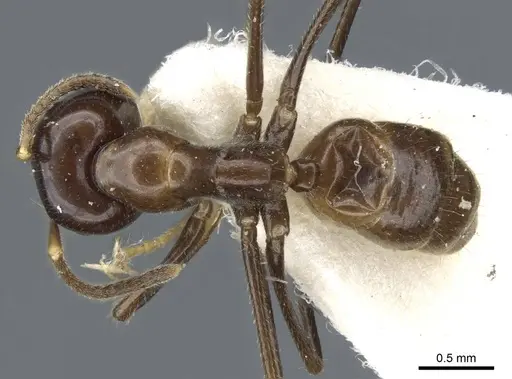
CASENT0911637
Посмотреть на AntWeb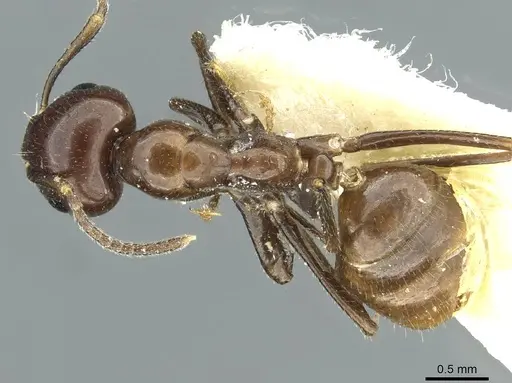
Литература
Загрузка карты распределения...Загрузка товаров...