
Carebara oertzeni
- Науч. назв.
- Carebara oertzeni
- Триба
- Crematogastrini
- Подсемейство
- Myrmicinae
- Автор
- Forel, 1886
- Распространение
- Встречается в 0 странах
Введение
Carebara oertzeni is an exceptionally rare ant and the sole representative of the genus Carebara in Europe. Workers are tiny, measuring approximately 0.4-0.7mm, with a distinctive yellow body color and 9-segmented antennae. The species has very small eyes containing only a single ommatidium, and workers possess propodeal spines. This hypogaeic (subterranean) species nests in soil, leaf litter, and rotting wood across its limited range in Albania, Greece, and Turkey. The species was described from the Peloponnese region of Greece in 1886 and remains one of the least encountered ants in Europe, with nests never successfully located despite multiple field attempts. Queens and males have been observed copulating on the outer wall of an adobe house in Turkey, suggesting nesting in human-made structures in addition to natural habitats .
Quick Summary
- Difficulty: Expert
- Origin & Habitat: Eastern Mediterranean, Albania, Greece, and Turkey. Found in rocky forest-steppe habitats, mountain pastures with scattered oaks, and decaying trees. Collected from rotten wood, leaf litter, and soil at altitudes from 336m to 1070m [2][1][3].
- Colony Type: Colony structure is unconfirmed. The species is extremely rare with no documented nests ever found [1][2].
- Size & Growth:
- Queen: ~0.8mm, inferred from genus patterns (Carebara are among the smallest ants, queens typically 0.8-1.5mm)
- Worker: ~0.4-0.7mm, inferred from genus patterns (Carebara are minute ants, workers typically 0.4-1.0mm)
- Colony: Unknown, no mature colonies have been documented [1]
- Growth: Unknown, no captive observations available
- Development: Unknown, no development data exists for this species (No captive breeding records exist. Development timeline is completely unstudied.)
- Antkeeping:
- Temperature: Based on its eastern Mediterranean distribution, this species likely tolerates temperatures from 18-28°C. Start around 24-26°C and observe colony behavior [3].
- Humidity: Requires high humidity consistent with its leaf litter and soil-dwelling habits. Keep nest substrate consistently moist but not waterlogged. Provide a gradient with slightly drier areas for workers to regulate moisture themselves.
- Diapause: Unknown, no overwintering data exists. Given its Mediterranean distribution, the species likely experiences reduced activity in winter but may not require true hibernation. Consider a cool period around 10-15°C for 2-3 months.
- Nesting: This cryptic, subterranean species nests in soil, leaf litter, and rotting wood. In captivity, a naturalistic setup with moist soil, leaf litter, and small passages works best. Test tubes with cotton may be too exposed, consider a Y-tong or plaster nest with tight chambers scaled to their tiny size. The species was found in decaying trees and house walls, suggesting they prefer enclosed, humid spaces [1][3].
- Behavior: Virtually nothing is known about their behavior in captivity. In the wild, they are hypogaeic (subterranean) and cryptic, with workers rarely seen on the surface. The species has never been observed foraging openly. Based on related Carebara species, they likely forage underground and accept small prey items. Their tiny size and cryptic habits make them extremely difficult to keep, they are not recommended for beginners. Escape prevention is critical due to their minute size, they can squeeze through the smallest gaps.
- Common Issues: no captive husbandry information exists, this is one of the least-studied ants in Europe, nests have never been found in the wild, making natural history poorly understood, tiny size means escapes are likely without fine mesh barriers, colony may fail due to unknown humidity or dietary requirements, slow or absent colony growth with no available guidance, risk of colony collapse from standard antkeeping mistakes due to lack of species-specific knowledge
Why Carebara oertzeni Is an Expert-Only Species
This species presents extraordinary challenges even for experienced antkeepers. Carebara oertzeni is the only Carebara species native to Europe, and it is also one of the rarest. Despite being described in 1886, no one has ever documented a complete nest in the wild. Researchers have only ever collected isolated workers through soil sampling and heat extraction from leaf litter. A mated queen and male were observed on a house wall in Turkey in 2007, but the actual nest was never located despite repeated visits [1]. This means there is zero captive husbandry information available, no one has successfully kept this species in captivity. Every aspect of their care must be inferred from related species and guesswork. For these reasons, Carebara oertzeni should only be attempted by experts who have extensive experience with difficult, cryptic species and who can provide the patient, specialized care this mystery ant likely requires.
Natural History and Distribution
Carebara oertzeni occupies a narrow range in the eastern Mediterranean, found only in Albania, Greece, and Turkey [2]. In Greece, it has been recorded from the Peloponnese (where it was originally described from Elis province) and Sterea Ellas, including Euboea island [4][5]. The Albanian record from 2016 represents the northernmost known distribution of the species [2]. The ant inhabits diverse settings: rocky slopes covered with forest-steppe in Albania, mountain pastures with scattered oaks at 1070m elevation in Greece, and the outer walls of adobe houses in Turkey [1][3]. In Albania, it was collected alongside Proceratium melinum from the same sample of rotten wood, leaf litter and soil [6]. All specimens have been collected through soil extraction methods, not by observing natural nests. This hypogaeic (subterranean) lifestyle explains why the species has remained so elusive, workers rarely if ever appear on the surface [1][2].
Morphology and Identification
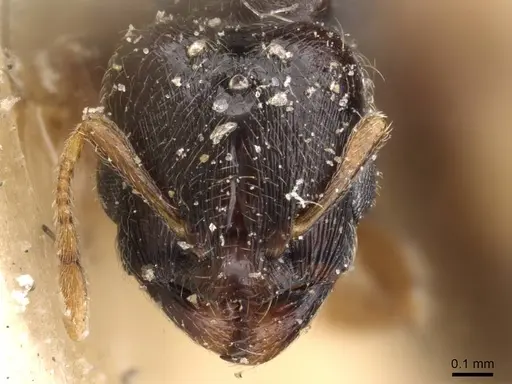
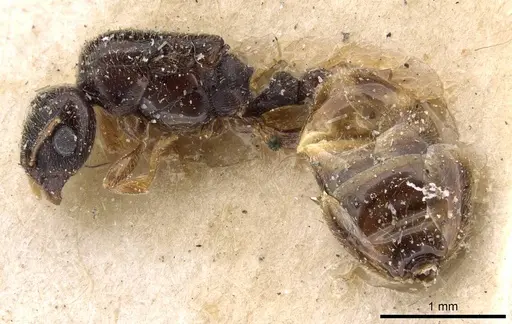
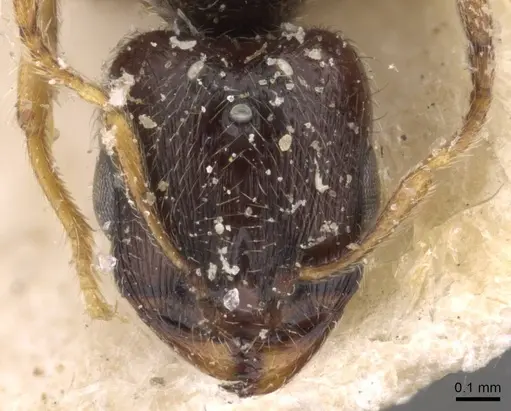
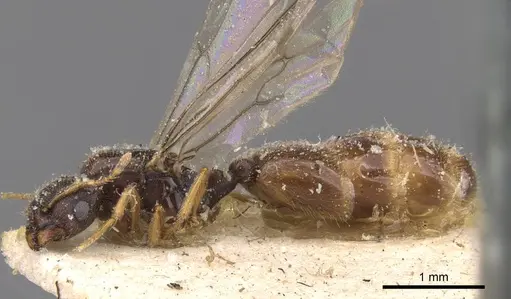
Workers are among the smallest ants in Europe, measuring approximately 0.4-0.7mm [1][3]. The species exhibits polymorphism with distinct minor and major castes. Key identifying features include 9-segmented antennae (unusual in European Myrmicinae), very small eyes containing only a single ommatidium, and propodeal spines. Workers are yellow throughout, while queens are darker with a reddish-brown mesosoma and yellowish-brown gaster [1]. The head is longer than wide with convex sides, and the anterior clypeal margin is distinctly broad and medially concave. These morphological features place it in the concinna species group [1]. The tiny size and yellow coloration make them distinctive among European ants, though they would be easily overlooked due to their subterranean habits.
Housing and Nesting Recommendations
Given this species' natural habitat in soil, leaf litter, and rotting wood, a naturalistic setup is most appropriate. Use a container with moist soil substrate mixed with leaf litter and small pieces of decaying wood. The setup should have tight chambers and passages scaled to their minute size, standard ant nest passages would be cavernous for these tiny ants. Maintain high humidity by keeping the substrate consistently moist but not waterlogged. A layer of leaf litter on the surface provides cover and helps maintain micro-humidity. Because they are hypogaeic, they will likely avoid light and remain hidden in the substrate. Provide minimal disturbance and red/UV filter lighting if you want to observe any activity. Escape prevention is absolutely critical, these ants are so small they can squeeze through gaps invisible to the naked eye. Use fine mesh and seal all potential entry points [1][3].
Feeding and Diet
The diet of Carebara oertzeni is completely unstudied in captivity. In the wild, related Carebara species are generalist omnivores that feed on small invertebrates, honeydew, and organic debris. Based on their tiny size and subterranean habits, they likely hunt micro-arthropods in soil and leaf litter. Offer tiny prey items such as springtails, small fruit flies, and minute booklice. Sugar sources may be accepted, though this is uncertain. Given the complete lack of captive feeding data, experimental feeding with various tiny prey items is necessary. Start with live springtails as a primary protein source and observe acceptance. Remove uneaten prey promptly to prevent mold. Do not expect active foraging on the surface, they will likely retrieve food from within their substrate [1].
Temperature and Seasonal Care
This eastern Mediterranean species likely tolerates a range from cool to warm. Based on its distribution and related species, aim for temperatures in the low-to-mid 20s°C (around 22-26°C). The Albanian and Turkish populations experience hot summers and mild winters, while Greek populations at higher elevations encounter cooler conditions. A heating cable on one side of the nest can create a temperature gradient, allowing workers to self-regulate. Regarding winter dormancy, no data exists. Mediterranean ants often reduce activity but may not require true hibernation. A safe approach is to provide a cool period around 10-15°C for 2-3 months during winter, reducing feeding accordingly. Monitor colony activity, if they remain active, maintain normal temperatures. The complete lack of captive data means you must observe and adapt to your colony's behavior [3].
Frequently Asked Questions
Is Carebara oertzeni suitable for beginners?
No. This species is absolutely not suitable for beginners. It is one of the rarest and least-studied ants in Europe, with zero captive husbandry information available. No one has ever successfully kept this species in captivity, and nests have never been documented in the wild. Every aspect of care must be guessed from related species. Only expert antkeepers with extensive experience with cryptic, subterranean species should attempt this ant.
How big do Carebara oertzeni colonies get?
We do not know. No mature colony has ever been documented. Based on related Carebara species, colonies likely reach a few hundred workers at most, but this is purely speculative. The few workers ever collected have been from soil samples, suggesting colonies remain small and cryptic.
What do Carebara oertzeni ants eat?
Unknown in captivity. Based on related species, they likely accept tiny live prey such as springtails, micro-arthropods, and small fruit flies. Sugar sources may be accepted experimentally. Start with live springtails and observe acceptance. Remove uneaten prey to prevent mold.
Do Carebara oertzeni ants sting?
Given their minute size (under 1mm), any sting would be negligible even if present. The genus Carebara is not known for painful stings, and these tiny ants are unlikely to penetrate human skin. However, their cryptic habits mean they are rarely encountered and handling is not recommended.
What temperature do Carebara oertzeni ants need?
No captive data exists. Based on their eastern Mediterranean distribution and related species, aim for 22-26°C. Provide a temperature gradient so workers can self-regulate. Adjust based on colony activity, if they seem sluggish, warm slightly, if they avoid heated areas, cool down.
How long does it take for Carebara oertzeni to develop from egg to worker?
Unknown. No development data exists for this species. There is no information to make any estimate, expect significant trial and error to determine optimal conditions.
Can I keep multiple Carebara oertzeni queens together?
Unknown. Colony structure has not been documented. Do not attempt combining unrelated queens, there is no data on founding behavior or colony structure for this species.
Do Carebara oertzeni need hibernation?
Unknown. No overwintering data exists. Given their Mediterranean distribution, they likely experience reduced winter activity but may not require true hibernation. A cool period around 10-15°C for 2-3 months is a reasonable approach, but observe your colony's response.
Where does Carebara oertzeni live in the wild?
This species is found only in Albania, Greece, and Turkey, making it Europe's only Carebara species. It inhabits rocky forest-steppe slopes, mountain pastures with scattered oaks, and has been found nesting in the walls of adobe houses. All specimens have been collected from soil, leaf litter, and rotting wood using specialized extraction methods.
Why is Carebara oertzeni so rarely seen?
This is a hypogaeic (subterranean) species that nests underground in soil and leaf litter. Workers rarely if ever appear on the surface, making them extremely difficult to find. Despite being described in 1886, no complete nest has ever been located in the wild. Researchers only collect isolated workers through soil sampling and heat extraction.
Report an Issue
The current care sheet is based fully on literature. See inconsistencies, or something that's incorrect? Please , it will be resolved after review from an admin. Contributing to the blogs tab also helps providing information, to make us be able to further improve the caresheets. Thank you for your support!
References

Эта инструкция по уходу лицензирована по CC BY-SA 4.0 .
Блоги сообщества
CASENT0908910
Посмотреть на AntWeb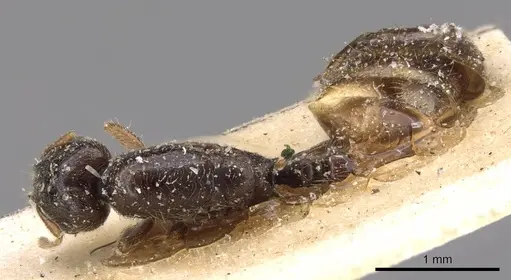
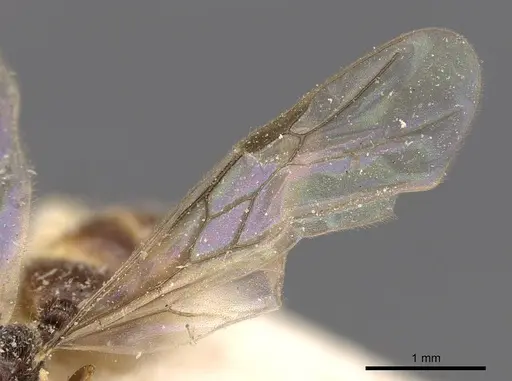
CASENT0908911
Посмотреть на AntWeb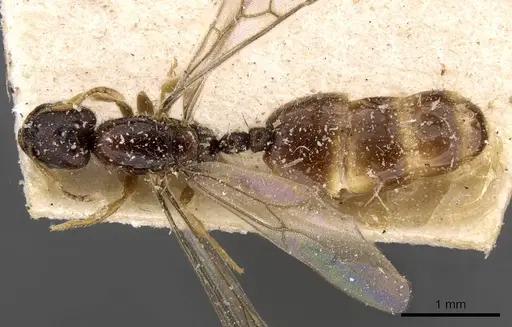
Литература
Загрузка карты распределения...Загрузка товаров...