
Axinidris nigripes
- Науч. назв.
- Axinidris nigripes
- Триба
- Tapinomini
- Подсемейство
- Dolichoderinae
- Автор
- Shattuck, 1991
- Распространение
- Встречается в 0 странах
Введение
Axinidris nigripes is one of the rarest ants in the world - known from a single worker collected in Aburi, Ghana in 1969 . No queen, male, or additional workers have ever been found despite decades of collecting in the region . The genus Axinidris contains arboreal Afrotropical ants that live in trees or rotting wood , though the specific microhabitat of A. nigripes remains unconfirmed. This species is essentially a scientific ghost. For antkeepers, it exists only as a museum specimen - it is not available in the ant trade, and no biological data exists to guide captive care .
Quick Summary
- Difficulty: Expert
- Origin & Habitat: Ghana, West Africa. Arboreal genus [2].
- Colony Type: Unknown, only the worker caste has been described [1].
- Size & Growth:
- Queen: Unknown, queens have never been collected [1].
- Worker: ~3-4mm, inferred from Axinidris genus (no total length data available)
- Colony: Unknown.
- Growth: Unknown.
- Development: Unknown. (No developmental data exists for this species.)
- Antkeeping:
- Temperature: Likely warm tropical conditions based on Ghana origin, start around 24-26°C.
- Humidity: Unknown, maintain moderate humidity consistent with tropical arboreal habitats.
- Diapause: Unknown, likely not required for tropical species.
- Nesting: Likely arboreal based on genus habits [2], small cavities in wood or vegetation.
- Behavior: Unknown. As a Dolichoderine, they lack a functional sting and instead exude sticky compounds from an anal gland to deter predators.
- Common Issues: impossible to acquire, only one museum specimen exists [1][2]., complete lack of biological data makes captive care entirely speculative., no queens known means colony reproduction is impossible., likely requires arboreal setup which differs from typical antkeeping setups.
The World's Rarest Ant
Axinidris nigripes is known from a single worker collected in Aburi, Ghana on 10 August 1969 [1]. This holotype specimen, collected by P.M. Room, resides in the Natural History Museum in London (BMNH) [1]. No queen, male, or additional workers have ever been found despite the type locality being well-collected by entomologists [1]. The species has never been kept alive in captivity, and no biological studies exist beyond the original species description [2].
Defense Mechanism
As a Dolichoderine ant, Axinidris nigripes lacks a functional sting. Instead, they defend by exuding sticky, foul-smelling compounds from an anal gland. This smear defense is common across the Dolichoderinae subfamily and effectively deters predators without requiring a sting.
Identification and Similar Species
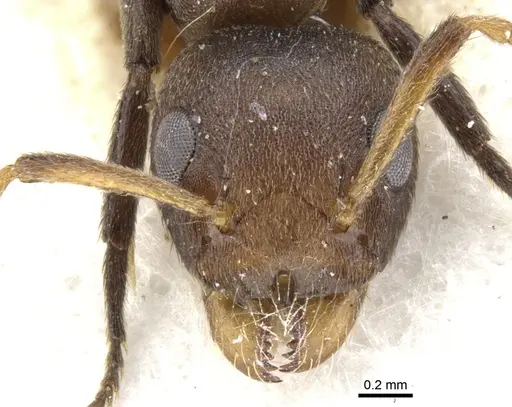
Axinidris nigripes can be identified by its erect hairs on the scape and pronotum, a medial carina on the propodeum, and brown coarse seta-like hairs on the head and mesosoma [2]. The gaster is darker than the head and mesosoma, which distinguishes it from the similar Axinidris palligastrion (where the gaster is lighter) [2]. It differs from Axinidris luhya by having coarser, darker mesosomal hairs (fine and yellowish in A. luhya) [2].
Inferred Care Guidelines
Since no biological studies exist, care is entirely speculative. Axinidris is an arboreal genus, so they likely prefer small cavities in wood or plant stems rather than soil [2]. Coming from Ghana, they probably need warm temperatures around 24-26°C. As Dolichoderines, they might accept sugar water and small insects, but this is unconfirmed. Any attempt to keep them would require extensive experimentation.
Frequently Asked Questions
Can I keep Axinidris nigripes as a pet?
No. This species is not available in the ant trade and is known only from a single museum specimen collected in 1969 [1][2].
How big are Axinidris nigripes workers?
Size data is limited, workers are estimated at roughly 3-4mm based on the Axinidris genus, as no total body length measurement exists for this species.
What do Axinidris nigripes eat?
Unknown. No one has ever observed this species feeding in the wild or in captivity [1].
Do Axinidris nigripes need a queen?
Yes, all ant colonies need a queen to reproduce, but no queen of this species has ever been found [1].
Where do Axinidris nigripes live?
Only known from Ghana, West Africa. The genus is arboreal, suggesting they live in trees or rotting wood [2].
Are Axinidris nigripes dangerous?
No. They are too small to sting humans. As Dolichoderines, they lack a functional sting and use a smear defense instead.
How do I find an Axinidris nigripes colony?
You would need to search in Ghana, specifically in the Aburi area where the type specimen was collected in 1969 [1]. However, no additional specimens have been found despite extensive collecting in the region.
What is the hardest part of keeping Axinidris nigripes?
Acquisition. Only one specimen exists in scientific collections, making it impossible to obtain for keeping [1][2].
Report an Issue
The current care sheet is based fully on literature. See inconsistencies, or something that's incorrect? Please , it will be resolved after review from an admin. Contributing to the blogs tab also helps providing information, to make us be able to further improve the caresheets. Thank you for your support!
References

Эта инструкция по уходу лицензирована по CC BY-SA 4.0 .
Блоги сообщества
CASENT0902933
Посмотреть на AntWeb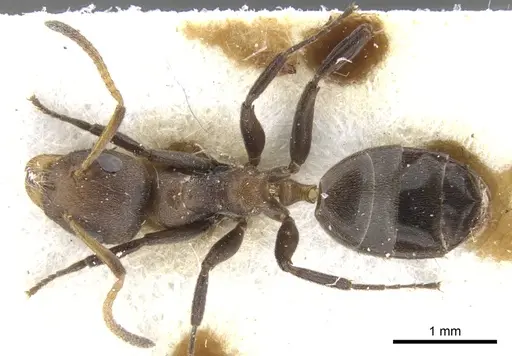

Литература
Загрузка карты распределения...Загрузка товаров...