
Aenictus longinodus
- Науч. назв.
- Aenictus longinodus
- Подсемейство
- Dorylinae
- Автор
- Jaitrong & Yamane, 2012
- Распространение
- Встречается в 0 странах
Введение
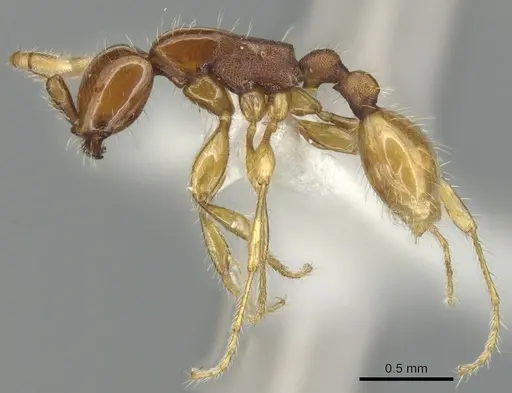
Aenictus longinodus is a tiny army ant from southern Thailand, with workers measuring 1.90 to 2.60 mm in total length . They have reddish-brown bodies, a paler yellowish-brown gaster, and a notably long petiole, which gives them their name . These ants inhabit lowland rainforests in both primary and disturbed forests and are active day and night . As members of the army ant subfamily Dorylinae, they lead a nomadic lifestyle, forming temporary bivouacs instead of permanent nests. Only the worker caste has been described, making traditional queen-based founding impossible .
Quick Summary
- Difficulty: Expert
- Origin & Habitat: Southern Thailand (Malay Peninsula), lowland rainforests in primary and disturbed forests [1][2]
- Colony Type: Unconfirmed, army ant subfamily suggests nomadic colonies with possible fission, but specific structure not documented
- Size & Growth:
- Antkeeping:
- Temperature: Warm and stable, roughly 24-28°C based on lowland tropical habitat [1][2]
- Humidity: Keep nest substrate damp but not waterlogged to match rainforest conditions [1][2]
- Diapause: No, based on tropical lowland habitat, likely no diapause required [1][2]
- Nesting: Nomadic species requiring large foraging areas and temporary bivouac setups, traditional static nests are unsuitable [3]
- Behavior: Highly active predators foraging day and night. Extreme escape risk due to small size (under 3mm) requiring exceptional barriers. Army ant lifestyle demands constant movement and large food intake.
- Common Issues: escape prevention is nearly impossible at 2mm size, workers pass through standard mesh and gaps easily, nomadic army ants die in static enclosures without room to raid and relocate constantly, massive daily food requirements, colonies starve without constant supply of live prey, cannot be founded from single queen, only established colonies can be collected (if legal), tropical humidity requirements cause mold issues in captive setups without perfect ventilation balance
Identification and Appearance
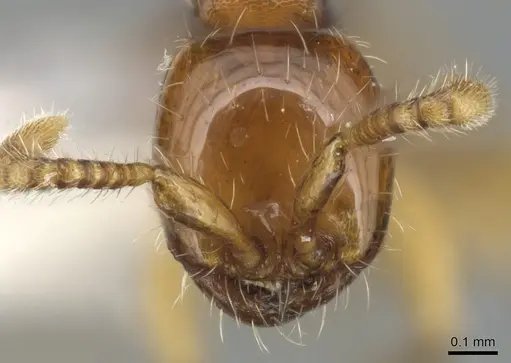
Workers of Aenictus longinodus range from 1.90 to 2.60 mm in total length, with larger workers around 2.45-2.60 mm and smaller workers as little as 1.90 mm [1][2]. Their bodies are reddish-brown with a paler yellowish-brown gaster, and the propodeum is the darkest part [1][2]. The species name refers to the long petiole, which is longer than high with a convex top surface [1][2]. The head is slightly longer than wide with rounded corners, and the mandibles have three sharp teeth including a large apical tooth [1][2].
Natural History and Army Ant Behavior
These ants live in lowland rainforests in southern Thailand, in both primary and disturbed forests, and are active day and night [1][2]. As army ants in the Dorylinae subfamily, they likely lead a nomadic lifestyle, constantly moving their temporary bivouac while raiding for prey [3]. Only workers have been described, suggesting colonies may reproduce by fission rather than through queen founding flights [3].
Housing and Enclosure Design
You cannot keep Aenictus longinodus in standard formicariums or test tubes. Army ants require enormous enclosures with extensive foraging areas to simulate nomadic raiding behavior [3]. Because workers are only 2 mm long, escape prevention is nearly impossible with standard equipment, specialized barriers with mesh under 0.5mm are needed [1][2].
Feeding and Diet
As army ants, they are likely obligate predators requiring large quantities of live prey, such as fruit flies or springtails [3]. They do not accept seeds or sugar water as primary food sources. Colonies will starve quickly if prey runs out.
Temperature and Humidity
Based on their lowland Thai rainforest habitat, maintain warm temperatures around 24-28°C with minimal fluctuation [1][2]. Humidity should be high, keep substrate damp but not waterlogged, with adequate ventilation to prevent mold [1][2].
Colony Acquisition and Legal Considerations
You cannot start this species from a single queen. Only workers are described, and army ants reproduce by colony fission, so you would need to collect an established colony from the wild [3]. This raises legal issues, as these ants are native to Thailand, and transporting them across borders may be restricted [3].
Frequently Asked Questions
Can I keep Aenictus longinodus in a test tube?
No. Army ants require large enclosures with extensive foraging space to maintain their nomadic lifestyle. Test tubes are completely unsuitable and will result in colony death [3].
How do I start an Aenictus longinodus colony?
You cannot found them from a single queen. Only the worker caste has been described, and army ants reproduce by colony fission. You would need to collect an established colony from Thailand, which raises legal concerns and is not recommended [3].
What do Aenictus longinodus eat?
Live insects. As army ants, they are predators requiring constant supplies of small live prey like fruit flies or springtails. They do not accept sugar water or seeds as primary food [3].
Are Aenictus longinodus good for beginners?
No. They are expert-only due to their nomadic lifestyle, massive space requirements, constant need for live prey, extreme escape risk, and inability to be founded from a single queen.
Do Aenictus longinodus need hibernation?
No. They are tropical ants from southern Thailand and remain active year-round, requiring consistent warm temperatures [1][2].
How big do Aenictus longinodus colonies get?
Unknown. Army ant colonies can be large, but specific size data for this species has not been documented.
How long until Aenictus longinodus get their first workers?
This question does not apply to army ants. They do not have a single queen founding stage, new colonies form when existing colonies split, already containing workers.
Can I keep multiple Aenictus longinodus queens together?
Army ants may have multiple queens, but you cannot purchase or artificially combine queens. Colonies grow by splitting, not by adding new queens.
How do I prevent Aenictus longinodus from escaping?
At 2mm, they fit through almost any standard gap. You need mesh finer than 0.5mm and perfect silicone seals. Escape is likely, making them unsuitable for home keeping [1][2].
Report an Issue
The current care sheet is based fully on literature. See inconsistencies, or something that's incorrect? Please , it will be resolved after review from an admin. Contributing to the blogs tab also helps providing information, to make us be able to further improve the caresheets. Thank you for your support!
References

Эта инструкция по уходу лицензирована по CC BY-SA 4.0 .
Блоги сообщества
CASENT0903679
Посмотреть на AntWeb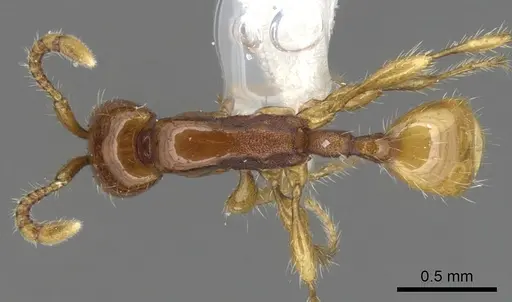
Литература
Загрузка карты распределения...Загрузка товаров...