
Aenictus breviceps
- Науч. назв.
- Aenictus breviceps
- Подсемейство
- Dorylinae
- Автор
- Forel, 1912
- Распространение
- Встречается в 0 странах
Введение
Aenictus breviceps is a small army ant endemic to the Indonesian island of Java . Workers measure approximately 3.8-4.0 mm in total body length and are dark reddish-brown with distinctive smooth and shiny patches on their mesosoma . This species was previously considered the same as Aenictus laeviceps but was separated as a distinct species in 2011 . Only worker ants have ever been collected - no queens or males are known, and almost nothing is documented about their biology in the wild . The single biological observation recorded is a jumping spider of the genus Myrmarachne (which mimics ants) collected from a foraging column of this species .
Quick Summary
- Difficulty: Expert (Not feasible for captive keeping)
- Origin & Habitat: Java, Indonesia, found in montane forests at Gunung Gedeh (West Java) and lowland botanical gardens in East Java [1][2].
- Colony Type: Unknown, only workers have been collected. Army ant colonies typically contain thousands of workers, but colony structure is unconfirmed for this species.
- Size & Growth:
- Antkeeping:
- Temperature: Tropical conditions, roughly 24-28°C based on Java habitat.
- Humidity: High humidity, tropical forest floor conditions.
- Diapause: No, tropical species.
- Nesting: Not applicable, army ants are nomadic and do not build permanent nests [4].
- Behavior: Nomadic army ant behavior is inferred from genus patterns. They likely hunt in groups and move constantly, carrying brood with them. Workers possess stings typical of Dorylinae [4].
- Common Issues: cannot be housed in standard nests or formicariums due to nomadic army ant biology., require impractical amounts of live social insect prey (ant and termite brood)., possess stings and may deliver painful stings when threatened., no queens are known, making captive colony founding impossible., require strict tropical conditions year-round with no diapause.
Identification: Telling Them From Lookalikes
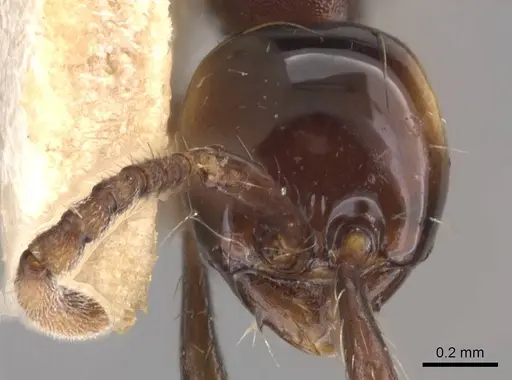
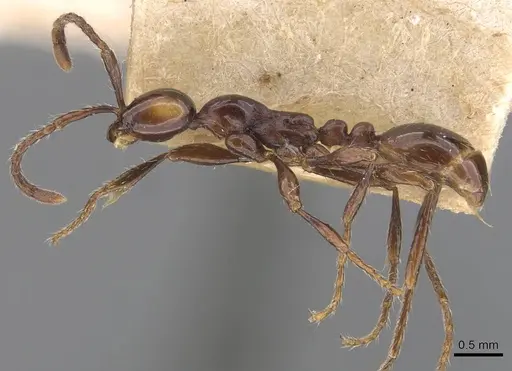
Aenictus breviceps looks nearly identical to its close relative Aenictus laeviceps, and was actually considered the same species for decades before being separated in 2011 [3]. You can tell them apart by examining the middle body section: A. breviceps has partly smooth and shiny areas on the mesonotum, metanotum, and propodeum, while A. laeviceps is entirely rough and punctate [1]. The propodeal junction is also rounder in A. breviceps, and they usually have 2-4 standing hairs on the pronotum compared to none in A. laeviceps [1]. Most importantly, A. breviceps is found only on Java, while A. laeviceps ranges from eastern Thailand to the Philippines [1].
Why These Ants Cannot Be Kept in Captivity
Despite their small size, Aenictus breviceps is effectively impossible to keep in a standard ant setup. As army ants, they are nomadic, they do not build permanent nests and instead wander constantly, carrying their brood and food with them [4]. They require massive amounts of space to roam and raid. Their diet consists almost entirely of other social insects, particularly the brood of ants and termites, which is impractical to provide continuously [4]. Additionally, no queens have ever been collected for this species, so you cannot start a colony even if you wanted to [4]. Army ant colonies reproduce by fission, splitting an existing colony, not by a single queen founding a new colony.
Habitat and Distribution
This species is endemic to Java, Indonesia. The original type specimens came from Gunung Gedeh (Mount Gede), a montane area in West Java [1]. More recently, they were collected in the Purwodadi Botanical Gardens in East Java, showing they tolerate both highland and lowland conditions [2]. The only biological observation ever recorded was a spider of the genus Myrmarachne (a jumping spider that mimics ants) collected from a foraging column of this species [1]. This suggests they forage in the open where predators can observe them, typical of army ant behavior.
Stings and Safety
As members of the subfamily Dorylinae, the true army ants, these ants possess stings and will use them when threatened [4]. While their small size means they cannot penetrate skin as deeply as larger ants, they can still deliver painful stings. Combined with their colony defense and typical army ant behavior, they are not ants to be handled casually. If you encounter them in the wild on Java, observe from a distance.
Frequently Asked Questions
Can I keep Aenictus breviceps in a test tube?
No. They are army ants that require massive space to roam and raid. They cannot survive in test tubes, standard formicariums, or any confined space suitable for typical ant keeping.
Do Aenictus breviceps ants sting?
Yes. As members of the army ant subfamily Dorylinae, they possess stings and can deliver painful stings when threatened.
What do Aenictus breviceps eat?
Unknown specifically for this species. Based on typical Aenictus behavior, they are specialized predators of other social insects, particularly ant and termite brood. They do not accept standard ant foods like sugar water or protein sources like mealworms.
How big do Aenictus breviceps colonies get?
Unknown for this species. Based on typical Aenictus genus patterns, colonies likely contain thousands to hundreds of thousands of workers.
Are Aenictus breviceps good for beginners?
Absolutely not. They are not suitable for captive keeping by anyone except possibly specialized research facilities with unlimited resources and space.
Where do Aenictus breviceps come from?
They are endemic to Java, Indonesia, found in both montane forests and lowland botanical gardens.
Can I start a colony from a queen?
No. Queens have never been collected for this species. Even if found, army ant queens do not found colonies alone, new colonies form when a queen and workers split from an existing colony through fission.
How long until first workers for Aenictus breviceps?
This does not apply to army ants. They do not develop from single queens raising brood alone. New colonies form when a queen and workers split from an existing colony.
Report an Issue
The current care sheet is based fully on literature. See inconsistencies, or something that's incorrect? Please , it will be resolved after review from an admin. Contributing to the blogs tab also helps providing information, to make us be able to further improve the caresheets. Thank you for your support!
References

Эта инструкция по уходу лицензирована по CC BY-SA 4.0 .
Блоги сообщества
CASENT0905999
Посмотреть на AntWeb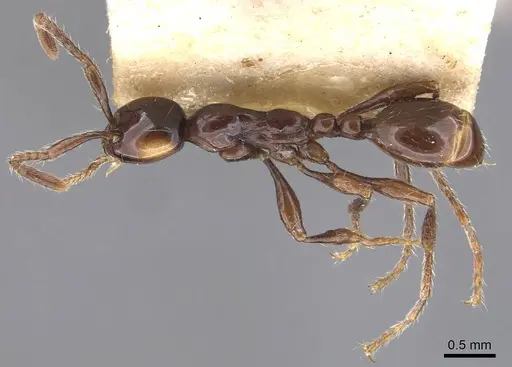
Литература
Загрузка карты распределения...Загрузка товаров...