
Temnothorax harlequina
- Nome cient.
- Temnothorax harlequina
- Tribo
- Crematogastrini
- Subfamília
- Myrmicinae
- Autor
- Prebus, 2021
- Distribuição
- Encontrado em 1 países
Introdução
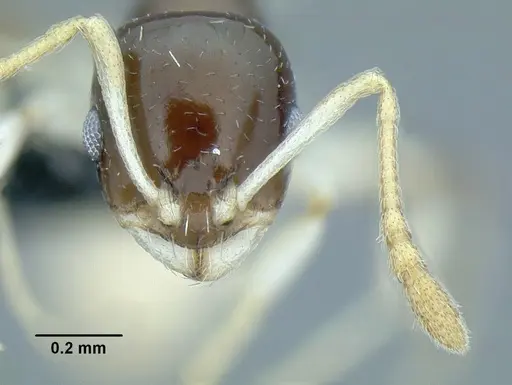
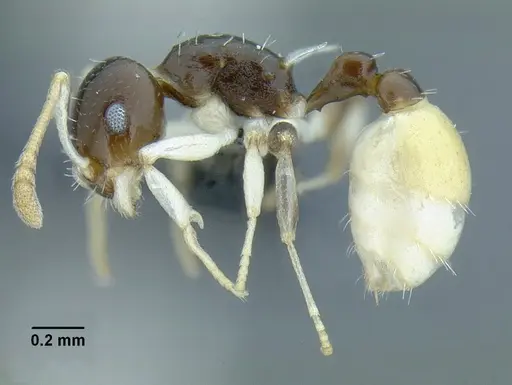
Temnothorax harlequina is a tiny, bicolored ant species only known from a single location in the Dominican Republic. Workers display a striking pattern: the head, mesosoma, waist segments, and most of the legs are medium brown, while the gaster (abdomen) is very light yellow - a unique color scheme within its group. This two-tone appearance is shared by several other arthropods on Hispaniola, including a similar-colored jumping spider found near the same nest . The species was described in 2021 based on a single nest fragment discovered in Parque Nacional del Este. The nest was in a dead, dry stick lying on leaf litter in low-elevation dry forest. Very little else is known about its biology - no queens or males have been described, and captive keeping data is completely absent. Any care advice beyond the basic habitat information is inferred from better-known relatives in the genus Temnothorax and should be treated as provisional.
Quick Summary
- Difficulty: Medium
- Origin & Habitat: Endemic to low-elevation dry forest in La Altagracia Province, Dominican Republic. The type locality is Parque Nacional del Este, at 10 m elevation, in evergreen coastal forest on coralline rock. The sole known nest was inside a dead, dry stick on the litter surface [1].
- Colony Type: Unknown. Only a nest fragment was collected, colony composition (queen number, worker count) is not documented [1].
- Size & Growth:
- Queen: Undescribed, not yet collected, size unknown
- Worker: Size data unavailable. The research paper gives detailed head and leg measurements, but total body length (TL) was not reported. Workers are very tiny, as indicated by scape lengths around 0.44-0.50 mm [1].
- Colony: Unknown, no data
- Growth: Unknown
- Development: Unknown, no data available (Any estimates would be pure speculation)
- Antkeeping:
- Temperature: Unknown. The species comes from a low‑elevation tropical site, so warmth (roughly 22-26°C) is likely, but specific requirements have not been investigated. Observe the colony and adjust based on activity.
- Humidity: Unknown. The natural nest was in a dry stick in a dry forest, suggesting moderate to low humidity. A gradient (one moist area, mostly drier) is probably safe, but no published data exists.
- Diapause: Unknown. As a tropical Caribbean species, diapause is unlikely, but not confirmed. A mild winter cool‑down is optional and untested.
- Nesting: The only natural nest found was inside a dead, dry twig about 2 cm in diameter. In captivity, a small test tube or a compact Y‑tong/plaster nest with narrow chambers likely mimics this environment. Avoid oversized nests.
- Behavior: Given the tiny worker size (~2-3 mm inferred from related species) and the typical shyness of litter‑nesting Temnothorax, the ants are expected to be non‑aggressive and prone to fleeing. Escape prevention is critical, any gap larger than 1 mm is a potential exit. The subfamily trait is a modified spatulate stinger used to smear venom (smear defense), but no specific behavioral observations exist for this species.
- Common Issues: tiny size (under 3 mm) makes escape prevention extremely challenging, use fine mesh over all openings, almost no captive experience exists, every keeper should be prepared for surprises, the species is newly described (2021) and not available from regular ant suppliers, wild collection in a protected park may be illegal without permits, because the biology is so poorly known, any care recommendation is experimental
Housing and Nest Setup
The only natural nest known for Temnothorax harlequina was a fragment inside a dead, dry stick about 2 cm in diameter [1]. This suggests the species naturally occupies very small, confined spaces. For captive keeping, a test tube with a water reservoir, as used for founding other small Temnothorax, is a good starting point. As the colony grows, transition to a compact Y‑tong or plaster nest with narrow tunnels and chambers scaled to the ants’ tiny size (roughly 2-3 mm worker body length, inferred from relatives). Avoid large, open nests that can overwhelm a small colony. Due to the lack of direct experience, monitor the ants closely and be ready to adjust the setup if they appear stressed or fail to thrive.
Feeding and Diet
No specific dietary data exists for Temnothorax harlequina. By analogy with other small litter‑nesting Temnothorax, they are likely opportunistic omnivores. Offer tiny protein sources such as fruit flies (Drosophila), small springtails, or freshly killed pinhead crickets. A drop of sugar water or honey (diluted to avoid drowning) can serve as an energy source. Because the workers are very small, even a single fruit fly may be a large meal for the whole colony. Feed small amounts 1-2 times per week and remove leftovers after 24 hours to prevent mold. All feeding recommendations are inferred from related species and have not been validated for this species. [1]
Temperature and Seasonal Care
Temnothorax harlequina is known only from low‑elevation tropical dry forest in the Dominican Republic, suggesting it prefers warm conditions [1]. However, no controlled temperature experiments have been performed. A reasonable starting point is room temperature (22-26 °C). Avoid extremes below 18 °C or above 30 °C. Since the natural habitat experiences little seasonal variation, a true hibernation period is not expected, but a mild cool‑down during winter (e.g.,18-20 °C) is optional and unlikely to harm the colony. The development speed and optimal temperature remain unknown, watch the ants’ activity and consumption as a guide.
Colony Founding and Growth
The founding queen of Temnothorax harlequina has never been observed or described. Based on the typical pattern in the subfamily Myrmicinae and related Temnothorax species, queens are likely claustral (sealing themselves in a chamber and raising the first brood on stored reserves), but this is speculation. Colony growth rate and mature colony size are completely unknown, no colonies have been kept in captivity. Because the species is so poorly studied, anyone attempting to keep it should document their observations and share them with the antkeeping community. [1]
Behavior and Temperament
Direct behavioral observations of Temnothorax harlequina are limited to a single field note: workers were foraging in the leaf litter alongside a bicolored jumping spider [1]. The ants are expected to be timid and non‑aggressive, typical of small litter‑nesting Temnothorax. They lack a piercing stinger but possess the modified spatulate stinger characteristic of the tribe Crematogastrini, used to smear a venom‑based defensive secretion onto opponents. The most critical behavioral consideration is their tiny size: workers likely measure only 2-3 mm (inferred from scape length of ~0.5 mm and comparison with related species). Any gap larger than 1 mm is an escape risk. Use fluon barriers combined with fine mesh over ventilation holes. All behavioral notes beyond the field observation are inferred from the genus and subfamily and should be treated as preliminary.
Frequently Asked Questions
How long does it take for Temnothorax harlequina to produce first workers?
Unknown. No data on egg‑to‑worker development exists for this species. The 6-8 week figure sometimes seen online is extrapolated from other Temnothorax and has not been confirmed.
What do Temnothorax harlequina ants eat?
Not documented. Based on related litter‑nesting species, they likely accept small protein sources (fruit flies, springtails, tiny crickets) and sugary liquids. All feeding advice is inferred, not proven.
Can I keep multiple Temnothorax harlequina queens together?
Unknown. The queen has never been observed in the field or captivity. Without any data, starting with a single queen per setup is the safest approach.
Do Temnothorax harlequina ants sting?
They do not have a piercing stinger, but they possess a modified spatulate stinger used to smear venom onto enemies (a smear‑defense typical of the tribe Crematogastrini). They are harmless to humans.
What temperature do Temnothorax harlequina need?
Specific requirements are unknown. The species originates from low‑elevation tropical dry forest, so warm conditions (22-26 °C) are likely suitable. Avoid temperatures below 18 °C or above 30 °C.
How big do Temnothorax harlequina colonies get?
Unknown. No colony has been reared in captivity. Related small Temnothorax often keep colonies under a few hundred workers, but this is purely speculative.
Are Temnothorax harlequina good for beginners?
They are rated Medium difficulty, but this is misleading. The complete lack of captive experience, tiny size, and uncertain needs make them unsuitable for beginners. Only experienced keepers with a willingness to experiment should attempt this species.
Do Temnothorax harlequina need hibernation?
Unknown. As a tropical Caribbean species, they likely do not require true hibernation, but no experiments have been performed. A cool‑down to 18-20 °C in winter is optional and not necessary for colony health.
What type of nest is best for Temnothorax harlequina?
The only natural nest found was a dead, dry stick. In captivity, start with a test tube. For larger colonies, use a compact Y‑tong or plaster nest with narrow tunnels. Avoid acrylic nests, they do not provide the moisture gradient these ants likely need.
Why are my Temnothorax harlequina escaping?
Their tiny size (likely ~2-3 mm) lets them slip through gaps that seem secure. Use fine mesh (0.5 mm) over all openings, apply fluon or PTFE barriers, and check for cracks daily.
Where is Temnothorax harlequina found in the wild?
It is only known from one location: Parque Nacional del Este in La Altagracia Province, Dominican Republic, at low elevation in dry forest [1].
Is Temnothorax harlequina invasive or dangerous?
No. It is a tiny, non‑aggressive endemic ant confined to a small area in the Dominican Republic. It poses no threat to ecosystems or humans.
Report an Issue
The current care sheet is based fully on literature. See inconsistencies, or something that's incorrect? Please , it will be resolved after review from an admin. Contributing to the blogs tab also helps providing information, to make us be able to further improve the caresheets. Thank you for your support!
References

Esta ficha de cuidados é licenciada sob CC BY-SA 4.0 .
Blogs da comunidade
CASENT0756091
Ver no AntWeb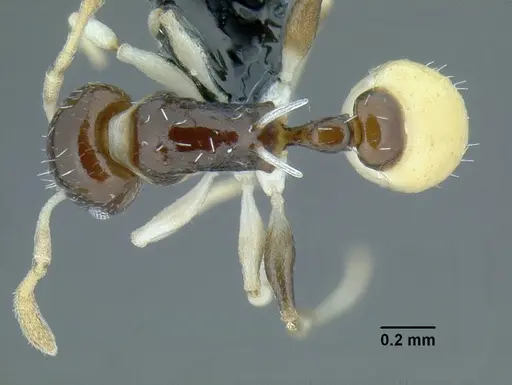
Literatura
A carregar mapa de distribuição...A carregar produtos...