
Strumigenys hispida
- Nome cient.
- Strumigenys hispida
- Tribo
- Attini
- Subfamília
- Myrmicinae
- Autor
- Lin & Wu, 1996
- Distribuição
- Encontrado em 0 países
Introdução
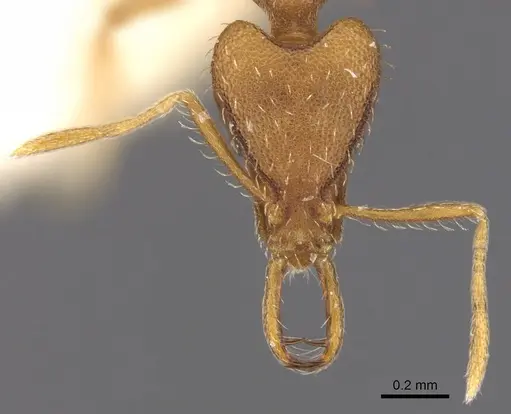
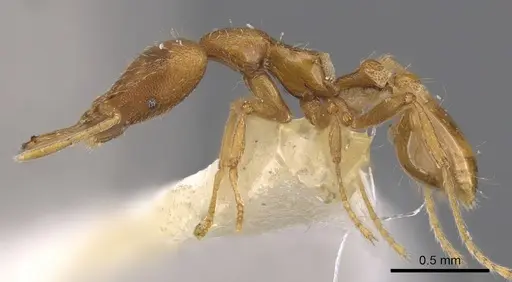
Strumigenys hispida is a tiny predatory ant, with workers measuring 2.7-2.9 mm in total length . It belongs to the smythiesii complex within the Strumigenys godeffroyi group . Workers have six-segmented antennae and sparse, long flagellate hairs on the first gastral tergite . The propodeal declivity is equipped with a broad, conspicuous spongiform lamella . The species name comes from the Latin 'hispidus, ' meaning hairy, referring to its distinct pilosity . This ant is found across southern China (Guangdong, Guangxi, Guizhou, Hainan, Henan), Taiwan, and northern Vietnam . Very little is known about its biology in the wild. Like other species in the genus, it is likely a cryptic predator that hunts small soil arthropods such as springtails and mites . Strumigenys ants move slowly and deliberately, using their specialized long mandibles to capture prey.
Quick Summary
- Difficulty: Expert
- Origin & Habitat: Southern China (Guangdong, Guangxi, Guizhou, Hainan, Henan), Taiwan, and northern Vietnam. This is a subtropical to tropical species found in forested areas [1][2].
- Colony Type: Social structure is not documented. Based on genus‑level patterns, likely single‑queen colonies (monogyne), but this is unconfirmed.
- Size & Growth:
- Queen: Not documented. Inferred from the genus, queens are slightly larger than workers, but specific measurements are unavailable.
- Worker: 2.7-2.9 mm total length [1].
- Colony: Unknown, likely under 100 workers based on typical cryptic Strumigenys species [6].
- Growth: Unknown, estimated slow based on genus patterns.
- Development: Unconfirmed, estimated 6-10 weeks based on typical Strumigenys development patterns at optimal temperature. (No published data exists for this species. This is a rough estimate.)
- Antkeeping:
- Temperature: Maintain 22-26 °C. This subtropical species from Taiwan and southern China likely prefers warm, stable temperatures. Use a gentle heat gradient if room temperature drops below 22 °C [1].
- Humidity: Keep the nest substrate consistently moist but not waterlogged. Provide a moisture gradient so the ants can choose their preferred humidity. Avoid dry conditions.
- Diapause: Not confirmed. This subtropical species may not require full winter diapause. A slight temperature drop (15-18 °C) for 2-3 months in winter could be beneficial, but is not strictly necessary. Observe colony behavior.
- Nesting: Use Y‑tong (AAC), plaster, or 3D‑printed nests with small, tight chambers (3-4 mm height). Test tubes with a moist cotton plug also work well for founding and small colonies. Avoid large open spaces. Ensure fine mesh barriers on all openings to prevent escapes due to their tiny size.
- Behavior: Slow‑moving, cryptic predator. Uses long mandibles to capture small prey like springtails. Not aggressive, they have a functional sting, but it is too small to penetrate human skin and poses no medical concern. Escape risk is high due to tiny size, use fine mesh barriers. They are harmless but require patience to observe.
- Common Issues: tiny size, escapes are very likely without fine mesh barriers on all ventilation and connections., extremely specialized diet, requires live springtails, will not accept sugar or dead insects., very slow growth and small colony size can be discouraging., wild‑caught colonies may have unknown parasites or diseases., biology is almost completely undocumented, keepers must experiment and observe carefully.
Housing and Nest Setup
Given their minute size, Strumigenys hispida requires carefully scaled housing. Test tubes with a moist cotton plug work well for founding and small colonies. For larger groups, use Y‑tong (AAC), plaster, or 3D‑printed nests with tight chambers no more than 3-4 mm high. These ants prefer cramped spaces, avoid large open areas that can stress them. The nest substrate should retain moisture without becoming waterlogged. A layer of moist soil or sand in the outworld provides a natural foraging area. Because they are so small (2.7-2.9 mm [1]), even tiny gaps in commercial formicaria can become escape routes, inspect all connections and cover ventilation holes with fine mesh.
Feeding and Diet
Like all Strumigenys, S. hispida is an obligate predator. Their primary food should be live springtails (1-3 mm), which trigger their natural hunting instincts. Other small live prey such as soil mites, booklice (psocids), and fruit fly larvae may also be accepted. Sugar sources and dead insects are generally ignored, they will not eat honey or sugar water. Feed every 2-3 days and remove any uneaten prey after 24 hours to prevent mold. A well‑fed colony will show more active, robust workers. This specialized diet makes them challenging to keep, springtail cultures are essential [6][2].
Temperature and Seasonal Care
Maintain temperatures between 22-26 °C for optimal colony health. This species comes from subtropical regions (Taiwan, southern China, Vietnam) where temperatures are warm year‑round [1]. Use a small heating cable on the side of the nest to create a gentle gradient if room temperature falls below 22 °C, place it on top to avoid drying out the substrate. During winter, consider a slight cool period (15-18 °C) for 2-3 months to mimic natural seasonal cycles, full hibernation is not recommended for this subtropical species. If workers become sluggish and cluster together, the temperature may be too low.
Behavior and Observation
Strumigenys ants are among the most patient hunters in the ant world. Workers move slowly and deliberately, using their long mandibles to capture prey in a precise snap. Their propodeal declivity bears a broad spongiform lamella that may aid in sensing vibrations or humidity [5][7]. They also have a characteristic mesopleural excavation lined with bristle hairs [8]. Unlike many ants that chase down food, these ants often wait in ambush or slowly stalk small arthropods. They have a functional sting, but it is too small to penetrate human skin and is not medically significant. Observation is best done with a magnifying glass or macro lens, as the entire colony can fit on a coin. Be patient, these ants do not respond to disturbance with frantic activity.
Colony Establishment and Growth
Establishing a colony of Strumigenys hispida requires patience. Founding behavior is unconfirmed, but based on the genus it is assumed to be claustral (the queen seals herself in a chamber and lives off stored fat until the first workers emerge). If you obtain a founding queen, place her in a test‑tube setup with a water reservoir and avoid disturbing her for at least the first month, stress may cause her to eat the brood or abandon the nest. First workers (nanitics) will be very small and few in number. Growth is slow, allow roughly 6-10 weeks from egg to first worker at optimal temperature. Subsequent broods develop gradually, and colonies likely remain small (probably under 100 workers). Do not check too frequently, once a week is enough after the first month.
Why This Species Is Expert‑Only
S. hispida is rated Expert for several reasons. First, virtually nothing is known about its specific biology in the wild or captivity, keepers are pioneering the husbandry. Second, its diet is extremely specialized: it needs live springtails and will not survive on typical ant foods. Third, its tiny size makes escape‑proof housing difficult. Fourth, growth is very slow and colonies stay small, which can be frustrating. Finally, consistent temperature and humidity must be maintained. This species is best attempted after gaining experience with more common Strumigenys species such as S. membranifera or S. louisianae.
Frequently Asked Questions
Can I keep Strumigenys hispida in a test tube?
Yes, a test tube with a moist cotton plug works well for founding and small colonies. Use a tube sized to their minute scale, avoid overly large tubes that may make them feel exposed. For larger colonies, consider a small Y‑tong or plaster nest with tight chambers.
What do Strumigenys hispida ants eat?
They are obligate predators that need live prey. Their primary food should be live springtails (1-3 mm). Other small live prey like soil mites, booklice, and fruit fly larvae may be accepted. They do NOT accept sugar sources, honey, or dead insects. This specialized diet is critical, if springtails are unavailable, the colony will not survive [6][2].
How long does it take for Strumigenys hispida to have first workers?
The exact timeline is unconfirmed for this species. Based on typical Strumigenys development, expect 6-10 weeks from egg to first worker at optimal temperature (22-26 °C). First workers (nanitics) will be very small. Growth is slow, do not expect rapid expansion.
Are Strumigenys hispida good for beginners?
No, this is an Expert‑level species. Nothing is known about their captive biology, they require specialized live prey (springtails), their tiny size makes housing difficult, and they are slow‑growing. Start with easier species like Lasius niger or Camponotus species before attempting Strumigenys.
How big do Strumigenys hispida colonies get?
Colony size is not documented, but based on typical cryptic Strumigenys species, colonies likely remain small, probably under 100 workers even at maturity. These are not large colony builders [6].
Do Strumigenys hispida need hibernation?
Probably not. This is a subtropical species from Taiwan and southern China where winters are mild. A slight temperature reduction (15-18 °C) for 2-3 months during winter may be beneficial, but full hibernation is not recommended. Monitor your colony, if they remain active year‑round, simply maintain normal temperatures [1].
Why are my Strumigenys hispida dying?
Common causes include: wrong food (they need live springtails, not sugar or dead insects), temperature too low (keep at 22-26 °C), humidity too dry or too wet, escape through tiny gaps, or stress from too much disturbance. Also check for mold in the nest. If the colony was wild‑caught, parasites are a strong possibility.
When should I move Strumigenys hispida to a formicarium?
Wait until the colony has at least 15-20 workers and the test tube is becoming crowded. Strumigenys prefer tight spaces, so even a small formicarium with small chambers is appropriate. Do not move too early, they may abandon a too‑large space.
Can I keep multiple Strumigenys hispida queens together?
This has not been documented. The genus is typically monogyne (single queen). Combining unrelated queens is not recommended as it likely results in fighting. If you obtain multiple foundresses, house them separately.
Report an Issue
The current care sheet is based fully on literature. See inconsistencies, or something that's incorrect? Please , it will be resolved after review from an admin. Contributing to the blogs tab also helps providing information, to make us be able to further improve the caresheets. Thank you for your support!
References

Esta ficha de cuidados é licenciada sob CC BY-SA 4.0 .
Blogs da comunidade
CASENT0900821
Ver no AntWeb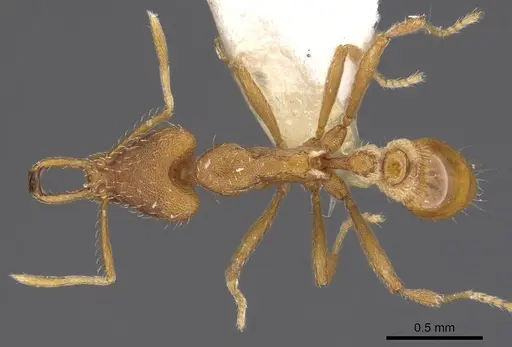
Literatura
A carregar mapa de distribuição...A carregar produtos...