
Stenamma yaluzangbum
- Nome cient.
- Stenamma yaluzangbum
- Tribo
- Stenammini
- Subfamília
- Myrmicinae
- Autor
- Liu & Xu, 2011
- Distribuição
- Encontrado em 0 países
Introdução
Stenamma yaluzangbum is a small, dark ant from high-altitude forests in Tibet and Sichuan Province, China. Workers measure 2.9-3.8 mm total length, with a blackish-brown head and body contrasting with yellowish-brown legs and gaster . First described in 2011,the species is known only from the worker caste - queens and males have never been documented. These ants nest under stones in pine (Pinus densata) and broadleaf forests between 2450-3170 m elevation, and have also been collected from leaf litter samples . The species name refers to the Yarlungzangbo River that flows through the main collection sites in southeastern Tibet . This high-elevation species is adapted to cold, stable conditions. As members of the Stenammini tribe, these ants are cryptic forest-floor dwellers. Only four collections have ever been made (2005-2008), making this one of the least-studied ant species in the world. Keeping them is purely experimental - no captive colonies exist.
Quick Summary
- Difficulty: Expert
- Origin & Habitat: Tibet (Milin County, Linzhi County) and Sichuan Province (Kangding County), China at 2450-3170 m elevation. Found under stones in Pinus densata forests and broadleaf forests, also in leaf litter [1][2]
- Colony Type: Only worker caste known, colony structure, queen, and male castes have never been documented. Single-queen colonies are typical for most Stenamma but unconfirmed for this species [1]
- Size & Growth:
- Queen: Unknown, queen caste has not been described [1]
- Worker: 2.9-3.8 mm total length [1]
- Colony: Unknown, no colony size data available. Likely small colonies under 100 workers based on genus patterns, but unconfirmed
- Growth: Unknown, no data on growth rate
- Development: No data, estimated 8-12 weeks based on typical high-elevation Stenamma development at cool temperatures (Direct development data unavailable, estimate based on genus-level patterns for cold-adapted species)
- Antkeeping:
- Temperature: 15-20°C year-round, with 3-4 months hibernation at 5-10°C. Never exceed 25°C [3]
- Humidity: Moderate to high, nest substrate should be kept moist but not waterlogged. Natural habitat includes moisture from decomposing leaf litter under stones. Provide a humidity gradient if possible [1]
- Diapause: Yes, required winter hibernation at 5-10°C for 3-4 months, reflecting high-elevation origin [3]
- Nesting: In nature, nests under stones and in leaf litter [1][2]. In captivity, use soil or Y-tong (AAC) nests with dark, cool chambers. Provide stable humidity and avoid flooding.
- Behavior: Shy, non-aggressive, likely nocturnal or crepuscular. Workers have small eyes (4 ommatidia) suggesting reliance on chemical cues. Escape risk is high due to tiny size (
- Common Issues: only worker caste known, no queens available, making captive breeding impossible until queen is discovered, escape risk, tiny 3 mm workers squeeze through standard barriers easily, cold requirements, most keepers cannot maintain 15-20°C year-round, hibernation difficulty, providing 3-4 months at 5-10°C is challenging, no captive breeding data, all attempts will be experimental, slow growth expected, colony development may take many months or years
Origin and Natural History
Stenamma yaluzangbum comes from remote high-altitude forests in western China. Workers have been collected from Tibet (Milin County, Linzhi County) at 2770-3170 meters and from Sichuan Province (Kangding County) at 2450 meters [1]. The holotype was found under a stone in a Pinus densata forest at 3085 meters in Milin County [1]. These ants inhabit a region with harsh winters and cool summers, the Tibetan Plateau is one of the coldest inhabited regions on Earth. The forests experience freezing temperatures for much of the year, which explains why captive colonies need cool conditions and a proper hibernation period [3]. The species belongs to the Stenamma clade that is mostly extratropical, specifically in the Palearctic biogeographic zone [3]. Only four collections have ever been made (2005-2008), all by researchers during field surveys. This makes S. yaluzangbum one of the least-studied ant species in the genus.
Identification and Appearance
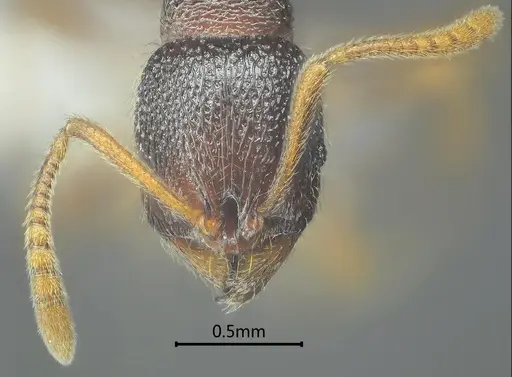
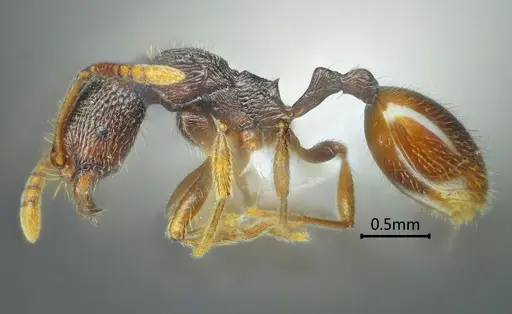
Workers are small ants measuring 2.9-3.8 mm total length [1]. The head and body (alitrunk and gaster) are blackish-brown, while the legs, antennae, and gaster are yellowish-brown. The eyes are small and black, located toward the front of the head [1]. The head is roughly rectangular when viewed from above, longer than wide, with a straight hind margin and rounded corners. The antennae are short with 12 segments and a 4-segmented club. The mandibles have 2 distinct apical teeth followed by 7 indistinct denticles [1]. In profile, the top of the thorax (promesonotum) is high and arched, with a deep metanotal groove that contains a small tubercle. The propodeum (rear section) is lower than the promesonotum, with straight sloping dorsum and slender acute spines about one-third the length of the declivity. The propodeal plates are broad and rounded, about as long as the spines [1]. The petiole (waist) is relatively long, with a cone-shaped node. The postpetiole has a distinctive toothed corner on the underside. The body surface is finely sculptured with ridges and punctures, the mesopleura are densely and coarsely punctuate, which helps distinguish this species from similar Stenamma [1][2]. The gaster is smooth and shiny. The body is covered with abundant erect hairs and dense decumbent pubescence, except on the propodeum and petiolar peduncle which lack erect hairs [1].
Housing and Nesting
In nature, these ants nest under stones on the forest floor and live in leaf litter [1]. This tells us they prefer dark, humid microhabitats with stable temperatures. For captive care, a naturalistic setup with a soil chamber or Y-tong (AAC) nest works best. Provide multiple dark chambers with a moist substrate. Avoid acrylic nests, they do not hold humidity well. Since they nest under stones in the wild, flat overhanging structures (like a flat stone or piece of bark) placed on damp soil can mimic their natural conditions. Keep the nesting substrate moist but not waterlogged, think damp forest floor, not swamp. Provide a water tube but ensure there is no flooding risk, these small ants can drown easily. Escape prevention is critical. Workers are only 3 mm and can squeeze through gaps that larger ants cannot. Use fluon on all rim edges and ensure connections between outworld and nest are tight.
Feeding and Diet
No specific feeding data exists for Stenamma yaluzangbum. Based on genus-typical behavior, they are likely omnivorous foragers that collect small insects, honeydew, and sugary liquids. Their small size and forest-floor lifestyle suggest a preference for tiny prey: springtails, fruit flies, pinhead crickets, and other small arthropods. In captivity, offer a varied diet: small live prey 2-3 times per week, and a drop of sugar water or honey as a carbohydrate source. Portion sizes should be tiny, a piece of prey smaller than the ants themselves. Remove uneaten food within 24 hours to prevent mold in the cool, humid setup. Since this species has never been kept in captivity, all feeding recommendations are estimates. Observe your colony and adjust based on what they accept. Some Stenamma species are picky eaters.
Temperature and Seasonal Care
Temperature management is the most critical aspect of keeping this species. As high-elevation ants from Tibet and Sichuan, they are adapted to cool conditions year-round. They will not thrive at typical room temperature (20-25°C) [3]. Keep the nest area at 15-20°C consistently. This may require a cool room, basement, or a controlled setup (e.g., a wine cooler with thermostat). Never expose them to temperatures above 25°C, this could be fatal. Winter hibernation is required. For 3-4 months (roughly November-February in the Northern Hemisphere), reduce temperature to 5-10°C. This mimics the harsh winters they experience at 3000+ m elevations in Tibet. During hibernation, reduce food to almost nothing, the colony will be mostly inactive. After hibernation, slowly increase temperature to 15-20°C in spring. This species likely has a short active season in nature (roughly May-September).
Behavior and Temperament
Based on their morphology and habitat, these are shy, non-aggressive ants that avoid confrontation. The eyes are tiny, only 4 ommatidia in diameter [1], suggesting weak vision and reliance on chemical cues. They likely forage at night or in dim light (crepuscular) to avoid predators. Workers are probably solitary foragers or form small recruitment trails, not large swarms. They are not defensive, Myrmicinae have stingers but these ants are unlikely to use them against keepers. However, their small size makes them easily stressed, minimize disturbances to the nest. Escape risk is high due to 3 mm workers. Even standard test tube barriers may fail, apply fluon to all edges and check connections regularly.
Frequently Asked Questions
Can I keep Stenamma yaluzangbum as a beginner?
No. This species is not suitable for beginners. It is one of the rarest and least-documented ant species, queens have never been found, and no captive breeding protocols exist. The main challenges are providing cool temperatures (15-20°C year-round), proper hibernation (5-10°C for 3-4 months), and the fact that no colonies are available. Start with easier species like Lasius niger or Tetramorium caespitum before attempting Stenamma [3].
Where can I get a Stenamma yaluzangbum queen?
You cannot obtain a queen. This species has only ever been described from workers, no queens, males, or reproductive castes exist in any scientific collection [1]. No queen has ever been collected from the wild, meaning no colony has ever been established in captivity. Captive breeding is impossible until someone discovers and describes the queen caste. Look for other Stenamma species with documented queens instead.
What temperature do Stenamma yaluzangbum need?
Keep them cool at 15-20°C year-round. This is much cooler than most ant species require. These are high-elevation ants from Tibet (3000+ m) where temperatures are cold even in summer. Never exceed 25°C. In winter, provide 3-4 months of hibernation at 5-10°C [3].
How big do Stenamma yaluzangbum colonies get?
Unknown, colony size has never been documented. Based on typical Stenamma patterns and their small worker size, colonies are likely small, probably under 100 workers. Given their high-elevation cold habitat and rarity of specimens, they probably form small, localized populations. Expect slow growth and small colony sizes if you ever manage to establish a colony.
Do Stenamma yaluzangbum ants sting?
Yes, they likely can sting, as all Myrmicinae have functional stingers. However, their small size and non-aggressive nature mean they rarely if ever sting handlers. The sting would be very mild due to their tiny size. These are shy ants that will flee rather than fight.
What do Stenamma yaluzangbum eat?
Based on genus-typical behavior, they likely eat small insects (springtails, fruit flies, tiny beetles), honeydew, and sugary liquids. Feed small live prey 2-3 times weekly and provide a drop of sugar water or honey constantly. Portions must be tiny, these are 3 mm ants. Remove uneaten food within 24 hours to prevent mold.
Do Stenamma yaluzangbum need hibernation?
Yes, hibernation is required and critical for their health. These high-elevation ants experience harsh winters at their natural habitat (3000+ m in Tibet). Provide 3-4 months at 5-10°C during winter (roughly November-February). Without proper hibernation, the colony will likely decline and die over time [3].
Can I keep multiple Stenamma yaluzangbum queens together?
Unknown, colony structure has never been documented. No one has ever found a queen of this species, so we have no data on monogyny or polygyny. Do not attempt to combine unrelated foundresses, this has never been studied and would be purely experimental with unknown outcomes.
How long does it take for Stenamma yaluzangbum to develop from egg to worker?
Unknown, no development data exists. Based on typical high-elevation Stenamma, estimate 8-12 weeks from egg to worker at optimal cool temperatures (around 18°C). Development would be slower than lowland species due to cold adaptation. Nanitics (first workers) will likely be smaller than normal workers.
Are Stenamma yaluzangbum good escape artists?
Yes. Workers are only 2.9-3.8 mm and can squeeze through the tiniest gaps [1]. Standard test tube cotton barriers may not stop them. Use fluon on all rim edges, ensure tight connections, and consider fine mesh over ventilation holes. Check your setup daily for the first few weeks.
Report an Issue
The current care sheet is based fully on literature. See inconsistencies, or something that's incorrect? Please , it will be resolved after review from an admin. Contributing to the blogs tab also helps providing information, to make us be able to further improve the caresheets. Thank you for your support!
References

Esta ficha de cuidados é licenciada sob CC BY-SA 4.0 .
Blogs da comunidade
ANTWEB1060577
Ver no AntWeb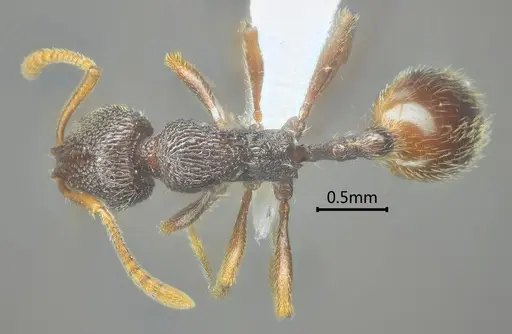
Literatura
A carregar mapa de distribuição...A carregar produtos...