
Simopone miniflava
- Nome cient.
- Simopone miniflava
- Subfamília
- Dorylinae
- Autor
- Bolton & Fisher, 2012
- Distribuição
- Encontrado em 0 países
Introdução
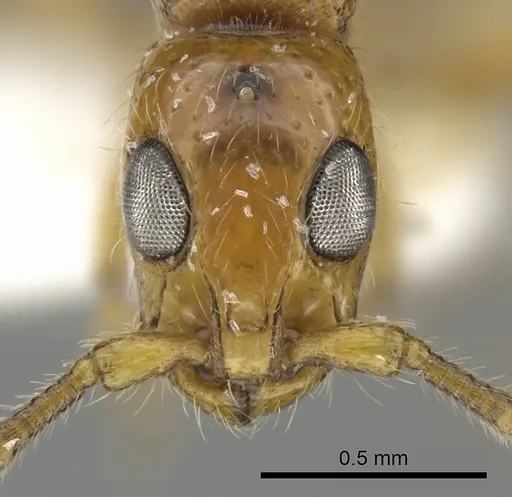
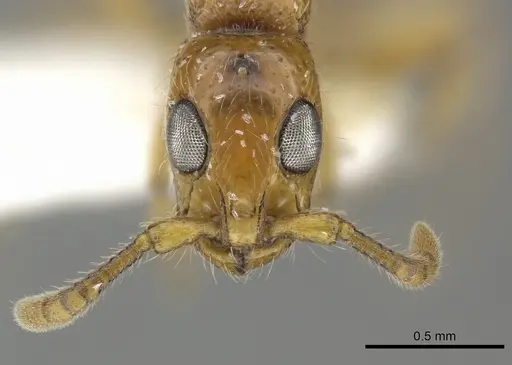
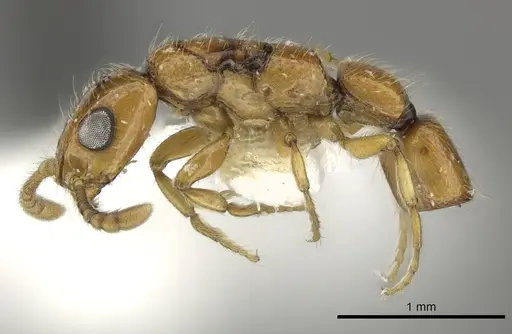
Simopone miniflava is an extremely rare ant species known only from a single dealate queen collected in Gabon. This small ant is uniformly yellow, including the head, body, and appendages, with only faint darker patches around the ocelli and flight sclerites . It belongs to the schoutedeni group and was formally described in 2012 by Bolton & Fisher. The lack of head sculpture and the parallel‑sided abdominal segments make it distinct among its relatives . No workers, males, or colonies have ever been documented. This species remains one of the most poorly known ants in the world.
Quick Summary
- Difficulty: Expert
- Origin & Habitat: Known only from Gabon: Ogooué‑Maritime, Réserve des Monts Doudou,600 m elevation, in coastal lowland rainforest undergrowth [1]. This habitat is tropical with high humidity and stable warm temperatures.
- Colony Type: Unknown, only the queen caste has been described. No information exists on colony structure.
- Size & Growth:
- Queen: Size data unavailable, no total length (TL) measurement has been published. The head length is 0.84 mm, but this is not a body size.
- Worker: Size data unavailable, workers have never been described or collected.
- Colony: Unknown, no colony data exists.
- Growth: Unknown, no development data exists.
- Development: Unknown, no direct observations of any life stage beyond the queen. (All aspects of development are unstudied.)
- Antkeeping:
- Temperature: Inferred from tropical rainforest origin: keep around 24-28 °C, with a mild gradient. No confirmed data.
- Humidity: Inferred from habitat: high humidity required. Keep the nest substrate consistently moist but not waterlogged. Mist regularly and provide a water source.
- Diapause: No, this is a tropical species from Gabon, so seasonal diapause is not expected.
- Nesting: No specific data. The holotype was collected by sweeping in undergrowth, suggesting they may nest in soil or small cavities in rotting wood [1]. A naturalistic setup with moist substrate or a test tube is a starting point, entirely experimental.
- Behavior: Behavior is completely unstudied. Use extreme escape prevention, the queen is tiny and can slip through standard barriers. All care advice is speculative.
- Common Issues: no captive colonies have ever been kept, all care is experimental, tiny size makes escape prevention extremely difficult, completely unknown biology means every husbandry choice is a guess, no established feeding or breeding protocols exist, the species may not be available in the antkeeping hobby at all
Species Overview and Identification
Simopone miniflava was described in 2012 from a single queen collected in Gabon. The name means 'tiny yellow, ' referring to its small size and uniform yellow color [1]. The queen lacks head sculpture, has parallel‑sided abdominal segment AII, and lacks a mesopleural transverse sulcus, features that separate it from related species [1]. The holotype is the only known specimen, workers and males remain undiscovered.
Habitat and Natural History
The sole record is from coastal lowland rainforest undergrowth at 600 m elevation in the Réserve des Monts Doudou, Gabon, collected in March 2000 during the wet season [1]. Nothing is known about nesting, foraging, or diet in the wild.
Keeping Simopone miniflava in Captivity
This species is not available in the hobby and no care protocols exist. If a colony were ever obtained, husbandry would be purely experimental. Based on its origin, provide warm (24-28 °C), humid conditions. The tiny size demands ultra‑fine mesh barriers. Feeding would likely require very small live prey (e.g., springtails, fruit flies), but this is unconfirmed [1]. Extreme caution against escape is essential. Recommended only for expert antkeepers willing to develop entirely new protocols.
Challenges and Limitations
Simopone miniflava presents the ultimate challenge: virtually nothing is known. No workers have ever been kept, no colony dynamics are recorded, and all care advice is speculative. The small size poses unique housing and feeding difficulties. The species should be seen as a future scientific goal rather than a current keeper's project. [1]
Frequently Asked Questions
Can I keep Simopone miniflava ants?
No, this species is not available in the antkeeping hobby. It is known only from a single queen collected in 2000,and no colonies have ever been documented or cultured [1].
What does Simopone miniflava look like?
The queen is uniformly yellow, head, body, legs, and antennae are pale yellow. Only a small patch between the ocelli and around the flight sclerites is slightly darker. It lacks head sculpture and has parallel‑sided abdominal segments [1].
Where is Simopone miniflava from?
Only known from Gabon: Ogooué‑Maritime, Réserve des Monts Doudou,600 m elevation, in coastal lowland rainforest undergrowth [1].
Do Simopone miniflava workers exist?
Unknown, workers have never been described. The species is known only from a single dealate queen (one that shed its wings after mating) [1].
What do Simopone miniflava eat?
Unknown, no feeding observations exist. As a member of Dorylinae, it is likely predatory on small invertebrates, but this is unconfirmed.
Are Simopone miniflava good for beginners?
No, this species is not recommended for any level of antkeeping. No captive colonies exist, all care is speculative, and the species may not even be obtainable.
How big do Simopone miniflava colonies get?
Unknown, no colony data exists. The small queen size suggests a small colony, but this is speculative [1].
Do Simopone miniflava need hibernation?
No, as a tropical species from Gabon, it likely experiences no seasonal temperature changes and would not require diapause.
What temperature do Simopone miniflava need?
Inferred at 24-28 °C based on its tropical rainforest origin. No direct temperature data exists.
Can I find Simopone miniflava in the wild?
Extremely unlikely, it is known from a single specimen collected in a protected reserve in Gabon. Expert field collection in its native habitat would be required [1].
Report an Issue
The current care sheet is based fully on literature. See inconsistencies, or something that's incorrect? Please , it will be resolved after review from an admin. Contributing to the blogs tab also helps providing information, to make us be able to further improve the caresheets. Thank you for your support!
References

Esta ficha de cuidados é licenciada sob CC BY-SA 4.0 .
Blogs da comunidade
CASENT0260386
Ver no AntWeb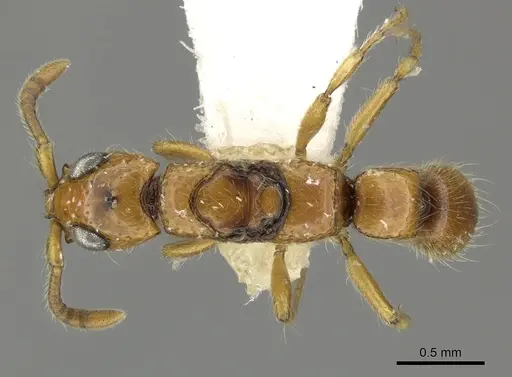
Literatura
A carregar mapa de distribuição...A carregar produtos...