
Simopone chapmani
- Nome cient.
- Simopone chapmani
- Subfamília
- Dorylinae
- Autor
- Taylor, 1966
- Distribuição
- Encontrado em 0 países
Introdução
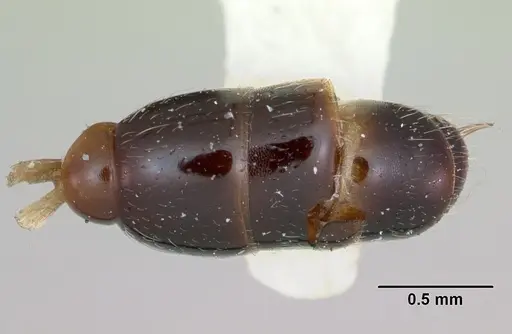
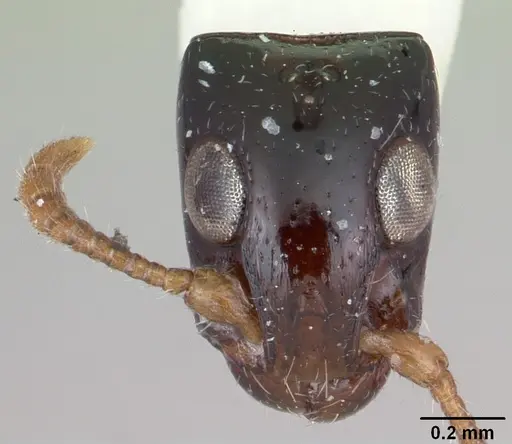
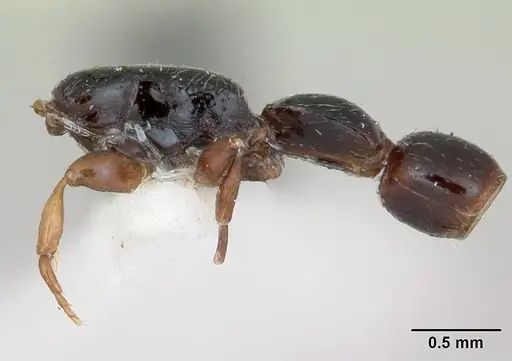
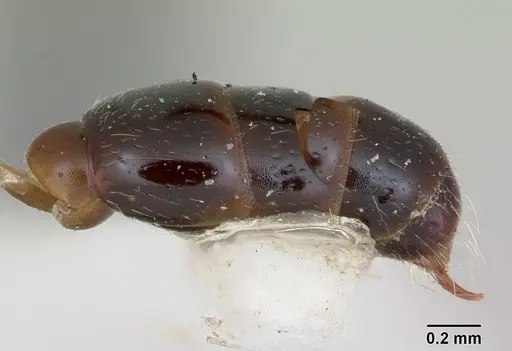
Simopone chapmani is one of the rarest ants in the world, known only from a single worker specimen collected in 1966 on Negros Island in the Philippines at around 3,600 feet elevation . The worker measures about 5mm in total length. It has a distinctly trapezoidal head shape with relatively large eyes, and its antennae are very short. The body is smooth and shiny, with fine scattered hairs on the upper surface of the body . This species belongs to the grandidieri-group within the genus Simopone, members of which share a narrow but deep antennal scrobe and a very short scape .
Quick Summary
- Difficulty: Expert
- Origin & Habitat: Philippines (Negros Island), known only from a single specimen collected at 3,600 ft elevation in the Horns of Negros region [1][2]. Nothing is known about its natural habitat preferences.
- Colony Type: Unknown, only a single worker specimen has ever been collected. Colony structure, queen presence, and social organization are completely unstudied.
- Size & Growth:
- Queen: Unknown, no queens have ever been collected or described
- Worker: 5.0mm total length (TL) [1]
- Colony: Unknown, no colony data exists
- Growth: Unknown
- Development: Unknown, no development data exists for this species (Development timeline cannot be estimated due to complete absence of biological data)
- Antkeeping:
- Temperature: Unknown, no thermal data exists. Based on related Simopone species from tropical Asia, likely prefer warm conditions (24-28°C) typical of lowland forest ants, but this is purely speculative.
- Humidity: Unknown, no humidity data exists. The Philippines has a tropical climate with high humidity, so moderate to high humidity (60-80%) is a reasonable starting point, but unconfirmed.
- Diapause: Unknown, no seasonal data exists. As a tropical species from the Philippines, diapause is unlikely but unconfirmed.
- Nesting: Unknown, no nesting observations exist. Most Simopone species are hypogaeic (ground-dwelling) and likely nest in soil or rotting wood. A naturalistic setup with moist substrate would be a reasonable starting point, but completely experimental.
- Behavior: Completely unstudied. As a Dorylinae member, Simopone chapmani likely exhibits predatory behavior similar to other army ants, potentially raiding colonies of other ants or preying on small arthropods. The relatively large eyes suggest some visual capability, unlike many fully subterranean Dorylinae. Temperament and aggression levels are unknown. Escape risk cannot be assessed due to lack of behavioral observations.
- Common Issues: no biological data exists, keepers have no foundation for care, colony founding behavior is completely unknown, diet preferences are unconfirmed, must be determined through experimentation, wild-caught colonies may be impossible to obtain since the species is only known from a single specimen, any husbandry information would be experimental and speculative
Species Overview and Identification
Simopone chapmani is one of the rarest ants in the world, known only from a single worker specimen collected in 1966 by J.W. Chapman on Negros Island in the Philippines [1]. The species was described by R.W. Taylor in 1966 and later reviewed by Bolton and Fisher in 2012 as part of their taxonomic revision of the Simopone genus [1]. The holotype is fragmented and mounted on three card triangles on a single pin, making comprehensive morphological study difficult [3]. Members of the grandidieri-group can be identified by their distinctly trapezoidal head shape in full-face view, very short scapes, and the outer margins of the eyes not interrupting the lateral margin of the head [2]. The species is distinguished from related species like Simopone gressitti by its smaller size (5.0mm vs 6.4mm total length), narrower head, and proportionately larger eyes [1].
Why This Species Is Not Recommended for Keepers
Simopone chapmani is absolutely not recommended for ant keeping under any circumstances. This is not a matter of difficulty or advanced skill level, there is simply no biological, behavioral, or husbandry information available for this species. No one has ever observed a colony, queen, founding behavior, diet preferences, temperature requirements, humidity needs, or any other basic aspect of their biology. Keeping this species would be pure experimentation with no foundation for success. Additionally, the species is known from only a single specimen collected decades ago, wild colonies may not even be findable, and collecting them would require significant effort in remote Philippine montane forest. Any specimens that do exist would almost certainly be needed for scientific study rather than the ant keeping hobby. If you are interested in Dorylinae ants, there are many other Simopone species or related genera (such as Cerapachys, Lioponera, or other Dorylinae) that have documented biology and can be kept successfully [1].
Taxonomy and Classification
Simopone chapmani belongs to the subfamily Dorylinae (army ants), tribe Dorylini, and is a member of the grandidieri species group [1][2]. The genus Simopone was historically placed in the subfamily Cerapachyinae, but taxonomic revisions by Borowiec (2016) reclassified Cerapachyinae as a junior synonym of Dorylinae, placing Simopone within the army ant lineage [2]. The grandidieri-group is characterized by specific morphological features including a narrow but deep antennal scrobe, very short scapes, and particular configurations of the abdominal segments [1]. The type locality is the Horns of Negros, a mountainous region in the Philippines at approximately 3,600 feet elevation. This elevation suggests a montane or highland habitat, though the specific microhabitat preferences remain completely unknown [1].
Related Species and What We Can Infer
While Simopone chapmani itself has no documented biology, we can make some educated inferences based on what is known about related Simopone species and Dorylinae ants in general. Simopone species are typically predatory army ants that raid colonies of other ants or hunt small arthropods. Most Simopone species are hypogaeic (ground-dwelling) and prefer moist forest floor habitats. Dorylinae ants as a group are known for their raiding behavior, where large numbers of workers coordinate to overwhelm prey colonies. However, these are broad generalizations, and the grandidieri-group may have unique behaviors not shared with other Simopone. The fact that S. chapmani has relatively large eyes (unlike many fully subterranean Dorylinae which are blind or nearly so) suggests it may be more surface-active than some relatives. Without direct observation, these inferences remain speculative and should not be treated as care requirements [4].
Frequently Asked Questions
Can I keep Simopone chapmani as a pet ant?
No. This species is not recommended for ant keeping. It is known from only a single specimen collected in 1966,and absolutely no biological or husbandry information exists. There is no foundation for successful captive husbandry, and any attempt would be purely speculative with near-zero chance of success [1].
What does Simopone chapmani eat?
Unknown. No feeding observations or diet data exists for this species. As a Dorylinae member, it likely preys on other ants or small arthropods similar to other army ants, but this is purely speculative [1].
How big do Simopone chapmani colonies get?
Unknown. No colony has ever been observed or documented. Related Dorylinae species can have colonies ranging from dozens to thousands of workers, but there is no data to make any estimate for this specific species [1].
Where does Simopone chapmani live in the wild?
Only known from Negros Island in the Philippines, collected at approximately 3,600 feet elevation in the Horns of Negros region. The specific habitat type (forest type, nesting microhabitat, etc.) is completely unknown [1][2].
What temperature should I keep Simopone chapmani at?
There is no documented temperature requirement for this species. While related tropical Simopone species likely prefer warm conditions (24-28°C), the lack of any biological data means temperature recommendations cannot be reliably given. Keeping this species is not recommended [1].
How long does it take for Simopone chapmani to develop from egg to worker?
Unknown. No development data exists for this species. Even genus-level development times are unstudied for Simopone [1].
Is Simopone chapmani endangered?
The conservation status of this species is unknown. It is listed as a valid species but has only been collected once. Without additional surveys, its true distribution and population status cannot be assessed [1][2].
Can I find Simopone chapmani in the wild?
Extremely unlikely. The species is known from a single specimen collected in 1966 from the Horns of Negros in the Philippines. No additional specimens have been found despite subsequent ant surveys in the region. Even if colonies exist, locating them would require extensive fieldwork in remote montane forest with no guarantee of success [1].
Are there easier Simopone species to keep instead?
While Simopone chapmani itself has no documented care requirements, other Simopone species may have more available information. However, Simopone as a genus are generally considered advanced-level ants due to their predatory nature and specific requirements. If you are interested in Dorylinae ants, consider starting with more commonly kept species that have documented care guides [1].
Report an Issue
The current care sheet is based fully on literature. See inconsistencies, or something that's incorrect? Please , it will be resolved after review from an admin. Contributing to the blogs tab also helps providing information, to make us be able to further improve the caresheets. Thank you for your support!
References

Esta ficha de cuidados é licenciada sob CC BY-SA 4.0 .
Blogs da comunidade
CASENT0173044
Ver no AntWeb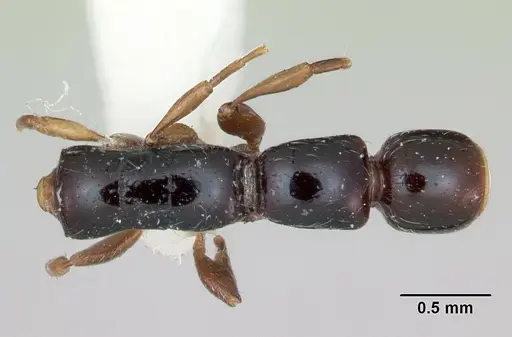
Literatura
A carregar mapa de distribuição...A carregar produtos...