
Polyrhachis imitator
- Nome cient.
- Polyrhachis imitator
- Subgénero
- Myrmothrinax
- Tribo
- Camponotini
- Subfamília
- Formicinae
- Autor
- Kohout, 2008
- Distribuição
- Encontrado em 0 países
Introdução
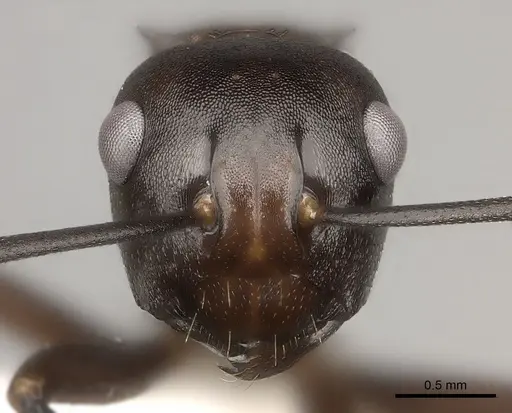
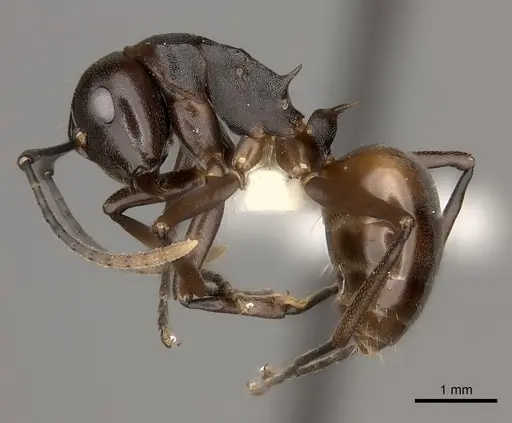
Polyrhachis imitator is a medium-sized arboreal ant from the aequalis species-group, first described from Sulawesi, Indonesia in 2008 . Workers have a dark reddish-brown coloration and three slender spines on the petiole . The queen is larger, with a total length of about 9.8 mm . These ants were discovered through fogging samples in cacao plantations, indicating they are canopy-dwelling . P. imitator belongs to the Myrmothrinax subgenus, known for distinctive features like the three-spined petiole .
Quick Summary
- Difficulty: Medium
- Origin & Habitat: Sulawesi, Indonesia, found in cacao plantations at elevations around 815 m [1].
- Colony Type: Colony structure is unconfirmed. Based on Polyrhachis patterns, likely monogyne (single queen) colonies.
- Size & Growth:
- Antkeeping:
- Temperature: Keep warm, roughly 24-28°C, as inferred from their tropical habitat.
- Humidity: Keep nest substrate consistently moist but not waterlogged. As arboreal ants, they prefer high humidity [2].
- Diapause: No, as a tropical species, they do not require diapause.
- Nesting: Provide arboreal-style nests with vertical orientation, such as Y-tong or cork bark setups [2].
- Behavior: Workers are relatively calm and non-aggressive. They are skilled climbers due to their arboreal nature [2]. Escape prevention should be moderate due to their medium size and climbing ability.
- Common Issues: tropical species may struggle in cool or dry environments, maintain warmth and humidity., arboreal nature requires vertical space and climbing structures., limited availability in the antkeeping hobby, may be difficult to acquire., escape prevention needed due to climbing ability., humidity control is critical, too dry causes dehydration, too wet causes mold.
Housing and Nest Setup
Provide an arboreal-style setup that mimics their natural canopy-dwelling habitat. Use a Y-tong nest with multiple chambers or a naturalistic setup with cork bark and branches [2]. Include climbing structures and ensure tight-fitting lids to prevent escapes.
Feeding and Diet
Polyrhachis imitator is omnivorous. Offer sugar water, honey, or diluted maple syrup as a constant carbohydrate source. Provide protein such as small insects 2-3 times per week [2].
Temperature and Humidity
Maintain temperatures between 24-28°C with a slight gradient. Humidity should be kept high, use a moisture reservoir and mist occasionally to maintain substrate moisture [2].
Behavior and Temperament
Workers are calm and non-aggressive. They have a distinctive three-spined petiole, which may serve as a defensive adaptation [1]. Provide enrichment with climbing structures.
Colony Development
The queen measures about 9.8 mm and workers 6.5-7.2 mm [1]. Development time is unconfirmed, but estimated 6-10 weeks for first workers based on related species [2].
Frequently Asked Questions
How long does it take for Polyrhachis imitator to produce first workers?
Exact development time is unconfirmed, but based on related Polyrhachis species, estimated 6-10 weeks at optimal temperatures [2].
Can I keep Polyrhachis imitator in a test tube setup?
A test tube can work for founding colonies, but these arboreal ants prefer vertical spaces. Consider transitioning to a more naturalistic setup once the colony grows [2].
What temperature range is best for Polyrhachis imitator?
Keep them warm at 24-28°C, as inferred from their tropical habitat [2].
How big do Polyrhachis imitator colonies get?
Colony size is not documented, so unknown [1].
Do Polyrhachis imitator need hibernation?
No, as a tropical species, they do not require diapause.
What do Polyrhachis imitator eat?
Omnivorous, offer sugar sources and protein insects [2].
Are Polyrhachis imitator good for beginners?
Rated medium difficulty due to humidity and temperature requirements.
Where is Polyrhachis imitator native to?
Sulawesi, Indonesia [1].
How do I set up a nest for Polyrhachis imitator?
Provide an arboreal-style setup with vertical orientation [2].
Report an Issue
The current care sheet is based fully on literature. See inconsistencies, or something that's incorrect? Please , it will be resolved after review from an admin. Contributing to the blogs tab also helps providing information, to make us be able to further improve the caresheets. Thank you for your support!
References

Esta ficha de cuidados é licenciada sob CC BY-SA 4.0 .
Blogs da comunidade
CASENT0217432
Ver no AntWeb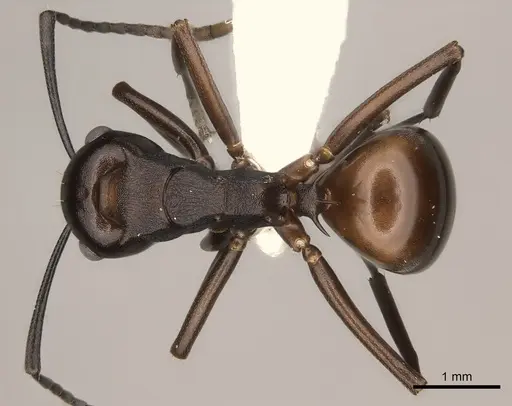
Literatura
A carregar mapa de distribuição...A carregar produtos...