
Pheidole rinae
- Nome cient.
- Pheidole rinae
- Tribo
- Attini
- Subfamília
- Myrmicinae
- Autor
- Emery, 1900
- Distribuição
- Encontrado em 0 países
Introdução
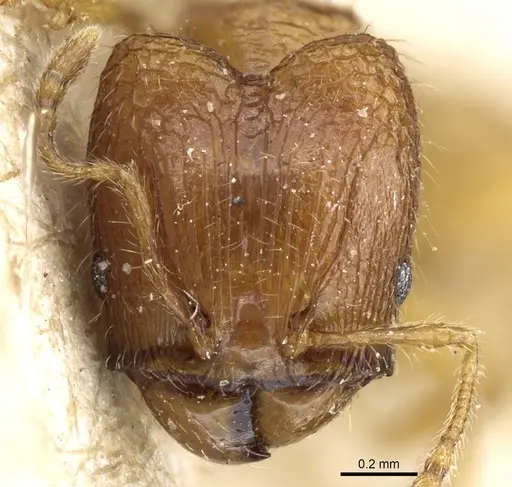
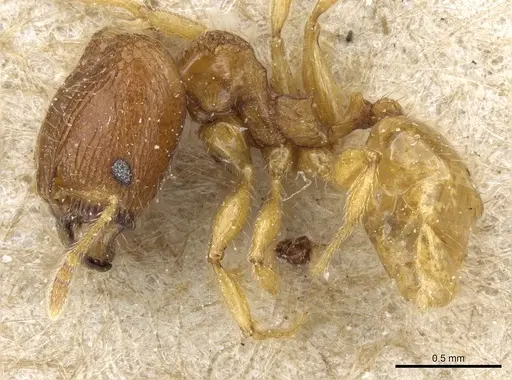
Pheidole rinae is a small ant species native to Southeast Asia, found in Sumatra, Borneo, Malaysia, Singapore, Thailand, and Vietnam . It was first described by Emery in 1900 . Major workers are approximately 3 mm long , while queen size is reported as 4 mm or 1.5-1.6 mm , indicating possible measurement variation. The species inhabits tropical forest environments and is often observed in gardens or on fallen fruits .
Quick Summary
- Difficulty: Medium
- Origin & Habitat: Tropical Southeast Asia, found in Sumatra, Borneo, Indonesia, Malaysia, Singapore, Thailand, and Vietnam [1][2][3][4]. Inhabits tropical forest environments, with specimens collected in gardens and on fallen fruits.
- Colony Type: Colony structure is unconfirmed. Based on typical Pheidole genus patterns, likely single-queen (monogyne) colonies with major and minor worker castes.
- Size & Growth:
- Queen: Approximately 4 mm [7] or 1.5-1.6 mm [6], measurements vary.
- Worker: Major workers: 3-3.2 mm [6], minor workers are smaller.
- Colony: Up to several hundred to a few thousand workers, typical for Pheidole genus.
- Growth: Moderate.
- Development: 6-10 weeks. (Development time is estimated, tropical temperatures likely accelerate development.)
- Antkeeping:
- Temperature: Keep warm, roughly 24-28°C, as this is a tropical species.
- Humidity: Keep nest substrate consistently moist but not waterlogged.
- Diapause: No diapause required as a tropical species.
- Nesting: Test tube setup for founding, Y-tong, plaster, or soil nests for established colonies.
- Behavior: Workers are active foragers, collecting seeds and protein. They are not particularly aggressive but will defend the colony. Escape risk is moderate due to small size.
- Common Issues: cold temperatures can weaken or kill the colony due to tropical nature., small size requires adequate escape prevention with barriers., overfeeding can cause mold in test tube setups., slow initial growth requires patience during founding.
Housing and Nest Setup
Pheidole rinae adapts well to various captive setups. For founding colonies, a standard test tube setup works excellently, fill one end with water trapped behind a cotton plug, providing humidity for 2-4 weeks without needing additional misting [5]. Connect the test tube to an outworld once the colony reaches workers. For established colonies, Y-tong nests, plaster nests with water reservoirs, or naturalistic setups all work well [5]. The key is maintaining moderate humidity while allowing good ventilation [5].
Feeding and Diet
As members of the tribe Attini, Pheidole species are naturally granivorous, they collect and process seeds [5]. Offer a mix of grass seeds, millet, poppy seeds, and other small seeds as a staple food. They also need protein sources: small insects like fruit flies, pinhead crickets, mealworms, and waxworms are readily accepted [5]. Sugar water, honey, or diluted honeydew can be offered occasionally, though seeds and protein form the core diet [5].
Temperature and Seasonal Care
This tropical Southeast Asian species requires warm conditions year-round. Maintain nest temperatures between 24-28°C. A heating cable placed on top of the nest creates a gentle thermal gradient [5]. Unlike temperate species, they do not require diapause or hibernation. Avoid placing the setup near air conditioning vents or cold drafts [5].
Colony Growth and Development
Pheidole rinae exhibits the genus's characteristic caste system with major and minor workers [5]. Major workers develop from larvae receiving extra nutrition and have distinctive enlarged heads [5]. The founding queen raises the first brood on her own body reserves [5]. Development from egg to worker takes approximately 6-10 weeks at optimal tropical temperatures. Colonies grow moderately fast once established [5].
Behavior and Observation
These ants are active foragers with typical Pheidole behavior patterns [5]. Workers emerge from the nest in search of seeds and protein [5]. Major workers join foragers when larger food items are discovered [5]. The colonies are not particularly aggressive toward keepers but will bite if provoked [5]. Observation is rewarding, you can watch seed-carrying chains and brood care [5].
Frequently Asked Questions
How long does it take for Pheidole rinae to have first workers?
Expect first workers to emerge 6-10 weeks after the queen lays her first eggs, assuming temperatures around 24-28°C. This is an estimate since specific timing for this species is unconfirmed.
What do Pheidole rinae ants eat?
They are omnivorous with a preference for seeds like other Attini ants [5]. Offer grass seeds, millet, or poppy seeds as a staple, and protein sources like small insects 2-3 times weekly [5].
Do Pheidole rinae ants need hibernation?
No. As a tropical Southeast Asian species, they do not require diapause or hibernation. Keep them warm year-round at 24-28°C.
Are Pheidole rinae good for beginners?
They are moderate difficulty, easier than some exotic tropical species but requiring warmth year-round. The lack of documented biology means keepers must rely on genus-level care patterns [5].
How big do Pheidole rinae colonies get?
Colony size is unconfirmed for this specific species, but typical Pheidole colonies reach up to several hundred to a few thousand workers.
Can I keep multiple Pheidole rinae queens together?
Not recommended. While colony structure is unconfirmed, Pheidole species are typically single-queen colonies [5]. Combining unrelated queens typically results in fighting.
What temperature is best for Pheidole rinae?
Keep nest areas at 24-28°C. Use a heating cable on one side of the nest to create a gradient if room temperature is below this range.
When should I move Pheidole rinae to a formicarium?
Move them when the test tube becomes crowded or the water reservoir is depleted, typically when the colony has several workers [5]. Ensure the formicarium has appropriate humidity and a connection to an outworld.
Why is my Pheidole rinae colony not growing?
Check temperature first, they need 24-28°C for proper development. Also verify humidity is adequate and the queen is still alive and laying eggs [5]. Poor nutrition can also slow growth.
Report an Issue
The current care sheet is based fully on literature. See inconsistencies, or something that's incorrect? Please , it will be resolved after review from an admin. Contributing to the blogs tab also helps providing information, to make us be able to further improve the caresheets. Thank you for your support!
References

Esta ficha de cuidados é licenciada sob CC BY-SA 4.0 .
Blogs da comunidade
CASENT0904259
Ver no AntWeb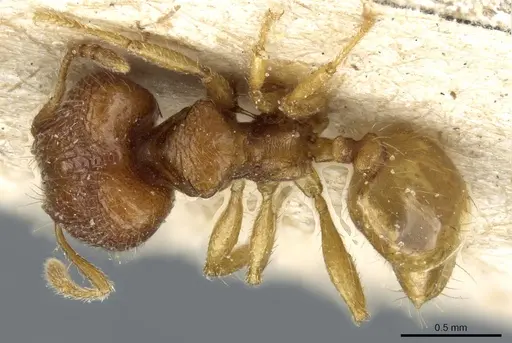
Literatura
A carregar mapa de distribuição...A carregar produtos...