
Paratopula demeta
- Nome cient.
- Paratopula demeta
- Tribo
- Crematogastrini
- Subfamília
- Myrmicinae
- Autor
- Bolton, 1988
- Distribuição
- Encontrado em 0 países
Introdução
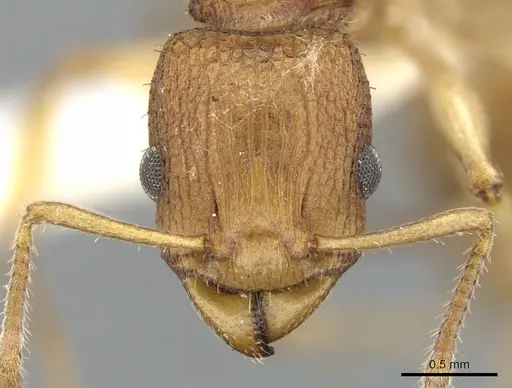
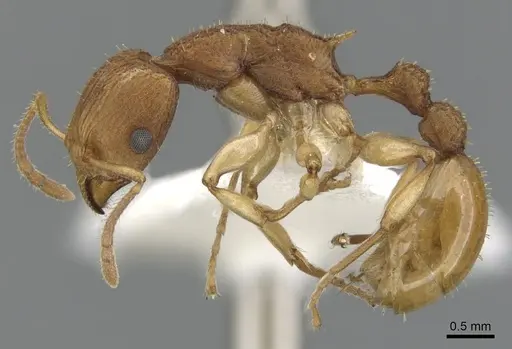
Paratopula demeta is a rare arboreal ant from the Myrmicinae subfamily. You can find this species in the Indomalaya region, specifically Borneo, Indonesia, Malaysia, and Singapore . The type specimen came from a limestone area in Gunong Mulu National Park, Sarawak, Malaysia . Workers show distinct features like angular pronotal humeri, a truncated postpetiolar sternite, and blunt-ended hairs on the body . These traits separate it from similar species that have pointed hairs. The genus contains very few described species, and Paratopula demeta remains one of the better documented ones, though biological details are still missing .
Quick Summary
- Difficulty: Expert
- Origin & Habitat: Tropical rainforests and limestone forests in Borneo, Indonesia, Malaysia, and Singapore [1].
- Colony Type: Social structure is unconfirmed. Only workers have been described, so we do not know if this species forms single-queen or multiple-queen colonies.
- Size & Growth:
- Queen: Unknown, the queen has never been described.
- Worker: size data unavailable, inferred from Paratopula genus (~3-5mm).
- Colony: Unknown, no colony samples exist.
- Growth: Unknown
- Development: Unknown, no development data exists. (Related Southeast Asian arboreal Myrmicinae typically take 6-10 weeks to reach worker stage at tropical temperatures.)
- Antkeeping:
- Temperature: Likely requires warm, stable conditions. Based on the species' rainforest origin, aim for 24-28°C [1]. Room temperature usually works if kept steady.
- Humidity: Requires high humidity. Keep the nest substrate consistently moist but not waterlogged. Provide a humidity gradient so the ants can choose their preferred moisture level.
- Diapause: Unknown. As a tropical species, seasonal dormancy is unlikely but unconfirmed.
- Nesting: Arboreal nesting is likely based on genus patterns. Use a small Y-tong (AAC), plaster, soil nest, or 3D-printed nest with tight chambers. Add climbing structures like twigs or cork to mimic tree habitats. Avoid large open spaces.
- Behavior: Behavior is unstudied. Based on genus patterns, expect a timid, non-aggressive species that nests in small cavities [1]. Workers likely tend honeydew-producing insects for food. Escape risk is moderate due to small size. Use standard barrier methods like fluon on tube rims. As a Myrmicinae ant, this species likely uses a smear defense mechanism rather than a piercing sting.
- Common Issues: complete lack of biological data makes captive care experimental, no confirmed diet preferences require trial and error, queen has never been described, so founding behavior is unknown, colony size and growth rate remain unconfirmed, wild specimens may carry unknown parasites or diseases
Species Overview and Identification
Paratopula demeta is an extremely rare ant described in 1988 by Barry Bolton from a single worker collected in Gunong Mulu National Park, Sarawak, Malaysia [1]. The genus Paratopula belongs to the tribe Crematogastrini and contains fewer than ten described species [1]. You can identify this ant by its angular pronotal humeri, truncated postpetiolar sternite, and blunt-ended body hairs [2][3]. These features separate it from related species with pointed hairs. The species ranges across Borneo, Indonesia, Malaysia, and Singapore [1].
Natural History and Habitat
Natural history details remain scarce due to the extreme rarity of specimens. The type specimen came from a limestone area in a forested hill environment [1]. This suggests the ants prefer tropical rainforest conditions with access to rocky substrates. We do not know their wild nesting sites, colony size, queen behavior, or diet. Related Paratopula species nest in tree hollows or under bark, so Paratopula demeta likely does the same [1].
Housing and Nesting in Captivity
No established captive protocols exist for this species. You should use a small Y-tong (AAC), plaster, soil nest, or 3D-printed nest with chambers scaled to worker size. The ants likely prefer tight-fitting chambers over large open spaces. Add climbing structures like twigs or cork to simulate an arboreal environment. Keep the nest substrate consistently moist but not waterlogged. Provide a water tube and ensure good ventilation to prevent mold. Use standard escape prevention measures like fluon on tube rims. [1]
Feeding and Diet
Diet preferences are completely unstudied. Based on genus patterns, these ants likely forage for honeydew from scale insects and other sap-sucking insects. They may also eat small arthropod prey. Offer sugar water or honey as a constant energy source. Provide protein like small fruit flies, pinhead crickets, or appropriately sized live or frozen prey. Start with small prey items and watch for acceptance. Remove uneaten food after 24-48 hours to prevent mold. Be prepared to experiment with different foods. [1]
Temperature and Seasonal Care
This species almost certainly requires warm, stable temperatures typical of Southeast Asian rainforests. Aim for 24-28°C [1]. Room temperature usually works if kept steady. Avoid cold drafts and sudden temperature swings. We do not know if this species undergoes seasonal dormancy. Given the constant tropical climate of lowland Borneo, diapause is unlikely. Monitor colony activity and adjust care if the ants slow down during cooler months.
Challenges and Expert-Level Considerations
This species is not suitable for beginners. You face significant uncertainty because biological data is virtually nonexistent. Acquiring specimens is difficult since they are rarely collected. Wild-caught queens or colonies may carry parasites or diseases. There is no established breeding protocol. Any successful captive reproduction would be a major contribution to antkeeping knowledge. Only attempt this if you have extensive experience with other arboreal Myrmicinae species. [1]
Frequently Asked Questions
Is Paratopula demeta available in the antkeeping hobby?
No, this species is extremely rare and virtually never available for sale. Only a handful of scientific specimens exist, and no captive breeding populations are known [1].
How do I care for Paratopula demeta?
Care protocols are unknown. Based on genus patterns, provide a small Y-tong or plaster nest, maintain 24-28°C, keep the substrate moist, and offer sugar sources with small protein prey. Expect to experiment heavily [1].
What does Paratopula demeta look like?
Workers show angular pronotal humeri, a truncated postpetiolar sternite, and blunt-ended body hairs [2][3]. Exact size is unknown, but related species typically measure 3-5mm.
Where does Paratopula demeta live?
This species inhabits tropical rainforests and limestone forests in Borneo, Indonesia, Malaysia, and Singapore [1].
Are Paratopula demeta queens known?
No. Only the worker caste has been described [1]. This makes captive breeding impossible at this time.
Do Paratopula demeta ants sting?
Stinging behavior is unstudied. As a Myrmicinae ant, they possess a stinger. Any sting would likely be negligible due to their small size.
How big do Paratopula demeta colonies get?
Colony size is completely unknown. No colony samples have ever been studied. Related arboreal Myrmicinae typically form small colonies.
Is Paratopula demeta good for beginners?
No. This is an expert-level species with zero established care protocols, no described queen, and no available captive stock. The lack of biological data makes success highly unlikely [1].
What temperature do Paratopula demeta ants need?
Requirements are undocumented. Based on the tropical rainforest origin, aim for 24-28°C. Room temperature usually works if kept steady [1].
Can I keep multiple Paratopula demeta queens together?
Unknown. No queen has ever been described, so social structure cannot be determined. Do not combine unrelated queens until more is known.
What do Paratopula demeta ants eat?
Diet is unstudied. Based on genus patterns, they likely feed on honeydew and small arthropod prey. Offer sugar water and small insects. Acceptability requires trial and error.
Does Paratopula demeta need hibernation?
Diapause requirements are unknown. As a tropical species, hibernation is unlikely but unconfirmed. Monitor activity levels and adjust care if needed.
Report an Issue
The current care sheet is based fully on literature. See inconsistencies, or something that's incorrect? Please , it will be resolved after review from an admin. Contributing to the blogs tab also helps providing information, to make us be able to further improve the caresheets. Thank you for your support!
References

Esta ficha de cuidados é licenciada sob CC BY-SA 4.0 .
Blogs da comunidade
CASENT0901742
Ver no AntWeb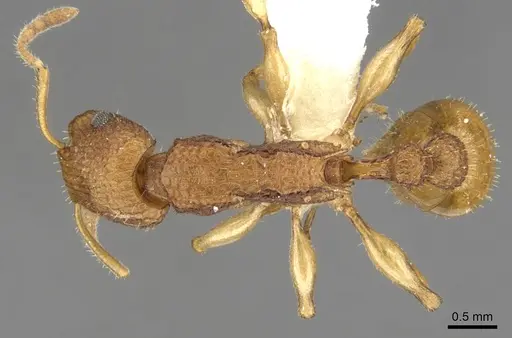
Literatura
A carregar mapa de distribuição...A carregar produtos...