
Discothyrea kalypso
- Nome cient.
- Discothyrea kalypso
- Tribo
- Proceratiini
- Subfamília
- Proceratiinae
- Autor
- Hita-Garcia & Lieberman, 2019
- Distribuição
- Encontrado em 0 países
Introdução
Discothyrea kalypso is a tiny ant species known only from Mlola Forest on Mafia Island, Tanzania. Workers lack eyes and have a disc-shaped frontal lamella . Body size data is unavailable, as no total length measurements are provided in the research. It inhabits primary coastal forest leaf litter at 20 meters elevation . This species is exceptionally rare, with only a single worker specimen collected in 2008,making it one of the least-known ants in the world. The name references Kalypso, a mythological nymph living on a secluded island, reflecting its isolated habitat.
Quick Summary
- Difficulty: Expert
- Origin & Habitat: Mlola Forest, Mafia Island, Tanzania, primary coastal forest leaf litter at 20m elevation [1]
- Colony Type: Unknown colony structure, only the holotype worker has been described
- Size & Growth:
- Queen: Unknown, queen has never been described or collected
- Worker: size data unavailable
- Colony: Unknown, no colony data exists
- Growth: Unknown
- Development: Unknown, no development data available (Development timeline is unknown for this species.)
- Antkeeping:
- Temperature: Keep warm, roughly 24-28°C, based on tropical coastal habitat [1]
- Humidity: Keep the nest substrate consistently moist but not waterlogged, as it inhabits leaf litter [1]
- Diapause: Unknown, likely active year-round given tropical location [1]
- Nesting: Leaf litter and soil micro-cavities, requires fine-grained, moist substrate with tiny chambers scaled to their minute size [1]
- Behavior: This species is likely subterranean or litter-dwelling due to eyelessness. No aggression data is available, but their tiny size suggests minimal defensive capability. Escape prevention is critical due to their minute size.
- Common Issues: this species is virtually unavailable to keepers, only known from a single wild specimen collected in 2008, no biological or behavioral data exists for this species, all care recommendations are speculative, their extreme tiny size makes them extraordinarily difficult to house and feed, no established captive breeding exists, wild collection would be nearly impossible, related species are notoriously difficult to keep alive in captivity
Why This Species Is Extremely Difficult to Keep
Discothyrea kalypso presents challenging circumstances for captive keeping. This species is known from a single worker collected in 2008 from Mafia Island, Tanzania, no queens, no males, no colonies have ever been found [1]. The entire global scientific knowledge consists of one dead specimen. There is no established population in captivity, no documented care history, and no way to legally obtain this species. Even professional myrmecologists have not found additional specimens despite dedicated collecting efforts in the region. This is not a species you can purchase, find locally, or acquire through any legitimate means. Even if you somehow obtained one, there is zero information on their diet, founding behavior, temperature preferences, or any aspect of their biology that would guide successful captive care.
Related Species as Care References
Since no direct data exists for D. kalypso, care must be inferred from related Discothyrea species, though this is speculative. The genus Discothyrea contains about 30 species globally, all of which are tiny, cryptic, leaf-litter dwelling ants. They are predators specializing on arthropod eggs. In captivity, related species have been kept successfully only by expert keepers using very small test tube setups with extremely fine hydration control. They require tiny prey items, springtails, booklice, and similar micro-arthropods are the only realistic food options. The genus is known for being extremely sensitive to drying out and to disturbance. However, even these general patterns are drawn from a handful of commonly kept species and may not apply to D. kalypso at all. [1]
Natural History and Ecology
The only known specimen of D. kalypso was collected from leaf litter in a primary coastal forest on Mafia Island, Tanzania at just 20 meters elevation [1]. Mafia Island is a small island off the coast of mainland Tanzania, and the habitat was described as primary forest, meaning mature, undisturbed woodland. The ant was collected using Winkler extraction of leaf litter, meaning it was living deep within the forest floor debris, not on the surface. The absence of eyes confirms this is a subterranean or litter-dwelling species that does not rely on visual cues. The coastal forest environment suggests warm temperatures year-round and relatively high humidity. Nothing else is known about their behavior, diet, colony size, reproductive biology, or any other aspect of their natural history.
Identification and Morphology
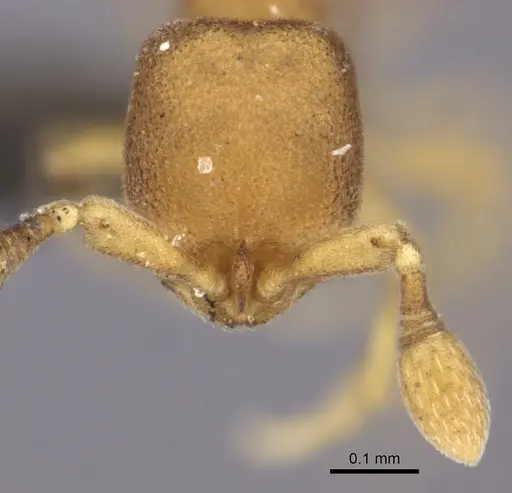
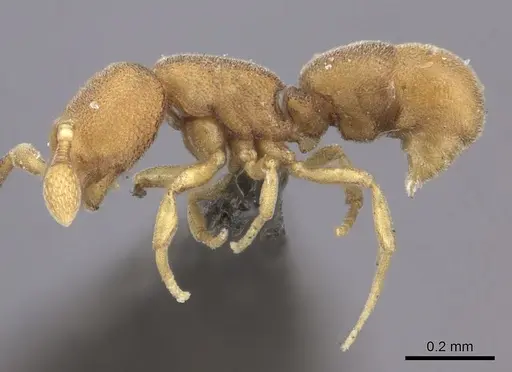
Workers of D. kalypso can be identified by completely absent eyes, a disc-shaped frontal lamella without a basal window, a low and slender mesosoma, short blunt propodeal denticles, and a mesotibia without a ventral spur [1]. The petiolar node is unusually attenuated, and the abdominal segment 3 is elongate-campaniform. The overall color is uniformly dull yellowish. The nine-segmented antennae with a compact apical club and the absence of any standing hairs on the mesosoma further distinguish this species [1].
Frequently Asked Questions
Can I keep Discothyrea kalypso as a pet?
No. This species is essentially unavailable to hobbyists. It is known from a single specimen collected in 2008,and no colonies exist in captivity. There is no legitimate way to obtain this species, and even if you could, there is no information on how to keep it alive.
How big are Discothyrea kalypso ants?
Body size data is unavailable for this species, as no total length measurements are provided in the research. Workers are extremely tiny, but specific dimensions are not known.
What do Discothyrea kalypso ants eat?
Unknown for this specific species, but Discothyrea genus members are predators of arthropod eggs and tiny micro-arthropods. In captivity, related species accept springtails, booklice, and similar minute prey. Sugar sources are unlikely to be accepted given their predatory nature.
Where does Discothyrea kalypso live?
Only known from Mlola Forest on Mafia Island, Tanzania. It was collected from leaf litter in primary coastal forest at 20 meters elevation [1].
Do Discothyrea kalypso ants have eyes?
No. This species completely lacks eyes, making it fully blind [1]. This is typical for leaf-litter dwelling ants that live in dark, confined spaces.
Are Discothyrea kalypso dangerous?
No. At their tiny size, they are far too small to sting or bite humans in any meaningful way. They pose no danger whatsoever.
What temperature do Discothyrea kalypso need?
Unknown, but based on their tropical coastal forest habitat in Tanzania, they likely prefer warm conditions around 24-28°C. This is inferred and speculative.
Is Discothyrea kalypso a good species for beginners?
Absolutely not. This is an expert-only species in theory, but in practice it is essentially impossible to obtain and impossible to keep even for professionals due to complete lack of biological data. Beginners should stick to established species with known care requirements.
Report an Issue
The current care sheet is based fully on literature. See inconsistencies, or something that's incorrect? Please , it will be resolved after review from an admin. Contributing to the blogs tab also helps providing information, to make us be able to further improve the caresheets. Thank you for your support!
References

Esta ficha de cuidados é licenciada sob CC BY-SA 4.0 .
Blogs da comunidade
CASENT0235468
Ver no AntWeb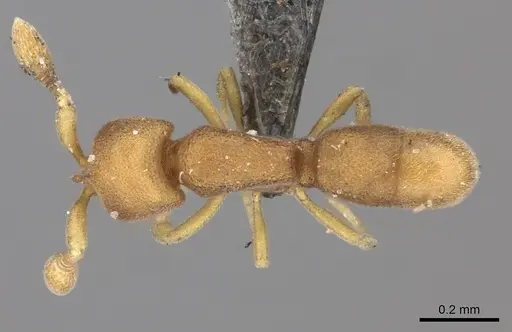
Literatura
A carregar mapa de distribuição...A carregar produtos...