
Axinidris kinoin
- Nome cient.
- Axinidris kinoin
- Tribo
- Tapinomini
- Subfamília
- Dolichoderinae
- Autor
- Shattuck, 1991
- Distribuição
- Encontrado em 0 países
Introdução
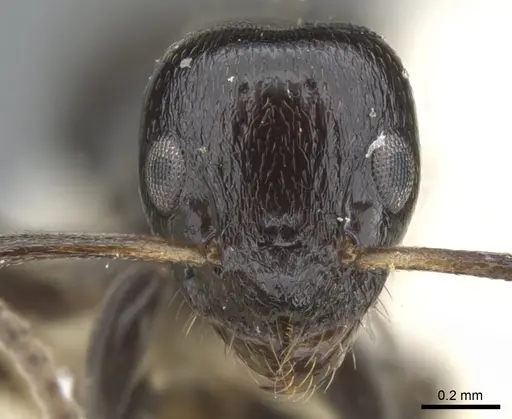
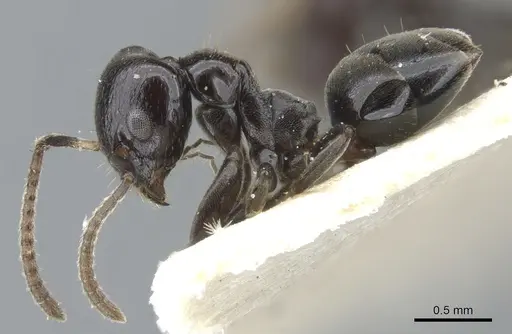
Axinidris kinoin is one of the rarest ants in existence - only two worker specimens have ever been collected, both from a single location in Nigeria in 1975. These tiny reddish-brown ants were found in roadside vegetation at what is now the Cocoa Research Institute of Nigeria . The workers have distinctive erect hairs on their pronotum and one or two short hairs on their antennae, helping separate them from similar species . Scientists have never observed living colonies, so nothing is known about their queens, colony structure, diet, or behavior .
Quick Summary
- Difficulty: Expert
- Origin & Habitat: Nigeria, Afrotropical region. Known only from roadside vegetation at the Gambari Experiment Station (now Cocoa Research Institute of Nigeria) [1][2].
- Colony Type: Unknown, only the worker caste has ever been described [1].
- Size & Growth:
- Queen: Unknown, queens have never been described [1].
- Worker: Size data unavailable, only head and mesosoma measurements exist in scientific literature [2].
- Colony: Unknown.
- Growth: Unknown.
- Development: Unknown, no developmental data exists for this species. (No studies have observed colony founding or brood development.)
- Antkeeping:
- Temperature: Unknown. Based on their tropical Nigerian origin, they likely need warm stable temperatures, but this is unconfirmed [1].
- Humidity: Unknown.
- Diapause: Unlikely required as they come from tropical Nigeria, but this is unconfirmed [1].
- Nesting: Unknown. The genus Axinidris is arboreal (tree-dwelling), suggesting they would need vertical nesting surfaces if found [2].
- Behavior: Unknown, only two preserved museum specimens exist, so no observations of living behavior have been made [2]. They belong to the Dolichoderinae subfamily, which lacks a functional sting and instead uses chemical defenses from an anal gland to deter predators.
- Common Issues: only workers are known, no queens have ever been described, making it impossible to start a captive colony., complete absence of data on diet, temperature needs, and nesting requirements means care would be pure guesswork., extreme rarity means the species is not available in the pet trade and should not be collected from the wild.
Why This Species Cannot Be Kept
You cannot keep Axinidris kinoin because no one has ever found a queen. Only two worker specimens exist in museum collections, collected in 1975 from Nigeria [1][2]. Without queens, you cannot start a colony. Even if someone discovered a queen tomorrow, there is zero information about how to care for them, no data on what they eat, what temperature they need, or how they build their nests [1]. This species exists only as a scientific curiosity, not as a pet ant.
Physical Description
The two known workers are small reddish-brown ants with specific hair patterns that distinguish them from similar species. They have about six erect hairs on their pronotum (the first section of the middle body) and one or two short erect hairs on their antennae [2]. Their middle body section lacks wrinkles or ridges, and they have a distinct medial carina (a raised line running down the center of the head) [2]. The head is reddish brown and slightly longer than it is wide [2].
Arboreal Genus
While we know nothing specific about where Axinidris kinoin nests, the genus Axinidris is described as arboreal, meaning they live in trees [2]. If you were to encounter this species in Nigeria, you would likely find them in vegetation above ground rather than in soil nests. This suggests they might prefer vertical nesting surfaces and humid microhabitats in tree bark or leaf litter, but this is speculation based on genus-level patterns [2].
Defense Mechanism
Axinidris kinoin belongs to the subfamily Dolichoderinae, which lacks a functional sting. Instead, these ants defend themselves by exuding sticky, foul-smelling chemicals from an anal gland. This is a common defense strategy across the Dolichoderinae subfamily.
Conservation and Ethics
Because only two specimens exist, Axinidris kinoin represents the extreme end of rarity in ant biodiversity. If you are an antkeeper in Nigeria, encountering this species would be a significant scientific event rather than a pet-keeping opportunity. You should document the find with photographs and contact entomological institutions rather than attempting to collect specimens for a personal collection. The species is likely not endangered in reality, it is probably just extremely difficult to find, but the lack of data means we cannot assess its conservation status [1].
Frequently Asked Questions
Can I keep Axinidris kinoin as a pet?
No. Only two worker specimens have ever been collected, and no queens are known. Without a queen, you cannot start a colony, and even if you found one, there is no information about how to care for them [1][2].
How big are Axinidris kinoin workers?
Size data is unavailable. Scientific literature only provides head and mesosoma measurements, not total body length [2].
Where does Axinidris kinoin live?
They are only known from Nigeria, specifically from roadside vegetation at the Gambari Experiment Station (now the Cocoa Research Institute of Nigeria) [1][2].
What do Axinidris kinoin eat?
Nobody knows. Their diet has never been studied because only two preserved specimens exist [1].
How long does Axinidris kinoin take to develop from egg to worker?
Unknown. No one has ever observed their brood development [1].
Are Axinidris kinoin good for beginners?
No. They are not available in the pet trade, no care information exists, and they should not be collected from the wild [1][2].
How do I find a queen Axinidris kinoin?
You cannot. Queens have never been described by scientists. The only way to potentially obtain a colony would be to collect an entire wild colony in Nigeria and hope it contains a queen, but this would require expert identification and is not recommended given the species' rarity [1].
Report an Issue
The current care sheet is based fully on literature. See inconsistencies, or something that's incorrect? Please , it will be resolved after review from an admin. Contributing to the blogs tab also helps providing information, to make us be able to further improve the caresheets. Thank you for your support!
References

Esta ficha de cuidados é licenciada sob CC BY-SA 4.0 .
Blogs da comunidade
CASENT0902936
Ver no AntWeb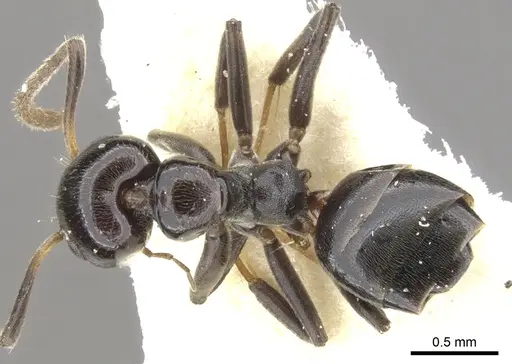
Literatura
A carregar mapa de distribuição...A carregar produtos...