
Aenictus samungi
- Nome cient.
- Aenictus samungi
- Subfamília
- Dorylinae
- Autor
- Jaitrong & Ruangsittichai, 2018
- Distribuição
- Encontrado em 0 países
Introdução
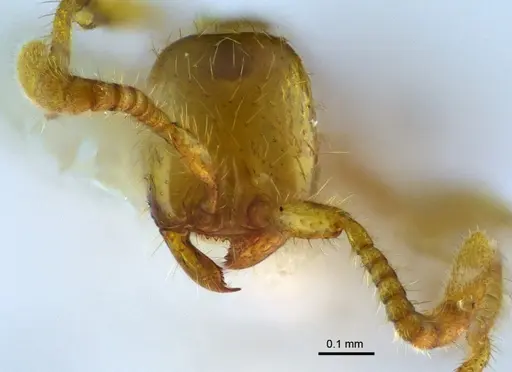
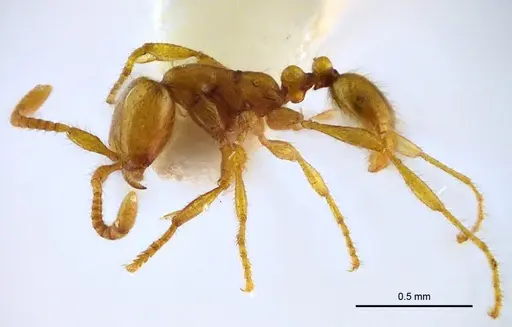
Aenictus samungi is a minute army ant from the mountains of western Thailand, with workers measuring approximately 1.75 mm in total length . These tiny yellowish-brown ants are the smallest species in the Aenictus wroughtonii group, distinguished by their very short antennae, compact petiole, and seven tiny teeth on the clypeus . Known only from the type locality in Thung Yai Wildlife Sanctuary near the Myanmar border, they were discovered foraging in fast-moving columns along a forest path in dry evergreen forest at approximately 1100 meters elevation . As a member of the army ant subfamily Dorylinae, they almost certainly live a nomadic lifestyle with no permanent nest, instead forming temporary bivouacs while raiding for prey . However, virtually nothing is known of their colony structure, diet, or reproductive habits beyond the single collection event in 2016 . Their extreme rarity and specialized biology make them unsuitable for captive keeping.
Quick Summary
- Difficulty: Expert
- Origin & Habitat: Western Thailand (Tak Province), dry evergreen forest at approximately 1100 m elevation [1]
- Colony Type: Unknown, army ants typically form large colonies, but specific structure unconfirmed for this species
- Size & Growth:
- Antkeeping:
- Behavior: Fast-running with column foraging observed in the field [1]. Extremely small size creates severe escape risk. Likely specialized predators of other social insects based on genus patterns [2].
- Common Issues: extremely small worker size allows escape through minute gaps in standard equipment., specialized army ant biology requires live prey and extensive space unavailable to hobbyists., nomadic lifestyle incompatible with standard formicarium setups., rarity and restricted range makes collection unethical and potentially illegal.
Identification and Appearance
Aenictus samungi workers are exceptionally small, measuring only about 1.75 mm in total length, making them the smallest species in the wroughtonii group [1]. They have a distinctive yellowish-brown coloration with dark brown mandibles [1]. Key identifying features include a head that is clearly longer than broad with weakly convex sides, very short antennae that only reach to the mid-length of the head, and a petiole that is shorter than it is high [1]. The clypeus bears seven small denticles on its anterior margin, and the mandibles are subtriangular with a large curved apical tooth followed by smaller teeth [1]. The body is mostly smooth and shiny with sparse standing hairs [1].
Natural History and Habitat
This species is known only from the type locality in Thung Yai Wildlife Sanctuary in western Thailand's Tak Province, specifically in dry evergreen forest at approximately 1100 meters above sea level [1]. The type series was collected from a foraging column on a forest path in September 2016 [1]. No immature stages or prey items were observed with the column [1]. A single additional worker was collected nearby in May 1999,suggesting the species may be genuinely rare or cryptic [1]. The habitat consists of dry evergreen forest at moderate elevation, indicating these ants likely prefer warm, stable conditions with moderate humidity [1][2].
The Army Ant Challenge
As a member of the army ant subfamily Dorylinae, Aenictus samungi likely possesses biological traits that make captive keeping virtually impossible for hobbyists [2]. Army ants are nomadic, meaning they do not construct permanent nests but instead form temporary bivouacs and frequently relocate [2]. They typically require massive colony sizes numbering in the thousands to function normally, and they are specialized predators that hunt other social insects, particularly ants and termites [2]. Standard ant keeping equipment such as test tubes, formicaria, and outworlds cannot accommodate their need for space, constant movement, and specialized prey. Additionally, their extremely small size means they would escape through the smallest gaps in any standard setup.
Conservation and Legal Status
Aenictus samungi is considered a rare species known only from its type locality in a protected wildlife sanctuary [1]. Collecting these ants would likely require permits and could be illegal under Thai law and international conservation agreements. Given their extreme rarity and limited known range, any removal of colonies from the wild would be unethical and potentially damaging to the species. Hobbyists should not attempt to collect or keep this species.
Frequently Asked Questions
Can I keep Aenictus samungi in captivity?
No, this is not a species suitable for captive keeping. As an army ant, they likely require massive colonies, constant movement, and specialized prey that cannot be provided in standard setups. Their extreme rarity also makes collection unethical.
How big do Aenictus samungi colonies get?
The colony size is unknown for this specific species. Related Aenictus army ants typically maintain colonies of thousands to tens of thousands of workers, but this has not been documented for A. samungi.
What do Aenictus samungi eat?
Their diet is unknown, but based on patterns in the genus Aenictus, they are likely specialized predators of other ants and termites. No prey was observed with the foraging column when they were discovered.
What temperature do Aenictus samungi need?
Specific temperature requirements are unknown. Based on their collection in tropical Thailand at 1100m elevation, they likely prefer warm conditions, but this is unconfirmed.
Where are Aenictus samungi found?
They are known only from western Thailand near the Myanmar border, specifically in Thung Yai Wildlife Sanctuary in Tak Province.
How fast do Aenictus samungi grow?
Growth rate and development time are completely unknown for this species. No captive colonies exist to study this.
Can I keep multiple Aenictus samungi queens together?
This is unknown for Aenictus samungi. Army ants often have different colony founding strategies than typical ants, but specific details are unconfirmed.
Report an Issue
The current care sheet is based fully on literature. See inconsistencies, or something that's incorrect? Please , it will be resolved after review from an admin. Contributing to the blogs tab also helps providing information, to make us be able to further improve the caresheets. Thank you for your support!
References

Esta ficha de cuidados é licenciada sob CC BY-SA 4.0 .
Blogs da comunidade
THNHM-I-02615
Ver no AntWeb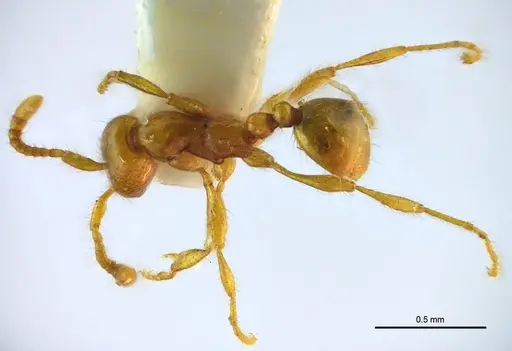
Literatura
A carregar mapa de distribuição...A carregar produtos...