
Aenictus cylindripetiolus
- Nome cient.
- Aenictus cylindripetiolus
- Subfamília
- Dorylinae
- Autor
- Jaitrong & Yamane, 2013
- Distribuição
- Encontrado em 0 países
Introdução
Aenictus cylindripetiolus is a tiny army ant from Southeast Asia, with workers measuring 2.9-3.15 mm and a distinctive cylindrical petiole that gives the species its name . These reddish-brown ants inhabit lowland primary rainforests in southern Thailand and Singapore, where they were discovered living under rotting logs during the rainy season . Like other members of the Aenictus ceylonicus group, they are specialized predators that hunt in coordinated groups, though their specific prey preferences remain unstudied. As an army ant species, they present extreme challenges for captive care. They do not build permanent nests but instead form temporary bivouacs (living clusters of bodies) that relocate frequently as they hunt . Their tiny size and nomadic lifestyle make them unsuitable for standard ant-keeping setups, requiring instead specialized laboratory facilities with massive foraging arenas.
Quick Summary
- Difficulty: Expert
- Origin & Habitat: Southern Thailand and Singapore, lowland primary rainforest, found under rotting logs in rainy season [1]
- Colony Type: Single queen (monogyne) with massive colonies that reproduce by colony fission (splitting) [2]
- Size & Growth:
- Queen: 6.15 mm [1]
- Worker: 2.90-3.15 mm [1]
- Colony: Unknown for this species, related Aenictus species reach thousands to tens of thousands of workers [2]
- Growth: Fast
- Development: Unknown for this species. (Army ants do not have a static 'egg to worker' timeline like typical ants, brood development is continuous and rapid in established colonies.)
- Antkeeping:
- Temperature: Warm tropical conditions, approximately 25-28°C (inferred from lowland rainforest habitat in Thailand) [1]
- Humidity: High humidity required, soil should be moist to wet (rainforest floor conditions) [1]
- Diapause: No, tropical species from Thailand/Singapore do not require hibernation [1]
- Nesting: Forms temporary bivouacs (living clusters), requires specialized facilities with extensive foraging space. Standard nests are unsuitable [1][2]
- Behavior: Highly aggressive, nomadic army ants that hunt in coordinated raids. Extreme escape risk due to 3mm worker size, they fit through the tiniest gaps [1].
- Common Issues: standard nests are completely unsuitable due to bivouac-forming behavior and constant nomadic movement., require massive daily quantities of live prey (other ants, termites) that hobbyists cannot sustainably provide., extreme escape risk, 3mm workers squeeze through the smallest gaps in standard enclosures., cannot be started from a single queen, colonies only form through fission from parent colonies.
Natural History and Habitat
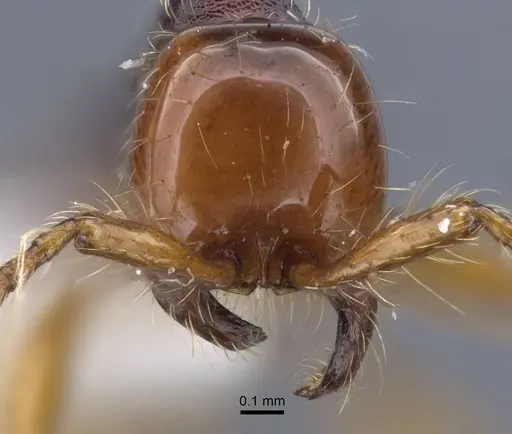
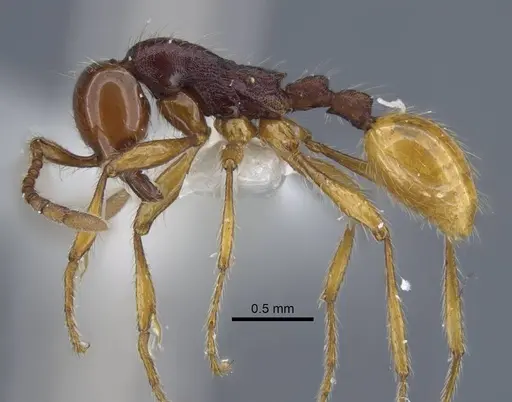
These tiny army ants measure just 3mm in length and display the characteristic cylindrical petiole that earned them their name [1]. Found in the rainforests of southern Thailand and Singapore, they inhabit lowland primary forests where they nest under rotting logs during the rainy season [1]. The type series was discovered in Khao Chong Botanical Garden, sheltering beneath a log with no visible worker activity around the entrance and no brood present in the bivouac [1]. This nomadic lifestyle reflects their army ant nature, they do not maintain permanent nests but instead form temporary living structures that relocate as they hunt [2].
The workers are reddish brown to dark reddish brown, with yellowish brown gasters and legs [1]. Queens are significantly larger at 6.15mm and have a more robust build with distinct color patterning including dark markings on the gaster segments [1].
Why Standard Ant Keeping Fails
Aenictus cylindripetiolus cannot be kept in standard formicaria. As an army ant, the colony operates as a mobile hunting unit that requires constant movement and enormous quantities of prey [2]. They do not found colonies through single queens raising first workers, instead, new colonies split off from parent colonies through fission, with workers accompanying the new queen [2]. This means you cannot start with a single queen in a test tube.
Additionally, their 3mm size allows them to escape through the tiniest gaps in standard enclosures [1]. Army ants also require massive foraging areas, often room-sized enclosures, to accommodate their nomadic columns and hunting behavior. Without constant access to large amounts of live prey, the colony will starve within days.
Research-Grade Housing Requirements
If you are researching these ants scientifically, you would need specialized facilities. Army ants require massive foraging arenas to accommodate their nomadic columns. The enclosure must maintain tropical rainforest conditions: temperatures around 25-28°C and high humidity [1].
Unlike typical ants that settle into nest chambers, these ants need open space to form bivouacs and room to roam. Standard Y-tong, plaster, or acrylic nests are completely unsuitable. You would need a large, sealed container with excellent escape prevention (fine mesh barriers and Fluon-coated walls) and a soil substrate deep enough for temporary bivouac formation. The enclosure must also allow for regular introduction of large quantities of live prey.
Feeding and Diet
In the wild, Aenictus species are specialist predators that hunt other social insects, particularly termites and other ant species [2]. They forage in coordinated raids, overwhelming prey through numbers. The type specimen was found in a longkong orchard, suggesting they may forage in disturbed habitats as well as primary forest [2].
In captivity, this translates to needing massive quantities of live prey daily, not occasional feeding, but constant availability of termites, small insects, or other ants. This feeding requirement alone makes them impossible for hobbyist keepers to maintain, as you would need continuous access to live colonies of other insects to sustain them.
Frequently Asked Questions
Can I keep Aenictus cylindripetiolus in a test tube?
No. Army ants do not found colonies individually. New colonies form when an existing colony splits (fissions), taking workers with the new queen. A single queen cannot survive alone, and the space constraints of a test tube are incompatible with their biology [2].
How long until first workers for Aenictus cylindripetiolus?
This question does not apply to army ants. They do not have a 'founding stage' where a queen raises her first workers alone. Colonies expand through fission from parent colonies, already containing workers [2].
What do Aenictus cylindripetiolus eat?
They are specialist predators that hunt other social insects, particularly termites and other ants. They require live prey in massive quantities daily, not occasional feeding [2].
How big do Aenictus cylindripetiolus colonies get?
Exact colony size for this species is unknown, but related Aenictus species maintain colonies of thousands to tens of thousands of workers [2].
Why are my Aenictus cylindripetiolus dying?
If you are attempting to keep these in standard ant farms, they are dying because army ants cannot be kept in captivity without specialized laboratory facilities. They require constant movement, massive foraging space, and enormous quantities of prey that hobbyist setups cannot provide [2].
What is the best nest type for Aenictus cylindripetiolus?
There is no suitable 'nest type' for hobbyists. Army ants form temporary bivouacs (living clusters) and require large, open enclosures with soil substrate and massive foraging areas, not enclosed nest chambers [1][2].
Report an Issue
The current care sheet is based fully on literature. See inconsistencies, or something that's incorrect? Please , it will be resolved after review from an admin. Contributing to the blogs tab also helps providing information, to make us be able to further improve the caresheets. Thank you for your support!
References

Esta ficha de cuidados é licenciada sob CC BY-SA 4.0 .
Blogs da comunidade
CASENT0917244
Ver no AntWeb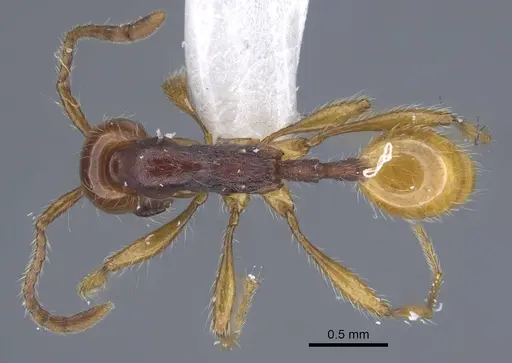
Literatura
A carregar mapa de distribuição...A carregar produtos...