
Temnothorax foreli
- Nome científico
- Temnothorax foreli
- Tribo
- Crematogastrini
- Subfamília
- Myrmicinae
- Autor
- Santschi, 1907
- Distribuição
- Encontrada em 0 países
Introdução
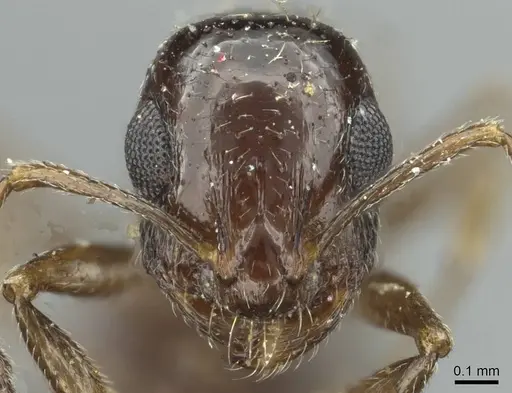
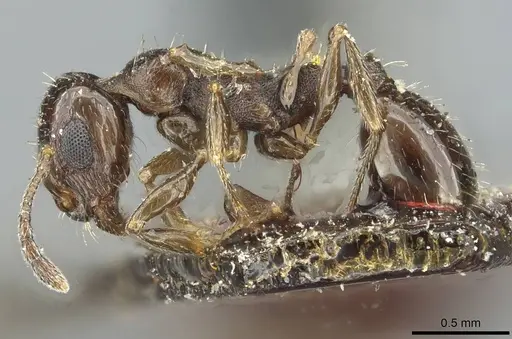
Temnothorax foreli is a small ant from North Africa, specifically Tunisia . Workers are blackish with relatively large eyes and well-developed propodeal spines . They belong to the genus Temnothorax, which nest in small cavities such as hollow stems, under stones, or in rotting wood. As a North African species, they are adapted to warmer, drier climates compared to European relatives. Their defense mechanism uses a modified spatulate stinger to smear venom, rather than piercing.
Quick Summary
- Difficulty: Medium, but many biological parameters are unknown, so keepers should be prepared to adapt and observe carefully.
- Origin & Habitat: Tunisia, North Africa (Palaearctic Region) [1] [2]. Presumed to inhabit dry to semi-arid areas, nesting in small cavities under stones or in dead wood.
- Colony Type: Unconfirmed. Based on typical Temnothorax patterns, likely monogyne (single queen), but no specific data exists for this species [1].
- Size & Growth:
- Queen: Unknown. Sexuals (queens and males) have not been described [1].
- Worker: Size data unavailable for the extant species. Based on genus patterns, workers are expected to be roughly 2-4 mm. A related fossil species had a worker body length of 3.4 mm [3], but this is not directly applicable to the living species.
- Colony: Unknown. Based on genus, likely small colonies of up to a few hundred workers, but unconfirmed.
- Growth: Unknown
- Development: Unknown. No data for this species. (Development likely depends on temperature and food availability, but specific requirements are unknown.)
- Antkeeping:
- Temperature: Unknown. As a North African species, likely prefers warm conditions (roughly 22-28°C). Provide a temperature gradient and avoid extremes above 30°C [1].
- Humidity: Unknown. Based on dry origin, provide a drier nest with one moist area. Avoid waterlogging.
- Diapause: Unknown. North African origin suggests no strict cold diapause, but a mild winter cooling (15-18°C for 4-6 weeks) may be beneficial if observed.
- Nesting: Small cavity nests like Y-tong (AAC) or plaster with tiny chambers. Test tubes work for founding. Ensure tight seals due to small size.
- Behavior: Generally non-aggressive based on genus. Uses smear defense (spatulate stinger), harmless to humans. Escape risk is high due to tiny size, use fine mesh (0.5 mm or smaller).
- Common Issues: escape prevention is critical due to tiny size, use fine mesh (0.5 mm or smaller) and airtight seals., limited biological data means husbandry is experimental, carefully observe colony health and adjust accordingly., overheating or desiccation can occur quickly in small nests, monitor humidity and temperature gradients., wild-caught queens may be parasitized, quarantine new colonies.
Housing and Nest Setup
As a small species [1], housing must be escape-proof. Y-tong (AAC) or plaster nests with small chambers work well because they mimic the natural cavity nesting. Test tube setups are suitable for founding colonies. The nest should have a water source at one end to create a humidity gradient. Because workers are tiny, use fine mesh (0.5 mm or smaller) on all ventilation and ensure tight seals on connections. A shallow outworld prevents workers from getting lost.
Feeding and Diet
No specific dietary studies exist for this species. In captivity, offer a balanced diet: sugar water or honey water changed every 2-3 days, and small protein sources like fruit flies, pinhead crickets, or small mealworms. Remove uneaten prey after 24-48 hours to prevent mold. Live prey may be better accepted, but prepared insect jellies can also be tried. Adjust amounts based on how quickly the colony consumes food.
Temperature and Seasonal Care
Exact temperature needs are unknown. Based on its North African origin [1], the species likely prefers warmth in the 22-28°C range. Use a heating cable on one part of the nest to create a gradient. Avoid temperatures above 30°C as these may stress the colony. Diapause requirements are unclear, a mild winter cooling (15-18°C for 4-6 weeks) might be beneficial if the colony shows decreased activity, but it is not strictly required. Monitor behavior to tune conditions.
Colony Development and Growth
No specific data on development time is available. Based on related Temnothorax species, the queen may remain sealed for several weeks while raising the first workers. Colony growth is likely slow, with small worker numbers over the first year. Be patient and avoid disturbing the nest frequently, especially during founding.
Behavior and Observation
Workers have large eyes [1], which may indicate visual ability. They forage individually, searching for food and returning to the nest. The smear defense mechanism involves a spatulate stinger used to apply venom, the venom is not considered harmful to humans. Because of their small size, they are not aggressive. They can easily escape through tiny gaps, so careful observation from a distance is recommended.
Frequently Asked Questions
How long does it take for Temnothorax foreli to have first workers?
Unknown. No data for this species. Based on related Temnothorax, possibly 6-10 weeks at warm temperatures, but this is not confirmed.
What do Temnothorax foreli ants eat?
Offer sugar water or honey water every 2-3 days, and small live prey like fruit flies or pinhead crickets. No specific dietary studies exist for this species.
Can I keep Temnothorax foreli in a test tube?
Yes, test tubes work well for founding colonies. Use a small tube with a water reservoir separated by cotton. Once the colony grows beyond 20-30 workers, consider moving to a small Y-tong or plaster nest.
Do Temnothorax foreli ants need hibernation?
Unknown. North African origin suggests no strict cold diapause, but a mild cooling period (15-18°C for 4-6 weeks) may be beneficial if colony activity slows.
How big do Temnothorax foreli colonies get?
Unknown. Likely small colonies, up to a few hundred workers, based on genus patterns. No specific data exists.
Are Temnothorax foreli ants dangerous?
No. They use a smear venom that is harmless to humans. They are non-aggressive and rarely bite.
Why are my Temnothorax foreli escaping?
Their tiny size lets them squeeze through the smallest gaps. Check all connections and use fine mesh (0.5 mm or smaller) on ventilation. Even small cracks are potential escape routes.
What temperature is best for Temnothorax foreli?
Unknown. Likely warm (22-28°C) based on North African origin. Provide a gradient and avoid temperatures above 30°C [1].
Can I keep multiple queens together?
Unknown. Likely monogyne, but no studies exist. Combining unrelated queens is not recommended.
Is Temnothorax foreli good for beginners?
This is a medium-difficulty species because many biological parameters are unknown. They require careful escape prevention and adaptable care, making them more challenging than common pet ants.
Report an Issue
The current care sheet is based fully on literature. See inconsistencies, or something that's incorrect? Please , it will be resolved after review from an admin. Contributing to the blogs tab also helps providing information, to make us be able to further improve the caresheets. Thank you for your support!
References

Este guia de cuidados está sob a licença CC BY-SA 4.0 .
Posts da comunidade
CASENT0912936
Ver no AntWeb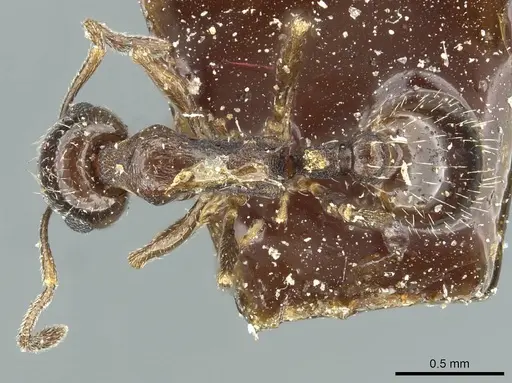
Literatura
Carregando mapa de distribuição...Carregando produtos...