
Strumigenys stygia
- Nome científico
- Strumigenys stygia
- Tribo
- Attini
- Subfamília
- Myrmicinae
- Autor
- Santschi, 1913
- Distribuição
- Encontrada em 0 países
Introdução
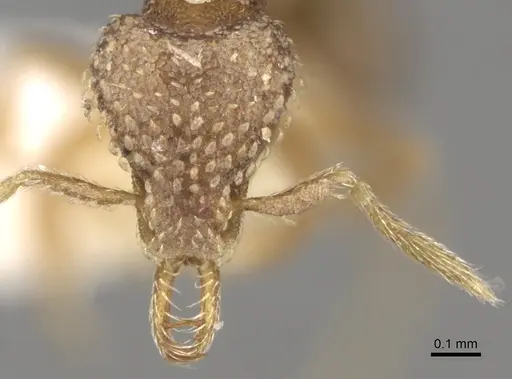
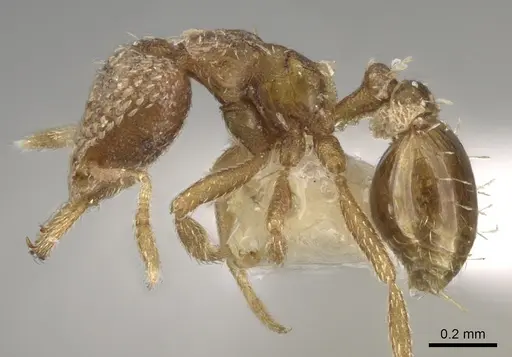
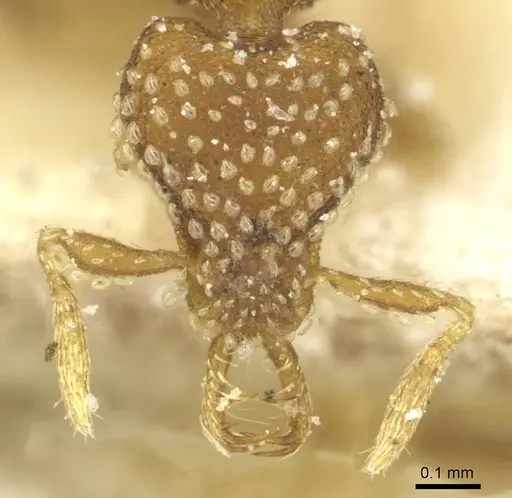
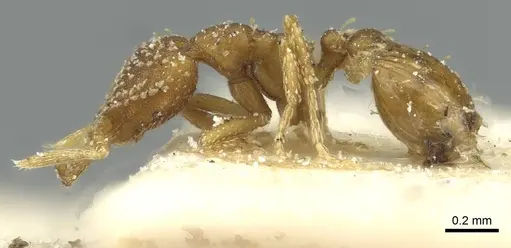
Strumigenys stygia is a tiny predatory ant measuring just 1.8-2.1 mm in total length, with workers colored light to medium brown . This species belongs to the arnoldi group of dacetine ants and is known from only two collections in the Afrotropical region - Kenya, and possibly Angola, Cameroun, and Zimbabwe . Unlike many other Attini, Strumigenys are specialized predators that hunt springtails using their unique trap-jaw mandibles. The original specimen was collected from a cave in Shimoni, Kenya in 1911,hinting at a preference for dark, humid environments . Their tiny size, broad spoon-shaped hairs, and small eyes make them a challenge to observe even in captivity.
Quick Summary
- Difficulty: Expert
- Origin & Habitat: Afrotropical region, Kenya, Angola, Cameroun, and Zimbabwe. The only confirmed collection came from a cave (Shimoni Cave A), indicating a preference for dark, humid microhabitats [2][1].
- Colony Type: Colony structure is unconfirmed, this species is known from only two collections with no biological data [1]. Based on related Strumigenys species, colonies are likely single-queen.
- Size & Growth:
- Queen: Unknown, no queen caste has been described [1]
- Worker: 1.8-2.1 mm total length [2][1]
- Colony: Unknown, no colony data exists [1]
- Growth: Unknown
- Development: Unknown, no development data exists. Based on similar tiny Strumigenys species, a rough estimate is 6-10 weeks at optimal temperature. (Timeline purely speculative, no captive rearing data available.)
- Antkeeping:
- Temperature: No thermal data exists. Based on its Afrotropical distribution and cave collection, start around 24-28°C with a gradient and adjust according to colony activity.
- Humidity: High humidity required. The cave habitat suggests consistently moist conditions, keep substrate damp but not waterlogged. Provide a humidity gradient if possible.
- Diapause: Unknown, as an Afrotropical species it likely does not hibernate. Maintain stable warm conditions year-round.
- Nesting: No nesting data exists. Based on the cave collection and related species, use a small Y-tong or plaster nest with tight chambers and consistent moisture. A naturalistic setup with fine substrate and cover is preferred.
- Behavior: Behavior is unstudied. Related Strumigenys are slow-moving, cryptic foragers that specialize on springtails. Due to their 2 mm size, escape prevention is critical, they can slip through standard barriers. They pose no threat to keepers, being non-aggressive and too small to sting effectively.
- Common Issues: no biological data exists, this is one of the least studied ants in the hobby, escape prevention is critical due to tiny 2 mm size, humidity requirements are unclear and must be carefully monitored, no confirmed diet acceptance, related species require live springtails, colony failure is likely without proper prey availability, no temperature data makes setup challenging
Species Identification and Related Species
Strumigenys stygia is a member of the arnoldi group, specifically the arnoldi complex, within the dacetine ants [1]. It can be distinguished from similar species by its unique combination of features: it has 2 teeth on the apical fork of each mandible, and it lacks the pronotal flagellate hairs of Strumigenys arnoldi, the reduced funicular segments of Strumigenys nimbrata, and the unsculptured postpetiole of Strumigenys mesahyla and Strumigenys traegaordhi [1]. Workers measure 1.8-2.1 mm total length, with light to medium brown body and distinctive broad spoon-shaped hairs curved anteriorly on the head dorsum [1][2].
Distribution and Habitat
This species is known from the Afrotropical region with confirmed collections in Kenya, and potential records from Angola, Cameroun, and Zimbabwe [1]. The type specimen was collected from Cave A at Shimoni, Kenya in November 1911, a dark, humid cave environment [2]. Only two scientific collections exist, and neither includes any biological details beyond the worker morphology [1]. The original description notes the worker was rusty ferruginous and 1.8 mm long [2].
Diet and Feeding (Inferred from Related Species)
No specific feeding data exists for Strumigenys stygia. However, species in the arnoldi group (and Strumigenys in general) are specialized predators of springtails and other micro-arthropods [1]. You should culture live springtails as the primary food source. Other small soft-bodied prey like booklice (psocids), mold mites, and tiny isopods may also be accepted. Sugar sources are unlikely to be taken, these are obligate predators. Feed small live prey every few days and remove leftovers to prevent mold.
Housing and Nesting
No captive husbandry data exists. Based on the cave collection and related species, provide high humidity in a naturalistic or semi-naturalistic setup. The tiny 2 mm worker size demands flawless escape prevention, use fine mesh barriers and seal all gaps. A small Y-tong nest with tight chambers or a small plaster nest with consistent moisture are good starting points. Keep the foraging area small with a thin layer of moist substrate. Due to their cryptic nature, avoid large open areas where they may get lost or stressed. [1]
Temperature and Care
No temperature data exists. As an Afrotropical species from an equatorial region, it likely prefers warm conditions, start around 24-28°C and monitor colony activity. The cave collection suggests tolerance for high humidity and darkness. Provide a thermal gradient so the colony can choose. Avoid extremes. Since no diapause data exists, assume no hibernation needed, keep warm year-round. Watch for stress signs (ants avoiding certain areas, clustering oddly) and adjust accordingly. [1]
Frequently Asked Questions
How long does it take for Strumigenys stygia to develop from egg to worker?
The egg-to-worker timeline is unconfirmed, no development data exists. Based on similar tiny Strumigenys, estimate roughly 6-10 weeks at optimal warm temperatures. This is a rough estimate only.
What do Strumigenys stygia ants eat?
No feeding data exists for this species. Based on related Strumigenys in the arnoldi group, they are specialized springtail predators. Provide live springtails as a staple food. Other small live prey may be accepted experimentally.
Are Strumigenys stygia good for beginners?
No, this is an expert-level species. It is known from only two scientific collections with virtually no biological data. There is no established husbandry information, making it extremely challenging to keep successfully.
How big do Strumigenys stygia colonies get?
Colony size is unknown, no colony data exists. Related Strumigenys typically form small colonies of under 100 workers.
Can I keep multiple Strumigenys stygia queens together?
Colony structure is unconfirmed. No data exists on queen number or whether they can form multi-queen colonies. Do not combine unrelated foundresses.
What temperature should I keep Strumigenys stygia at?
No specific temperature data exists. Based on Afrotropical distribution and cave habitat, start around 24-28°C with a gradient. Adjust based on colony activity and observe for stress signs.
Do Strumigenys stygia need hibernation?
Diapause requirements are unknown. As an Afrotropical species from Kenya, they likely do not require hibernation. Maintain stable warm conditions year-round.
Why are my Strumigenys stygia dying?
Without established husbandry data, colony failure is common. Ensure excellent escape prevention (they are tiny), provide high humidity, and maintain live springtail prey. Stress from improper conditions is the likely cause.
When will Strumigenys stygia produce their first workers?
Unknown, no founding or development data exists. Expect 6-10 weeks based on related species, but this is purely estimated.
What type of nest should I use for Strumigenys stygia?
No established nest data exists. Based on their tiny size and cave habitat, use a small naturalistic setup or Y-tong with tight chambers. Maintain consistently high humidity.
Is Strumigenys stygia aggressive?
Behavior is unstudied. Related Strumigenys are not aggressive toward humans but are specialized predators. They pose no threat to keepers.
Report an Issue
The current care sheet is based fully on literature. See inconsistencies, or something that's incorrect? Please , it will be resolved after review from an admin. Contributing to the blogs tab also helps providing information, to make us be able to further improve the caresheets. Thank you for your support!
References

Este guia de cuidados está sob a licença CC BY-SA 4.0 .
Posts da comunidade
CASENT0280728
Ver no AntWeb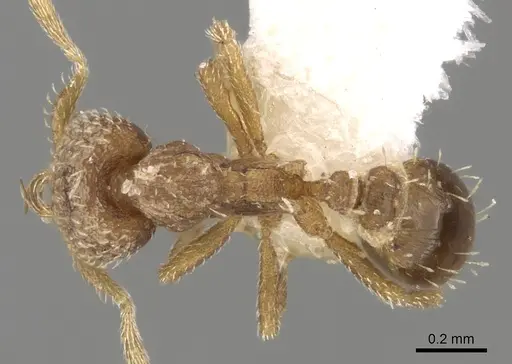
CASENT0912864
Ver no AntWeb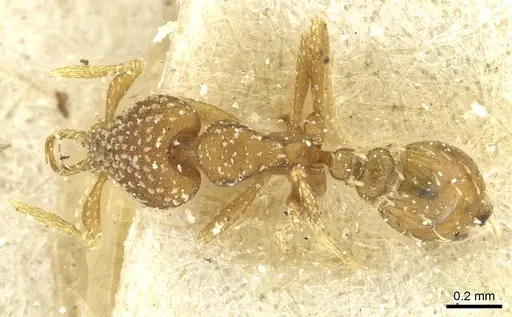
Literatura
Carregando mapa de distribuição...Carregando produtos...