
Strumigenys sanctipauli
- Nome científico
- Strumigenys sanctipauli
- Tribo
- Attini
- Subfamília
- Myrmicinae
- Autor
- Kempf, 1958
- Distribuição
- Encontrada em 1 países
Introdução
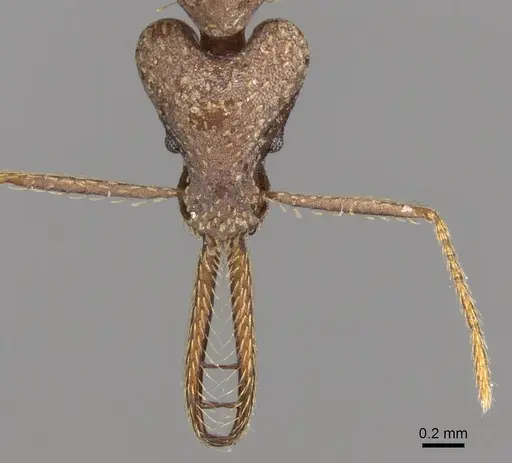
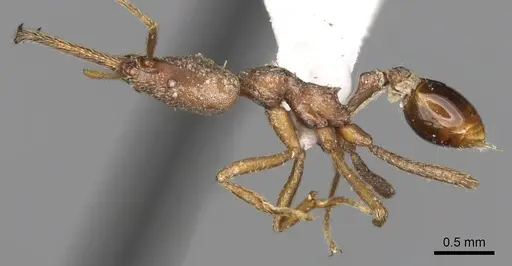
Strumigenys sanctipauli is a tiny predatory ant measuring 4.3-4.5mm in total length . It belongs to the mandibularis-complex within the Strumigenys mandibularis group, characterized by remarkably long, slender mandibles that diverge outward when closed . Only two worker specimens have ever been collected, both in the Atlantic Forest of São Paulo state, Brazil . The species was first described in 1958 and remains one of the rarest ants in the world . It lives in the forest floor leaf litter layer, where it hunts small arthropods.
Quick Summary
- Difficulty: Expert
- Origin & Habitat: Atlantic Forest of São Paulo state, Brazil (Neotropical region). Collected from leaf litter using winkler sampling, indicating a ground-dwelling, litter-foraging lifestyle in humid forest habitats [1][2].
- Colony Type: Unknown, only two workers have ever been collected, with no data on queen morphology or colony structure [1].
- Size & Growth:
- Queen: Unknown, queen has never been described [1]
- Worker: 4.3-4.5mm total length [1]
- Colony: Unknown, only two workers ever collected [1]
- Growth: Unknown, likely slow based on genus patterns for specialized predators
- Development: Unknown, no development data exists for this species. Related Strumigenys species typically take 2-4 months from egg to worker at tropical temperatures. (No direct observations of founding or development. Estimates based on genus-level data for similar Dacetini ants.)
- Antkeeping:
- Temperature: Keep at 22-26°C (estimate for tropical species from Atlantic Forest) [1]. Avoid prolonged cold.
- Humidity: High humidity, keep substrate moist, mimicking the humid leaf litter environment of the Atlantic Forest [1]. Do not let dry out.
- Diapause: Unlikely to require diapause, this is a tropical species from Brazil that experiences mild seasonal variation rather than cold winters [1].
- Nesting: Best kept in a naturalistic setup with moist substrate (soil/leaf litter mix) or a plaster nest with high humidity chambers [1]. The species was collected from leaf litter, suggesting they forage in the top layers of forest floor substrate.
- Behavior: Has a functional sting used to subdue prey, but not medically significant to humans [1]. Strumigenys are specialized predatory ants that use their elongated mandibles to capture small arthropods like springtails. They are typically slow-moving and use a stealthy hunting approach rather than aggressive swarming. Workers likely forage individually through leaf litter. Escape prevention is critical given their small size (4.3-4.5mm), use fine mesh barriers.
- Common Issues: extreme rarity makes this species nearly impossible to acquire for captive keeping, no captive husbandry information exists, this species has never been kept in captivity, very small size requires fine mesh barriers to prevent escapes, specialized diet (small live prey) makes feeding challenging, single colony failure could represent significant portion of known specimens
Species Background and Rarity
Strumigenys sanctipauli is one of the rarest ants in the world, known from only two worker specimens collected over 65 years ago [1]. The holotype was collected on December 22,1957,from Meio da Serra in São Paulo state, Brazil, along the old road between São Paulo and Santos [2]. A second specimen was collected later using a winkler extractor, a method that sifts through leaf litter to capture tiny arthropods. This collection method confirms the species lives in the forest floor leaf litter layer. The extreme rarity suggests this species either has a very limited distribution, lives in microhabitats that are rarely sampled, or exists in very low population densities. The Atlantic Forest of São Paulo is one of the most heavily studied regions for Neotropical ants, making the scarcity of this species particularly noteworthy [1].
Identification and Morphology
This species is a member of the Strumigenys mandibularis group, specifically the mandibularis-complex, which is characterized by extremely elongated mandibles [1]. Workers measure 4.3-4.5mm in total length [1]. The most distinctive feature is the very long mandibles, with the outer margins diverging anteriorly even when fully closed. The distal preapical tooth on the mandible is closer to the apicodorsal tooth than to the proximal preapical tooth. The eye is small and protuberant. The propodeum has a sharp triangular tooth dorsally and a small triangular lobe at the base of the declivity, connected by a narrow lamella. The petiole has a narrow lateral spongiform lobe, and the postpetiole disc is reticulate-punctate. The first gastral tergite is smooth with only vestigial basigastral costulae [1].
Feeding and Diet
Like all Strumigenys, this species is a specialized predator that hunts small arthropods in leaf litter [1]. The extremely elongated mandibles are an adaptation for capturing springtails and other small, fast-moving prey [1]. In captivity, you would need to provide a diet of tiny live prey such as springtails, small mites, and fruit flies. These ants do not forage on sugar sources like honeydew, they are obligate predators that rely entirely on protein. Feeding would require culturing live prey or providing freshly killed small insects. This specialized diet makes them challenging to keep, as they require a constant supply of appropriate-sized live prey. Related Strumigenys species are known to be extremely selective feeders that often ignore prey that is too large or inappropriate for their hunting strategy [1].
Natural Habitat and Collection
Strumigenys sanctipauli is found in the Atlantic Forest of southeastern Brazil, specifically in São Paulo state [1][2]. The Atlantic Forest is a highly biodiverse tropical rainforest ecosystem with high humidity and dense leaf litter layers. The species has been collected using winkler sampling, which involves sifting through leaf litter to extract tiny invertebrates. This confirms it is a leaf-litter dwelling species that forages in the top few centimeters of forest floor material. The region experiences a tropical climate with warm temperatures year-round and high rainfall. These ants prefer humid, shaded microhabitats within the forest understory. The original collection site (Meio da Serra) is at moderate elevation in the Serra do Mar mountain range [1].
Keeping Considerations
This species is not recommended for captive keeping due to its extreme rarity and complete lack of husbandry information [1]. No Strumigenys sanctipauli have ever been maintained in captivity, and there is no data on their temperature, humidity, or dietary requirements. If a colony were somehow obtained, you would need to replicate the humid leaf-litter environment of the Atlantic Forest floor. A naturalistic setup with a deep layer of moist substrate (soil mixed with decaying leaves) would be most appropriate. Temperature should be maintained in the low-to-mid 20s Celsius. The primary challenge would be establishing a sustainable food source, these specialized predators require constant access to tiny live prey. The extreme rarity of this species in the wild also raises conservation concerns about removing any potential colonies from their natural habitat.
Frequently Asked Questions
Can I keep Strumigenys sanctipauli as a pet ant?
This species is not recommended for captive keeping and is essentially unavailable to hobbyists. Only two workers have ever been collected in over 65 years of research, making it one of the rarest ants in the world. No captive husbandry information exists for this species [1].
What does Strumigenys sanctipauli eat?
Like all Strumigenys species, this is a specialized predator that hunts small arthropods in leaf litter. The extremely elongated mandibles are adapted for capturing springtails and tiny invertebrates. They do not collect honeydew or sugar sources [1].
Where does Strumigenys sanctipauli live?
This species is known only from the Atlantic Forest in São Paulo state, Brazil. It was collected from leaf litter using winkler sampling, indicating it lives in the humid forest floor layer [1][2].
How big do Strumigenys sanctipauli colonies get?
Unknown. Only two workers have ever been collected, and no colony data exists. Based on related Strumigenys species, colonies are likely small (under 100 workers) [1].
What is the difficulty level for keeping Strumigenys sanctipauli?
Expert/Impossible. This species has never been kept in captivity, no biological data exists for captive care, and only two specimens have ever been collected. It is not a viable species for antkeeping [1].
Does Strumigenys sanctipauli need hibernation?
Unlikely. This is a tropical species from southeastern Brazil where temperatures remain warm year-round. No diapause requirement would be expected [1].
How long does it take for Strumigenys sanctipauli to develop from egg to worker?
Unknown, no development data exists for this species. Related Strumigenys species typically take 2-4 months at tropical temperatures, but this is purely an estimate [1].
Can I find Strumigenys sanctipauli in the wild to start a colony?
Extremely unlikely. This species is known from only two specimens collected in 1957 and has not been reported since. The Atlantic Forest has been heavily sampled by ant researchers, making its extreme rarity genuine rather than a sampling artifact [1][2].
What makes Strumigenys sanctipauli special?
This is one of the rarest and least-known ants in the world. The combination of extreme morphological specialization (the elongated mandibles), extremely limited distribution, and complete absence of captive data makes it a species of scientific interest rather than a keeper species. The original description by Kempf in 1958 remains the primary source of biological information [1].
Report an Issue
The current care sheet is based fully on literature. See inconsistencies, or something that's incorrect? Please , it will be resolved after review from an admin. Contributing to the blogs tab also helps providing information, to make us be able to further improve the caresheets. Thank you for your support!
References

Este guia de cuidados está sob a licença CC BY-SA 4.0 .
Posts da comunidade
CASENT0280720
Ver no AntWeb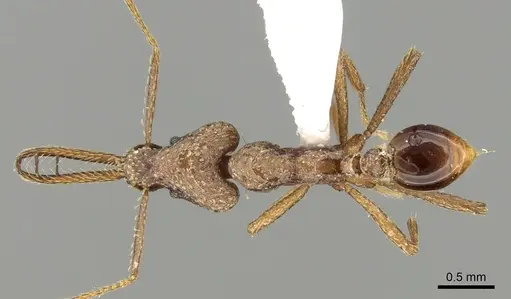
Literatura
Carregando mapa de distribuição...Carregando produtos...