
Plagiolepis demangei
- Nome científico
- Plagiolepis demangei
- Tribo
- Plagiolepidini
- Subfamília
- Formicinae
- Autor
- Santschi, 1920
- Distribuição
- Encontrada em 0 países
Introdução
Plagiolepis demangei is a small ant species with workers measuring 3.5-4.5mm in body length . Workers have a reddish-red to reddish-brown coloration, with the gaster being darker . This species is found in southern China (Yunnan, Guangxi) and Vietnam . This species belongs to the Formicinae subfamily and Plagiolepidini tribe. It is poorly studied in captivity, and much of its biology remains unknown .
Quick Summary
- Difficulty: Medium
- Origin & Habitat: Southern China (Yunnan, Guangxi) and Vietnam. Found in tropical and subtropical forest environments in the Indomalaya and Palaearctic regions [1][2].
- Colony Type: Unconfirmed
- Size & Growth:
- Antkeeping:
- Temperature: Temperature needs are unclear, start around 22-25°C and observe, based on native habitat [1][2].
- Humidity: Keep substrate consistently moist but not waterlogged, based on humid forest habitats [1][2].
- Diapause: Unknown, likely no true diapause given tropical range, but may have reduced activity in cooler months [3].
- Nesting: Natural nesting habits unconfirmed. In captivity, use test tube setup or small nest with moisture provision [3].
- Behavior: Behavior is unconfirmed. Based on genus patterns, these are active foragers that likely tend aphids for honeydew [3]. They are small ants and may escape through fine gaps, so ensure escape prevention. Temperament is likely peaceful [3].
- Common Issues: lack of captive breeding data makes care requirements uncertain., small size may create escape risk through fine gaps., humidity requirements are unconfirmed and must be inferred from habitat., no established feeding protocols exist for this species.
Appearance and Identification
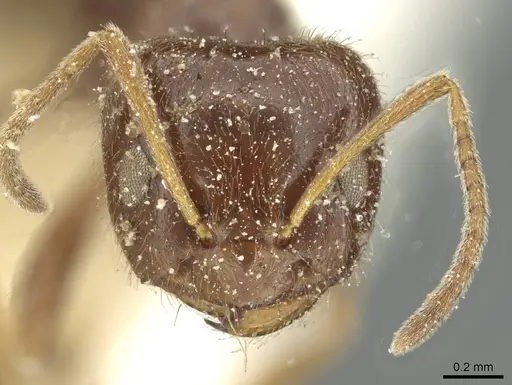
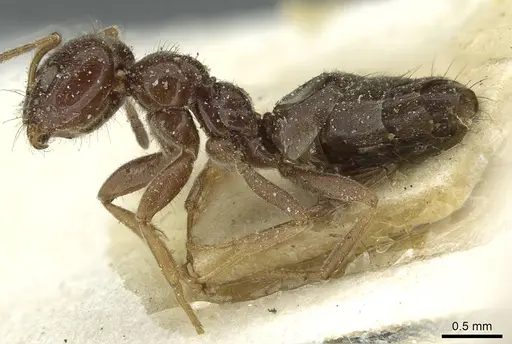
Plagiolepis demangei workers measure 3.5-4.5mm in body length [1]. They have a reddish-red to reddish-brown coloration, with the gaster being notably darker [1]. The body has a moderate shine, and the surface is covered with abundant standing hairs of varying lengths, particularly on the legs [1]. The pubescence is long and very abundant, with denser pubescence on the gaster [1]. The head is rectangular, large workers have heads wider than long, while small workers have heads longer than wide [1].
Distribution and Native Habitat
This species is found in southern China and Vietnam. In China, documented locations include Yunnan province, Guangxi province (specifically Qinzhou), and the Xishuangbanna area [1][2]. The type locality is Vietnam [1]. The species inhabits tropical and subtropical forest environments in the Indomalaya and Palaearctic regions [1][2].
Nest Preferences
Natural nesting behavior for this species has not been directly documented. Based on typical Plagiolepis genus behavior, they likely nest in soil or under stones in humid microhabitats [3]. In captivity, a test tube setup with a water reservoir works well for founding colonies. For established colonies, a small nest with chambers scaled to their size would be appropriate. Maintain moderate to high humidity within the nest.
Feeding and Diet
Diet preferences for Plagiolepis demangei specifically have not been studied. Based on typical Formicinae behavior, they likely feed on honeydew from aphids and supplement with small insects [3]. In captivity, you can offer sugar water or honey as a constant energy source, along with small protein sources like fruit flies or tiny insect pieces.
Temperature and Care
Since this species comes from tropical and subtropical regions, it likely prefers warmer temperatures. Provide a temperature gradient so the ants can self-regulate. Room temperature in the low-to-mid 20s°C is likely suitable [1][2]. Maintain moderate to high moisture levels in the nest using a test tube water reservoir or occasional misting.
Behavior and Temperament
Specific behavioral observations for Plagiolepis demangei are not documented. Based on genus patterns, these are active foragers that search for honeydew and small prey [3]. Plagiolepis species are generally not aggressive and are considered peaceful. Their small size means they could potentially escape through small gaps, so standard escape prevention measures are advisable.
Colony Structure and Development
The colony structure of Plagiolepis demangei has not been directly studied. Colonies are likely monogyne (single queen) based on genus patterns [3]. Founding behavior is unconfirmed. Colony size is unknown. Development time from egg to worker is unconfirmed.
Frequently Asked Questions
How long does it take for Plagiolepis demangei to produce first workers?
The exact development timeline is unknown for this species. Based on typical Formicinae development patterns, expect approximately 6-10 weeks from egg to first worker at optimal temperatures around 24-26°C [3].
What do Plagiolepis demangei ants eat?
Specific diet preferences are unconfirmed, but based on genus behavior, they likely feed on honeydew and small insects. In captivity, offer sugar water or honey as a constant energy source, along with small protein sources like fruit flies or tiny insect pieces [3].
What temperature do Plagiolepis demangei ants need?
Temperature requirements are not directly studied. Based on their native tropical/subtropical habitat, aim for 22-28°C with a gentle gradient [1][2].
How big do Plagiolepis demangei colonies get?
Colony size is unconfirmed for this species. No data on maximum colony size is available.
Are Plagiolepis demangei ants good for beginners?
This species is not commonly kept in captivity and there is limited captive breeding data available. The care requirements are not well-established, making it a challenging species for beginners. Consider starting with more common, better-documented species first.
What size nest do Plagiolepis demangei ants need?
Workers are 3.5-4.5mm in size [1]. Use a small nest with chambers appropriately scaled to their size. A test tube setup works well for founding colonies, and small nests are suitable for established colonies.
Where is Plagiolepis demangei found?
This species is found in southern China (Yunnan, Guangxi provinces) and Vietnam [1][2]. The type locality is Vietnam.
Do Plagiolepis demangei ants need hibernation?
Diapause requirements are unconfirmed. Given their tropical/subtropical distribution, a true hibernation is unlikely necessary, but they may have reduced activity during cooler months [3].
Can I keep multiple Plagiolepis demangei queens together?
Colony structure is unconfirmed. Based on typical Plagiolepis patterns, colonies are likely monogyne (single queen) [3]. Combining unrelated queens has not been documented and is not recommended.
Report an Issue
The current care sheet is based fully on literature. See inconsistencies, or something that's incorrect? Please , it will be resolved after review from an admin. Contributing to the blogs tab also helps providing information, to make us be able to further improve the caresheets. Thank you for your support!
References

Este guia de cuidados está sob a licença CC BY-SA 4.0 .
Posts da comunidade
CASENT0912417
Ver no AntWeb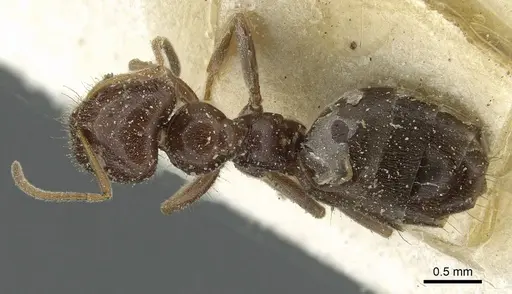
Literatura
Carregando mapa de distribuição...Carregando produtos...