
Parasyscia luteoviger
- Nome científico
- Parasyscia luteoviger
- Subfamília
- Dorylinae
- Autor
- Brown, 1975
- Distribuição
- Encontrada em 0 países
Introdução
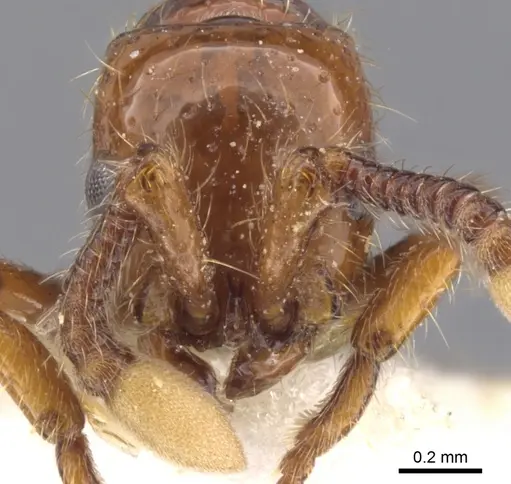
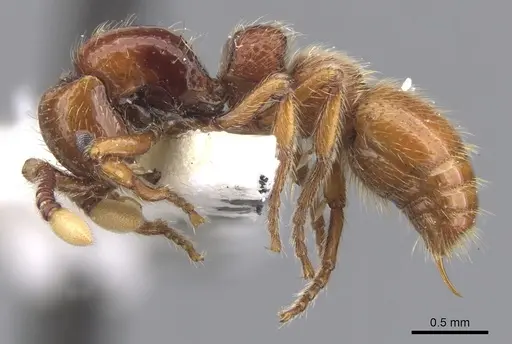
Parasyscia luteoviger is a small army ant species native to Sri Lanka. Workers measure approximately 4 mm in total length and are light ferruginous red with a distinctive yellow apical segment on their antennae, which gives the species its name . This species is part of the Dorylinae subfamily and is found in forest habitats, nesting in downed wood . The queen is ergatoid, meaning she is wingless and resembles a larger worker, which is a notable trait for this species .
Quick Summary
- Difficulty: Expert
- Origin & Habitat: Sri Lanka (Indomalaya Region), found in forest habitats, nesting in downed wood on the forest floor [2][1]
- Colony Type: Single-queen colonies with an ergatoid (wingless) queen. The type colony contained one ergatoid queen alongside workers [1].
- Size & Growth:
- Queen: ~4.5 mm [1]
- Worker: ~3.9-4.0 mm [1]
- Colony: Unknown, no colony size data available
- Growth: Unknown
- Development: Unknown, no development data available for this species (Development timeline has not been studied. Based on related Parasyscia species, development may take several months, but this is an estimate.)
- Antkeeping:
- Temperature: Keep warm, around 24-28°C. Based on the tropical climate of Sri Lanka, these ants likely need year-round warmth [1].
- Humidity: Keep the nest substrate consistently moist but not waterlogged, mimicking forest floor conditions [1].
- Diapause: No true diapause is expected. As a tropical species from Sri Lanka, they likely remain active year-round with minimal seasonal slowing [1].
- Nesting: Natural nesting in rotting wood on the forest floor. In captivity, use moist substrate with small chambers, such as Y-tong or plaster nests, scaled to their small size [1].
- Behavior: Workers are nervous and active, retreating rapidly when disturbed. Their small size (under 4 mm) means they can escape through tiny gaps, so excellent escape prevention is essential. They are predatory, hunting small invertebrates [1].
- Common Issues: escape prevention is critical due to their tiny size, use fine mesh and tight-fitting lids., limited availability, this species is rarely kept in captivity and hard to obtain., no established husbandry guidelines exist, keepers must experiment with care conditions., predatory diet may be challenging, they likely need small live prey., stress from disturbance, wild-caught colonies may be nervous and prone to abandoning brood.
Natural History and Distribution
Parasyscia luteoviger is endemic to Sri Lanka, found in forest habitats nesting in downed wood [2][1]. The type specimens were collected from Gilimale,16-20 km northeast of Ratnapura, in partially decomposed wood on the forest floor [1]. This species belongs to the dohertyi group within Parasyscia, characterized by morphological traits like the yellow antenna tip [1]. The ergatoid queen, which is wingless and worker-like, was found in the type colony, suggesting this is the normal colony structure [1].
Identification and Distinguishing Features
Workers are small, about 4 mm in total length, with a light ferruginous red body and darker brownish tones on the posterior trunk [1]. The most distinctive feature is the yellow ovoidal apical segment of the antenna, contrasting with the red body [1]. The petiolar node has a concavely marginate anterodorsal border, and the body is smooth with spaced punctures [1]. Workers are nervous and active when exposed, moving quickly [1].
Housing and Nest Setup
Provide a naturalistic setup with moist substrate, such as soil mixed with rotting wood fragments, in a shallow container with small chambers [1]. Use Y-tong or plaster nests with tight chambers scaled to their small size [1]. Include rotting wood or bark in the outworld for foraging [1]. Maintain moisture by keeping the substrate damp but not waterlogged [1].
Feeding and Diet
As predatory army ants, offer small live prey such as springtails, fruit flies, and small mealworms, no larger than the ants themselves [1]. Sugar sources may be occasionally accepted, but protein should be the primary diet [1]. Feed every 2-3 days and remove uneaten prey to prevent mold [1].
Temperature and Seasonal Care
Keep ants warm at 24-28°C, based on their tropical habitat [1]. Use a heating cable on one side of the nest to create a gradient if room temperature is low [1]. Minimal diapause is expected, they likely remain active year-round [1].
Colony Structure and Reproduction
The ergatoid queen is wingless and morphologically similar to workers, suggesting monogyne colony structure [1]. Unlike typical ants, ergatoid queens may mate within the nest and not produce winged reproductives, affecting colony reproduction in captivity [1].
Frequently Asked Questions
How long does it take for Parasyscia luteoviger to produce first workers?
The egg-to-worker timeline is unknown. Based on related species, it may take several months at optimal temperatures [1].
What do Parasyscia luteoviger ants eat?
They are predatory and eat small live prey like springtails and fruit flies, no larger than themselves [1].
Can I keep multiple Parasyscia luteoviger queens together?
The species appears monogyne based on the type colony having one ergatoid queen. Combining unrelated queens is not recommended [1].
Do Parasyscia luteoviger ants sting?
As Dorylinae, they likely have a stinger, but it is probably too small to penetrate human skin effectively. They are more likely to flee than sting [1].
Are Parasyscia luteoviger good for beginners?
No, this species is rated Expert due to rarity, lack of husbandry guidelines, small size requiring escape prevention, and specific dietary needs [1].
What temperature do Parasyscia luteoviger need?
Keep them at 24-28°C, based on their tropical habitat [1].
Do Parasyscia luteoviger need hibernation?
No, as a tropical species, they do not require hibernation and remain active year-round [1].
Why are my Parasyscia luteoviger dying?
Potential causes include stress from disturbance, improper humidity, temperatures outside 24-28°C, escape, inadequate prey size, or parasites [1].
When should I move Parasyscia luteoviger to a formicarium?
Allow the colony to establish in a founding setup for a few months. Move to a larger formicarium once the colony has 20-30+ workers and the setup is drying out [1].
How big do Parasyscia luteoviger colonies get?
The maximum colony size is unknown, but as a small species with an ergatoid queen, colonies are likely smaller than typical army ants [1].
Report an Issue
The current care sheet is based fully on literature. See inconsistencies, or something that's incorrect? Please , it will be resolved after review from an admin. Contributing to the blogs tab also helps providing information, to make us be able to further improve the caresheets. Thank you for your support!
References

Este guia de cuidados está sob a licença CC BY-SA 4.0 .
Posts da comunidade
CASENT0902744
Ver no AntWeb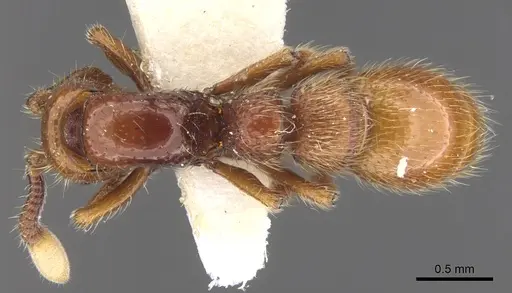
Literatura
Carregando mapa de distribuição...Carregando produtos...