
Leptanilla africana
- Nome científico
- Leptanilla africana
- Tribo
- Leptanillini
- Subfamília
- Leptanillinae
- Autor
- Baroni Urbani, 1977
- Distribuição
- Encontrada em 0 países
Introdução
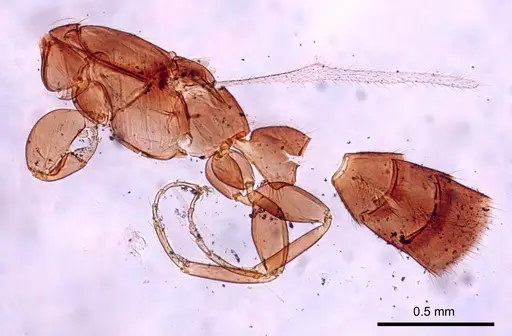
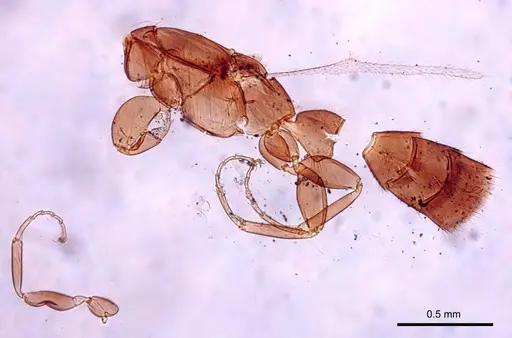
Leptanilla africana is an extremely rare ant species from the Leptanillinae subfamily, known only from Nigeria in West Africa. Only the male has ever been described - the workers and queens remain unknown to science . The genus Leptanilla contains some of the smallest ants in the world, with species typically measuring 1-2mm in total length. These ants are hypogaeic, meaning they live almost entirely underground in soil or rotting wood, rarely appearing on the surface. This makes them one of the most difficult ant groups to study and keep in captivity.
Quick Summary
- Difficulty: Expert
- Origin & Habitat: Nigeria in the Afrotropical Region. Like other Leptanilla species, they likely inhabit soil or rotting wood in forested areas, living almost entirely underground [1][2].
- Colony Type: Unknown, only the male has been described. The colony structure, whether single-queen or multi-queen, has not been documented [2].
- Size & Growth:
- Queen: Unknown, queens have not been described for this species
- Worker: Unknown, workers have not been described. Based on genus Leptanilla patterns, workers are typically 1-2mm in total length [2]
- Colony: Unknown, colony size has not been documented
- Growth: Unknown
- Development: Unknown, development has not been studied (No direct observations exist for this species)
- Antkeeping:
- Temperature: Unknown for this species. No captive records exist to establish temperature requirements.
- Humidity: Unknown. Leptanilla species typically require high humidity consistent with subterranean conditions, but specific requirements for L. africana are unstudied.
- Diapause: Unknown, seasonal behavior has not been studied. Given the Nigerian origin (tropical), hibernation is likely not required.
- Nesting: No captive husbandry records exist for this species. Based on genus patterns, they likely nest in soil or small cavities in rotting wood. A small test tube setup with moist substrate would be an appropriate starting point. They are extremely small and require fine-tuned humidity control.
- Behavior: Behavior is unstudied in captivity. In the wild, Leptanilla species are predatory on other small arthropods and live almost entirely underground. They are not aggressive and likely have minimal defense. Escape prevention is critical due to their tiny size, they can squeeze through the smallest gaps. Workers are blind or nearly blind and navigate using chemical trails [2].
- Common Issues: this species has never been kept in captivity, there are no established care protocols., only male described, worker and queen morphology unknown, making identification of colony members impossible., extreme rarity, finding wild colonies would require specialized field work in Nigeria., tiny size makes escape prevention extremely difficult., no information on diet acceptance in captivity, must experiment cautiously., subterranean lifestyle makes them difficult to observe and may cause stress in captive setups.
Why This Species Is So Challenging
Leptanilla africana represents one of the most difficult ant species to keep because virtually nothing is known about its biology in captivity. Only the male was described in 1977 by Baroni Urbani, workers and queens have never been found or described [2]. This means there are no established care protocols, no feeding guides, no temperature requirements, and no development timelines. Even the most basic information that antkeepers need, worker size, queen size, colony size, is completely unknown. This is not a species for beginners or even intermediate antkeepers. It is truly a species for advanced researchers or those interested in contributing to scientific knowledge of a poorly understood genus [1].
What We Know About the Genus Leptanilla
While L. africana specifically is a mystery, we know more about the genus Leptanilla as a whole. These are among the smallest ants in the world, with workers typically measuring 1-2mm in total length. They are hypogaeic, meaning they live underground, rarely coming to the surface. Their eyes are reduced or absent, and they navigate using chemical signals rather than vision. Leptanilla species are predatory, hunting small soil arthropods like springtails, mites, and other micro-arthropods. They typically form small colonies. Nests are found in soil, under stones, or in small cavities within rotting wood [2].
Housing Recommendations
Since no captive records exist for L. africana, housing recommendations must be based on genus-level patterns. Use a small test tube setup with moist substrate. The nest must maintain high humidity, think damp forest floor underground. A water reservoir connected to the nest helps maintain moisture. Because they are subterranean, minimize light exposure and provide darkness. Escape prevention is critical, their tiny size means they can squeeze through gaps that seem impossible. Use fine mesh barriers and ensure all connections are sealed. Start with a simple setup and observe before scaling up [2].
Feeding and Diet
Feeding is entirely speculative for this species. Based on genus patterns, Leptanilla species are predatory on small micro-arthropods. You could attempt to offer live springtails, tiny mites, or other very small prey. Do not offer large insects or large prey items, their tiny size means they can only tackle the smallest prey. Sugar sources are unlikely to be accepted, these are specialized predators, not sugar-feeding ants. Any feeding should be done with extreme caution and close observation. Start with tiny live prey and document any acceptance or rejection [2].
Legal and Ethical Considerations
Leptanilla africana is known only from Nigeria. If you were to acquire this species, it would almost certainly require wild collection in Nigeria, which raises significant legal and ethical concerns. Ant export laws vary by country, and collecting permits would likely be required. Furthermore, given how rare and poorly understood this species is, wild collection could potentially harm wild populations. For these reasons, L. africana is not a species anyone should be actively seeking to keep. It remains a species for scientific study rather than the antkeeping hobby [1][2].
Frequently Asked Questions
Can I keep Leptanilla africana as a pet ant?
No. This species has never been kept in captivity and virtually nothing is known about its care requirements. Only the male has ever been described, workers and queens are unknown to science. This is not a species for antkeepers. It is a species for researchers studying ant taxonomy.
How big are Leptanilla africana workers?
Unknown, workers have never been described. Based on the genus Leptanilla, workers are typically 1-2mm in total length, making them among the smallest ants in the world.
Where does Leptanilla africana live?
Only known from Nigeria in West Africa. The exact habitat is unknown, but Leptanilla species typically live underground in soil or rotting wood in forested areas.
What do Leptanilla africana ants eat?
Unknown for this specific species. Based on genus patterns, they are predatory on small micro-arthropods like springtails and mites. They likely do not accept sugar sources.
How long does it take for Leptanilla africana to develop from egg to worker?
Unknown, this has never been studied. There are no records of captive colonies or development timelines for this species.
Do Leptanilla africana ants sting?
Unknown, sting apparatus is not documented for this species. Given their extremely small size, any sting would likely be negligible to humans even if present.
Is Leptanilla africana a good species for beginners?
Absolutely not. This is an expert-only species that has never been kept in captivity. There are no established care protocols, no feeding guides, and no development timelines. The entire colony structure is unknown.
Can I find Leptanilla africana in the wild?
Extremely unlikely. They are known only from a single male described in Nigeria in 1977. Finding them would require specialized field work in West Africa and significant expertise in ant taxonomy.
Do Leptanilla africana colonies have one queen or multiple?
Unknown, colony structure has not been documented. Only the male has ever been described. We do not know if they are monogyne (single queen) or polygyne (multiple queens).
What temperature should I keep Leptanilla africana at?
Unknown for this species. No captive records exist to establish temperature requirements. Any temperature guidance would be purely speculative.
Is Leptanilla africana endangered?
Unknown, the conservation status has not been assessed. Given how rarely they are encountered and how little is known about them, population status is completely unknown.
Why is Leptanilla africana so poorly studied?
Leptanilla species are extremely cryptic, they live almost entirely underground and rarely appear on the surface. Their tiny size makes them easy to overlook. Combined with their limited distribution, they are among the most difficult ants to find and study.
Report an Issue
The current care sheet is based fully on literature. See inconsistencies, or something that's incorrect? Please , it will be resolved after review from an admin. Contributing to the blogs tab also helps providing information, to make us be able to further improve the caresheets. Thank you for your support!
References

Este guia de cuidados está sob a licença CC BY-SA 4.0 .
Posts da comunidade
CASENT0280997
Ver no AntWeb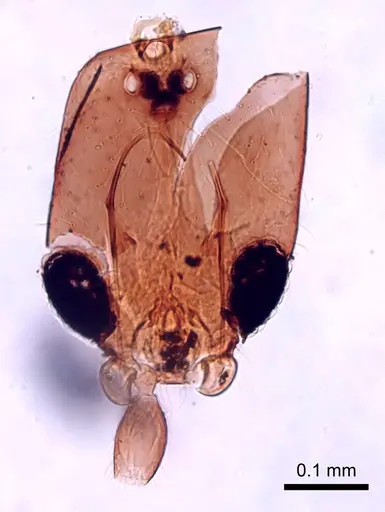
Literatura
Carregando mapa de distribuição...Carregando produtos...