
Hypoponera traegaordhi
- Nome científico
- Hypoponera traegaordhi
- Tribo
- Ponerini
- Subfamília
- Ponerinae
- Autor
- Santschi, 1914
- Distribuição
- Encontrada em 0 países
Introdução
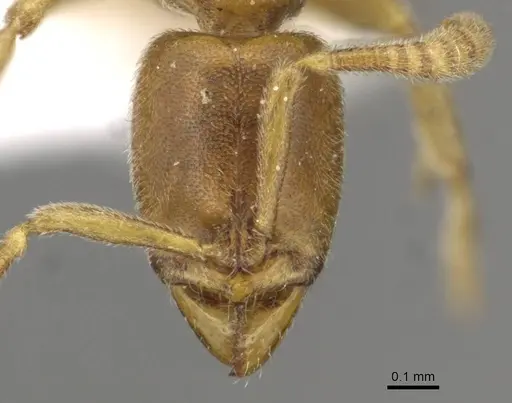
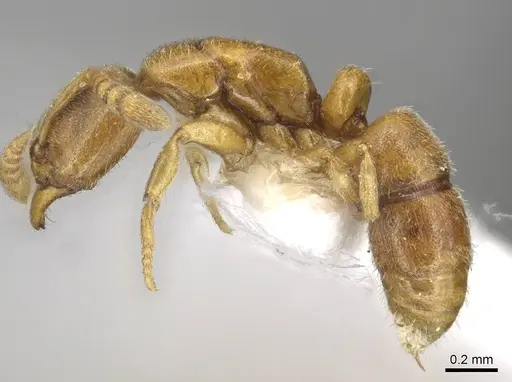
Hypoponera traegaordhi is an extremely rare ant species known only from a single worker specimen collected in South Africa (Natal, Pietermaritzburg) in 1905. These are tiny ants with workers measuring approximately 2-2.5mm in total length, making them among the smallest ants you could keep . They are entirely yellow in color and have a distinctive feature: the posterior surface of their petiole has cuticular ridges that form a dark transverse rim . Notably, they have no eyes at all, which is unusual among ants and suggests they live a completely subterranean lifestyle . This species is part of the Hypoponera abeillei group and is closely related to Hypoponera exigua from Ethiopia and several other southern African species . Because only a single specimen has ever been found, virtually nothing is known about their biology in the wild - no one has ever observed a colony, queen, nuptial flights, or nesting behavior. This makes them one of the most poorly documented ant species kept in captivity. What we know about their care comes largely from general Hypoponera genus patterns rather than species-specific research.
Quick Summary
- Difficulty: Expert
- Origin & Habitat: South Africa (Natal region, Pietermaritzburg), collected from what was likely a natural area with soil or under stones in the early 1900s [1][2]
- Colony Type: Unknown, only a single worker has ever been documented. The colony structure (single queen vs multiple queens) is completely unconfirmed.
- Size & Growth:
- Queen: size data unavailable, no queens have ever been described
- Worker: approximately 2-2.5mm total length, inferred from Hypoponera genus patterns [1]
- Colony: Unknown, no colony has ever been observed. Most Hypoponera species have small colonies.
- Growth: Unknown, no developmental data exists
- Development: Unknown, no direct observations exist for this species (No developmental data exists for this species. Estimates are based on genus-level patterns only.)
- Antkeeping:
- Temperature: Keep at room temperature (20-24°C). This species comes from subtropical South Africa, so moderate warmth is appropriate. A slight gradient allows workers to choose their preferred temperature.
- Humidity: Moderate to high humidity is likely needed. Hypoponera species typically prefer damp soil environments. Keep the nest substrate consistently moist but not waterlogged, with some drier areas available.
- Diapause: Unknown, no data on overwintering behavior exists. South Africa has mild winters, so a reduced activity period during cooler months may be beneficial, but this is unconfirmed.
- Nesting: Natural nesting is unknown, but based on related species, they likely nest in soil, under stones, or in shallow underground chambers. A small test tube setup or mini Y-tong nest with moist substrate would be appropriate. Their tiny size means chambers should be small and tight-fitting.
- Behavior: Completely unstudied in captivity. Based on genus patterns, these are likely cryptic, slow-moving ants that forage underground or in leaf litter. Their complete lack of eyes indicates they rely on chemical and tactile cues rather than vision. They probably do not pose any sting threat to humans given their minute size. Escape prevention is critical due to their minute size, they can squeeze through incredibly tiny gaps. Handle with extreme care as they are fragile and easily crushed.
- Common Issues: no documented captive care exists, you will be pioneering their husbandry, tiny size makes them extremely difficult to house and observe, escape prevention must be excellent, they can pass through mesh that appears solid, no information on diet acceptance, you will need to experiment, colony failure is likely since we do not know their specific requirements, no data on founding behavior, obtaining a colony may be impossible
Why Keep Such an Unknown Species?
Hypoponera traegaordhi represents a unique opportunity in antkeeping, the chance to document biology that has never been observed. This species is known from a single worker collected over 100 years ago, and no researcher has ever documented a colony, queen, or any aspect of their natural history. By attempting to keep them, you could potentially contribute genuinely new knowledge to science. However, this also means there are no established care protocols, no feeding guides, and no one to ask for advice when things go wrong. This is truly frontier antkeeping, you are exploring completely uncharted territory. Only experienced antkeepers who enjoy experimentation and careful observation should attempt this species. Be prepared for failures and understand that success may require trying approaches that work for related species but may need significant adaptation. [1]
Housing and Setup
Given their minute size, standard antkeeping setups will need modification. A small test tube setup with a cotton plug and water reservoir can work, but the connection to an outworld must be extremely well-sealed. Fine mesh barriers are essential, these ants can squeeze through gaps that appear microscopic. A mini Y-tong (AAC) nest with very small chambers would be ideal if available, as it allows for better observation while maintaining appropriate humidity. The nest material should be kept consistently moist but never saturated. A small outworld with minimal space reduces the risk of escapes and makes food easier to locate. All connections should be checked with a magnifying glass before introducing ants. [1]
Feeding and Diet
The diet of Hypoponera traegaordhi is completely unstudied. Based on genus patterns, they are likely predatory or omnivorous, feeding on tiny arthropods, springtails, and other micro-invertebrates found in soil. In captivity, you should offer tiny live prey items such as springtails, small fruit flies, and micro-arthropods. Sugar sources (honey water, sugar water) may or may not be accepted, some Hypoponera species take them, others ignore them. Start with small live prey and observe carefully. Remove uneaten prey after 24-48 hours to prevent mold. Given their subterranean lifestyle and lack of eyes, they may prefer hunting live prey over scavenging. Experiment cautiously and keep detailed notes of what works and what does not.
Temperature and Seasonal Care
This species comes from the Natal region of South Africa, which has a subtropical climate with mild winters. Room temperature (20-24°C) is likely appropriate, with a slight gradient allowing workers to regulate their own temperature. During South African winter (roughly June-August), you might consider slightly reducing temperatures to simulate their natural seasonal cycle, but this is speculative. No data exists on their actual temperature preferences, diapause requirements, or seasonal behavior. Observe your colony carefully for signs of stress (workers avoiding warm areas, clustering in cool spots, or becoming inactive) and adjust accordingly. The lack of eyes suggests they may be more sensitive to humidity than temperature fluctuations. [1]
Handling and Observation Challenges
Hypoponera traegaordhi presents unique observation challenges. Their complete lack of eyes means they are effectively blind and navigate using chemical and tactile cues. They are likely slow-moving and cryptic, spending much of their time underground or hidden in leaf litter. Observing them may be difficult, you may need to use a magnifying glass or microscope to confirm they are eating, moving, and healthy. Their tiny size also makes them extremely fragile, they can be crushed by even gentle handling. When moving or observing, use soft brushes or allow them to walk onto surfaces rather than picking them up. Document everything you observe, this species has no captive history, so your observations could be the first ever recorded. [1]
Frequently Asked Questions
Is Hypoponera traegaordhi suitable for beginners?
No. This species is absolutely not suitable for beginners. Virtually nothing is known about their care, there are no established protocols, no feeding guides, and no one to ask for help. Only expert antkeepers who enjoy experimentation and detailed observation should attempt this species. You will essentially be pioneering their captive husbandry.
How big do Hypoponera traegaordhi colonies get?
Unknown, no colony has ever been observed. Based on typical Hypoponera genus patterns and their extremely small worker size, colonies are likely small. This is purely an estimate with no direct evidence.
What do Hypoponera traegaordhi eat?
Unconfirmed, no direct observations exist. Based on genus patterns, they likely eat tiny live prey such as springtails, micro-arthropods, and small insects. They may accept sugar sources experimentally, but this is uncertain. Start with tiny live prey and observe carefully.
What temperature should I keep Hypoponera traegaordhi at?
Room temperature (20-24°C) is a reasonable starting point based on their South African origin. No specific temperature data exists for this species. Monitor your colony and adjust if workers consistently avoid or seek certain areas.
How long does it take for Hypoponera traegaordhi to develop from egg to worker?
Unknown, no developmental data exists for this species.
Can I keep multiple queens together?
Unknown, no queen has ever been documented for this species, let alone multiple queens. The colony structure is completely unconfirmed. Do not attempt combining unrelated queens without extensive research and experimentation.
Where can I obtain Hypoponera traegaordhi?
Extremely unlikely to be available commercially. This species is known from a single worker collected in 1905 and has rarely (if ever) been observed since. You would need to find a specialist supplier or collect them yourself from the Pietermaritzburg area in South Africa, which would require permits.
Do Hypoponera traegaordhi need hibernation?
Unknown, no data on overwintering behavior exists. The Natal region of South Africa has mild winters, so a dramatic diapause may not be necessary. A slight reduction in temperature during cooler months may be beneficial, but this is speculative.
Why do Hypoponera traegaordhi have no eyes?
Their complete lack of eyes indicates they live a completely subterranean lifestyle where vision provides no advantage [1]. Many cave-dwelling and soil-dwelling ant species have reduced or absent eyes. This adaptation suggests they navigate and hunt using chemical and tactile senses rather than sight.
Report an Issue
The current care sheet is based fully on literature. See inconsistencies, or something that's incorrect? Please , it will be resolved after review from an admin. Contributing to the blogs tab also helps providing information, to make us be able to further improve the caresheets. Thank you for your support!
References

Este guia de cuidados está sob a licença CC BY-SA 4.0 .
Posts da comunidade
CASENT0915210
Ver no AntWeb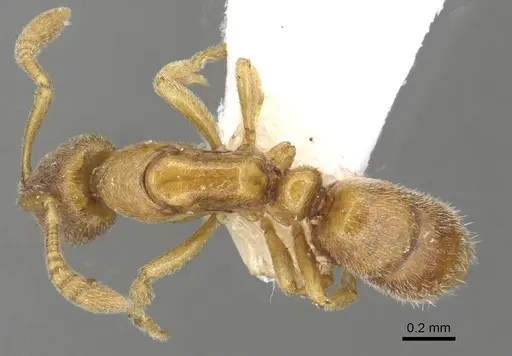
Literatura
Carregando mapa de distribuição...Carregando produtos...