
Hypoponera obtunsa
- Nome científico
- Hypoponera obtunsa
- Tribo
- Ponerini
- Subfamília
- Ponerinae
- Autor
- Bolton & Fisher, 2011
- Distribuição
- Encontrada em 0 países
Introdução
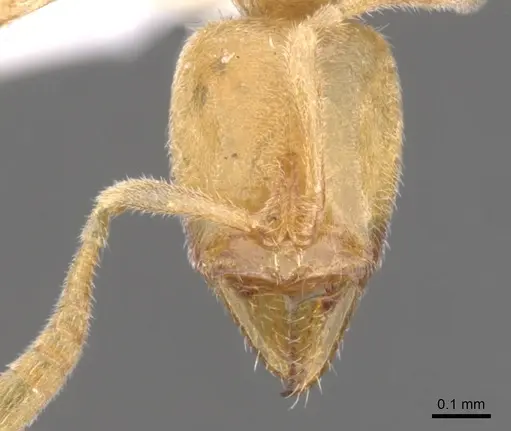
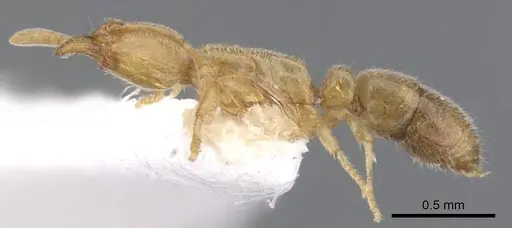
Hypoponera obtunsa is a tiny yellow ponerine ant species first described in 2011,originally known only from specimens collected under a stone on a hillside in Bulawayo, Zimbabwe . The workers are among the smaller ant species, and they lack eyes entirely - a common trait in cryptic soil-dwelling ants . The species belongs to the Hypoponera abeillei group and can be identified by the smooth, polished base of the second gastral segment without cross-ribs . This species was recently recorded for the first time in Rwanda's Akagera National Park, confirming it has a wider distribution than originally known . Hypoponera ants are cryptic nesters, typically found in soil or decaying wood, which allows them to maintain populations across diverse habitats despite being considered rare . Queens and males have been collected but were not formally described alongside the workers .
Quick Summary
- Difficulty: Unknown, likely Expert
- Origin & Habitat: Originally described from Bulawayo, Zimbabwe, with recent records from Akagera National Park, Rwanda. Found under stones on hillsides in subtropical climates [1][2].
- Colony Type: Colony structure is unconfirmed. Queens have been collected but colony composition has not been documented in scientific literature.
- Size & Growth:
- Queen: Not described with workers [1]
- Worker: size data unavailable, inferred from Hypoponera genus (~2-3 mm)
- Colony: Unknown, considered a rare species with limited specimens [2]
- Growth: Unknown
- Development: Unconfirmed, no development data exists for this species (Development timeline has not been studied. Related Hypoponera species may provide rough estimates, but no specific data is available.)
- Antkeeping:
- Temperature: Unknown, no thermal studies exist. Inferred from habitat: likely tolerates subtropical warmth (roughly 22-28°C). Start in the mid-20s°C range and observe colony activity.
- Humidity: Unknown, no humidity data. Based on cryptic soil-nesting habits, moderate to high substrate moisture is likely needed. Keep substrate consistently damp but not waterlogged.
- Diapause: Unknown, no seasonal data. Subtropical origin suggests they may tolerate year-round activity or have mild seasonal slowdowns.
- Nesting: Inferred from collection data: prefers soil nests under stones. In captivity, a test tube setup with moist substrate or a small naturalistic setup with soil and flat stones would likely suit them. Their tiny size and lack of eyes suggest they avoid light and prefer dark, confined spaces.
- Behavior: Behavior is unstudied. As a Ponerine ant, they are likely predatory on small invertebrates. Their tiny size and lack of eyes suggest slow, cryptic movement and reliance on chemical cues. Escape prevention is critical due to their very small size, they can squeeze through standard mesh. Ponerine ants have functional stings, though this species' sting would likely be ineffective on human skin due to its minute size.
- Common Issues: no established husbandry guidelines, this species has never been kept in captivity, escape prevention is critical due to tiny size, standard mesh may not contain them, lack of basic biological data makes proper care difficult, rare in the wild meaning few opportunities to acquire colonies, predatory diet may be challenging to meet with appropriate live prey
Species Identification and Distinguishing Features
Hypoponera obtunsa belongs to the Hypoponera abeillei group, which contains only two species lacking cross-ribs at the base of the second gastral segment: H. lepida and H. obtunsa [1]. The two species are easily separated, H. lepida is larger, brown to reddish-brown in color, has a larger petiole, and is found in West and Central Africa. H. obtunsa is smaller, entirely yellow, and has a lower, longer petiole node [1]. The workers have no eyes, a trait shared with many cryptic Hypoponera species. The petiole lacks the ventral process found in H. lepida, instead showing a simple obliquely descending anterior face ending in a blunt ventral angle [1]. These identification features require microscopy and taxonomic expertise to observe, making this species difficult for casual identification.
Distribution and Habitat
This species was originally described from Bulawayo, Zimbabwe, where specimens were collected from under a stone on a hillside in December 1916 and 1918 [1]. The recent discovery of specimens in Akagera National Park, Rwanda, represents a significant range extension of approximately 1,500 kilometers northeast [2]. This suggests the species may be more widespread across East Africa than previously recognized. Hypoponera species are cryptic nesters typically found in soil or decaying wood, which allows them to maintain populations in various habitats while remaining rarely collected [2]. The subtropical climate of both locations suggests tolerance for warm temperatures with seasonal variation.
Current State of Knowledge
Hypoponera obtunsa is one of the least studied ant species in the world. Only a handful of specimens have ever been collected, and no scientific study has examined its biology, behavior, or captive requirements [1]. We do not know: colony structure (single queen or multiple), founding behavior (whether queens seal themselves in or must hunt), development timeline, temperature and humidity preferences, diet in captivity, or nuptial flight timing. Queens and males have been collected but were not formally described alongside the workers [3]. This lack of data makes creating a reliable caresheet impossible, any advice given here is either inferred from genus-level patterns or is pure speculation. This species is best considered a collector only species for advanced antkeepers interested in studying unknown biology.
Housing and Nesting (Inferred)
Based on collection data showing specimens found under stones, this species likely nests in soil in dark, confined spaces. In captivity, a small test tube setup with moist cotton would be the safest starting point, or a small naturalistic setup with soil substrate and a flat stone or other cover object. The absence of eyes strongly suggests photophobic behavior, they will likely thrive in darkness and avoid exposed, lit areas. Chamber dimensions should be tiny given the worker size. Any escape prevention must account for their minute size, standard cotton or foam may not stop them, and fine mesh or petroleum jelly barriers would be necessary. [1]
Diet and Feeding (Inferred)
As a Ponerine ant, Hypoponera obtunsa is likely predatory on small invertebrates, similar to other members of the subfamily. Their tiny size suggests they would target micro-prey such as springtails, tiny mites, or newly hatched insect larvae. No data exists on sugar acceptance, some Ponerines occasionally take honeydew or nectar, but this should not be assumed. If attempting to keep this species, offer small live prey items and observe acceptance. Given their rarity and the complete lack of captive husbandry knowledge, experimental feeding should be approached with caution to avoid losing valuable colonies.
Frequently Asked Questions
Can I keep Hypoponera obtunsa as a pet ant?
This species is not recommended for antkeeping at this time. It has never been kept in captivity, and no biological data exists to guide proper care. Only a handful of specimens have ever been collected in the wild. This would be an experimental species requiring significant research and guesswork, making it unsuitable for most antkeepers.
What do Hypoponera obtunsa ants eat?
Diet is unconfirmed. As a Ponerine ant, they are likely predatory on small invertebrates like springtails and micro-arthropods. No captive feeding observations exist.
How big do Hypoponera obtunsa colonies get?
Unknown. The species is considered rare, and colony size has never been documented. Only isolated workers have been collected, suggesting small colonies in the wild.
Do Hypoponera obtunsa ants sting?
Ponerine ants have functional stings, but this species is so tiny that the sting would be ineffective on human skin. However, they should still be handled with care as individual reactions vary.
What temperature do Hypoponera obtunsa ants need?
No specific data exists. Based on their subtropical origin (Zimbabwe and Rwanda), they likely tolerate temperatures in the 22-28°C range. Start in the mid-20s and monitor colony behavior for guidance.
How long does it take for Hypoponera obtunsa eggs to become workers?
Unknown, no development data exists for this or likely any Hypoponera species. This is one of many fundamental biological questions that remain unanswered for this species.
Is Hypoponera obtunsa a good species for beginners?
No. This species has no established husbandry guidelines, making it one of the most difficult ants to keep successfully. It is not recommended for anyone except advanced antkeepers willing to conduct experimental husbandry.
Where can I find Hypoponera obtunsa ants for sale?
This species is extremely rare in the antkeeping hobby and may not be available commercially. The few known specimens were collected from under stones in Zimbabwe and Rwanda over 100 years ago. If available at all, it would only be from specialized dealers or researchers studying African ants.
Do Hypoponera obtunsa queens need to hunt during founding?
Unknown. Founding behavior has not been documented for this species.
Can I keep multiple Hypoponera obtunsa queens together?
Unknown, colony structure has not been studied. We do not know whether this species is single-queen or multi-queen. Combining unrelated queens is not recommended without biological data.
Report an Issue
The current care sheet is based fully on literature. See inconsistencies, or something that's incorrect? Please , it will be resolved after review from an admin. Contributing to the blogs tab also helps providing information, to make us be able to further improve the caresheets. Thank you for your support!
References

Este guia de cuidados está sob a licença CC BY-SA 4.0 .
Posts da comunidade
CASENT0902543
Ver no AntWeb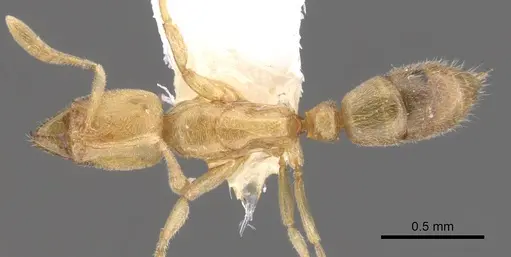
Literatura
Carregando mapa de distribuição...Carregando produtos...