
Eurhopalothrix depressa
- Nome científico
- Eurhopalothrix depressa
- Tribo
- Attini
- Subfamília
- Myrmicinae
- Autor
- Ketterl <i>et al.</i>, 2004
- Distribuição
- Encontrada em 1 países
Introdução
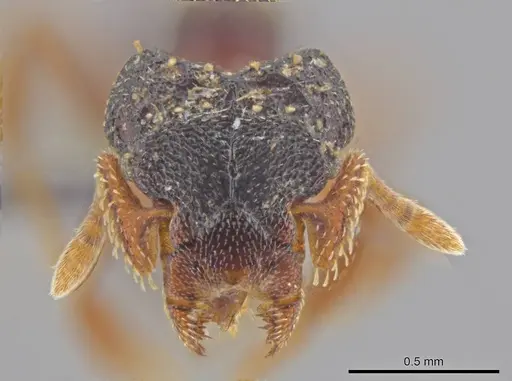
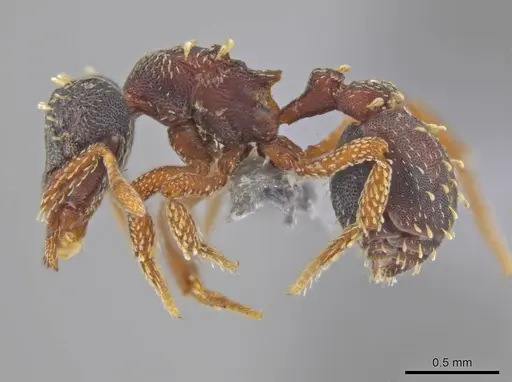
Eurhopalothrix depressa is a tiny predatory ant measuring 3.52-3.60mm for workers and 3.75-3.93mm for queens . It belongs to the bolaui species group within the Basicerotini tribe. The species has a highly distinctive appearance: a dark brown body covered in yellowish-white erect spatulate hairs, with a unique transverse ridge across the face that divides the head into upper and lower sections . This ridge is so distinctive that E. depressa is one of only two New World Eurhopalothrix species with this feature . The species was described in 2004 from southern Brazil and is considered quite rare, with only a handful of specimens collected from the Atlantic rain forest and Araucaria forest regions of São Paulo and Rio Grande do Sul states . What makes this species particularly interesting is its specialized morphology - the 16 specialized erect hairs on its head are reduced from the typical 18 seen in other bolaui group species, making it unique among New World species . Like other leaf-litter predatory ants, these ants are slow-moving hunters that cruise through the forest floor hunting tiny arthropods.
Quick Summary
- Difficulty: Hard
- Origin & Habitat: Southern Brazil (São Paulo to Rio Grande do Sul), specifically the Atlantic rain forest and Araucaria forest regions at elevations of 900-920 meters [1][3]. They live in leaf litter layers of humid forest floors, collected using Winkler extraction methods from soil litter sifting [4].
- Colony Type: Colony structure is unconfirmed. Only a few specimens have ever been collected, and the species is considered rare based on sample size [1]. No data exists on whether colonies are single-queen or multi-queen.
- Size & Growth:
- Antkeeping:
- Temperature: Based on its habitat in southern Brazil at 900m elevation in Atlantic/Araucaria forest, moderate temperatures around 18-22°C are likely suitable. Start at room temperature and observe colony activity.
- Humidity: High humidity is essential, these ants live in leaf litter of humid forests. Keep the nest substrate consistently moist but not waterlogged. Provide a humidity gradient with some slightly drier areas available.
- Diapause: Unknown for this species. The species comes from southern Brazil (29°30'S latitude) where temperatures drop in winter. A mild winter rest period may be beneficial but this is speculative.
- Nesting: In nature they live in leaf litter and soil layers of humid forests. For captivity, a small test tube setup or a small Y-tong/plaster nest with tight chambers scaled to their tiny size works well. Avoid tall, open spaces, they prefer tight, enclosed spaces.
- Behavior: These are slow-moving, cryptic leaf-litter ants that are predators of tiny arthropods [5]. They are not aggressive and their small size means any sting would be negligible to humans. They are escape risks due to their small size (3.5mm), so fine mesh barriers and tight-fitting lids are essential. Workers probably forage individually or in small groups, hunting micro-arthropods.
- Common Issues: escape prevention is critical, they are very small and can squeeze through tiny gaps, no captive husbandry information exists, this is an essentially unknown species in the antkeeping hobby, slow growth is likely, related species can take months to establish, high humidity requirements can lead to mold problems if ventilation is poor, wild-caught colonies may have parasites that kill them in captivity
Appearance and Identification
Eurhopalothrix depressa is a tiny ant, with workers measuring 3.52-3.60mm and queens at 3.75-3.93mm [1]. The most distinctive feature is the transverse ridge that divides the head into a lower anterior and higher posterior part, this is rare among New World Eurhopalothrix species [2]. The body is dark brown with lighter brown areas, and is covered in yellowish-white erect hairs that are modified into spatulate (spoon-shaped) structures [1]. The head has exactly 16 of these specialized hairs, reduced from the typical 18 seen in other bolaui group species, this is unique among all New World species [1]. The eyes are small, consisting of only about 25 ommatidia, and the antennae have greatly expanded scapes that are translucent on the outer margin [1]. The propodeum has well-developed spines, and the body surface is opaque and densely punctuate-granulated [1].
Natural Habitat and Distribution
This species is known only from southern Brazil, specifically from São Paulo state north to Rio Grande do Sul in the south [2]. The type locality is the Araucaria forest reserve Pró-Mata in Rio Grande do Sul (29°30'S 50°10'W), at an elevation of 900-920 meters [1]. Paratypes were also collected from Pico da Macela in São Paulo state (23°08'S 44°48'W) [1]. They inhabit the Atlantic rain forest and Araucaria forest biomes, living in the leaf litter layer where they are collected through soil litter sifting using Winkler extractors [1][4]. The species is considered very rare, only a handful of specimens have ever been collected despite extensive ant surveys in the region [1].
Feeding and Diet
Like all Basicerotini ants, Eurhopalothrix depressa is a predator that hunts tiny arthropods in the leaf litter [5]. The genus representatives are confirmed predators in leaf litter environments [5]. In captivity, you should replicate this diet with small live prey. Primary foods should be tiny live arthropods such as springtails, small mites, and fruit fly larvae. Do not rely on sugar sources, these are specialized predators, not sugar-feeding ants. Feed small prey items every 2-3 days, removing any uneaten prey after 24 hours to prevent mold.
Nest Preferences and Housing
In nature, these ants live in the humid leaf litter and soil layers of forest floors. They are not arboreal and do not nest in wood or above-ground locations. For captivity, the best options are small test tubes set up as a founding setup, or small Y-tong or plaster nests with chambers scaled to their tiny size. The key requirements are high humidity and tight, enclosed spaces, avoid tall open areas that would stress these small, cryptic ants. Because of their very small size (3.5mm), escape prevention must be excellent. Use fine mesh barriers and ensure all connections are tight. Test tubes work well for founding colonies, fill them about 1/3 with water reservoir and provide a cotton ball barrier, then add the queen or colony.
Temperature and Seasonal Care
The natural habitat of southern Brazil at 900m elevation in Atlantic/Araucaria forest suggests moderate temperature requirements. The region experiences temperate to subtropical conditions with cool winters. Aim for roughly 18-22°C as a starting point, with a gentle thermal gradient if possible. A heating cable on one side of the nest can create this gradient, if you use one, place it on top of the nest rather than underneath to avoid evaporating all the moisture. Observe colony activity: if workers cluster near the warmer area, increase slightly, if they avoid it, reduce temperature. Regarding winter dormancy, the species comes from a region (29°30'S latitude) where winter temperatures can drop significantly. A mild winter rest period at 10-15°C may be beneficial, but this is speculative since no captive data exists for this species.
Behavior and Temperament
These are slow-moving, cryptic ants that spend most of their time in the leaf litter layer. They are not aggressive and their small size means any sting would be negligible to humans. Workers likely forage individually or in very small groups, hunting micro-arthropods through the substrate. The specialized erect hairs on their body may help them detect vibrations from prey or communicate with nestmates in the dark, humid environment where they live. They are not known to be escape artists in terms of climbing ability, but their tiny size means they can squeeze through remarkably small gaps. Excellent escape prevention is essential, review all connections, use fine mesh on any ventilation holes, and ensure lids fit tightly. [1]
Frequently Asked Questions
How long does it take for Eurhopalothrix depressa to go from egg to worker?
The egg-to-worker timeline is completely unknown for this species, it has never been kept in captivity to our knowledge.
Can I keep Eurhopalothrix depressa in a test tube?
Yes, test tubes work well for this species. Use a small test tube (15mm or less diameter) with a water reservoir at one end and a cotton barrier. Keep the substrate consistently moist but not flooded. The small size of these ants (3.5mm) means you should use a test tube with a tight-fitting cotton barrier to prevent escapes.
What do Eurhopalothrix depressa ants eat?
They are specialized predators that eat tiny live arthropods. Feed them small live prey like springtails, small mites, and fruit fly larvae. Sugar sources are not a reliable food source for this predatory species, protein-rich live prey should be their primary diet.
Are Eurhopalothrix depressa good for beginners?
No. This is an expert-level species that has never been kept in captivity to our knowledge. There is no established husbandry information, and they require high humidity and specialized live prey. They are considered rare in the wild and should only be attempted by experienced antkeepers who can provide the specialized care they need.
How big do Eurhopalothrix depressa colonies get?
The maximum colony size is unknown. Only a handful of specimens have ever been collected in the wild, and no large colonies have been documented [1]. Based on related species, colonies are likely small.
Do Eurhopalothrix depressa need hibernation?
This is unknown. The species comes from southern Brazil (29°30'S latitude) where winter temperatures can drop significantly. A mild winter rest period at 10-15°C may be beneficial, but this is speculative since no captive data exists.
When should I move Eurhopalothrix depressa to a formicarium?
There is no established guidance for this species. Given their tiny size and high humidity requirements, keeping them in a test tube setup long-term is perfectly acceptable. If you do move them, use a small Y-tong or plaster nest with chambers scaled to their size, and maintain high humidity.
Can I keep multiple queens together?
This has not been documented. The colony structure (monogyne vs polygyne) is completely unknown for this species. Combining unrelated queens is not recommended since we have no information about their founding behavior.
Why are my Eurhopalothrix depressa dying?
Without established husbandry information, diagnosing problems is difficult. Common issues likely include: escape through tiny gaps (use excellent barrier protection), drying out (they need high humidity), mold from poor ventilation, and starvation if prey is too large or not available. Wild-caught colonies may also carry parasites that can decimate small colonies in captivity.
Report an Issue
The current care sheet is based fully on literature. See inconsistencies, or something that's incorrect? Please , it will be resolved after review from an admin. Contributing to the blogs tab also helps providing information, to make us be able to further improve the caresheets. Thank you for your support!
References

Este guia de cuidados está sob a licença CC BY-SA 4.0 .
Posts da comunidade
CASENT0636778
Ver no AntWeb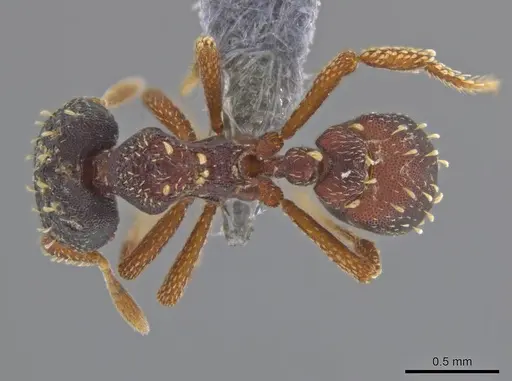
Literatura
Carregando mapa de distribuição...Carregando produtos...