
Eurhopalothrix cimu
- Nome científico
- Eurhopalothrix cimu
- Tribo
- Attini
- Subfamília
- Myrmicinae
- Autor
- Longino, 2013
- Distribuição
- Encontrada em 1 países
Introdução
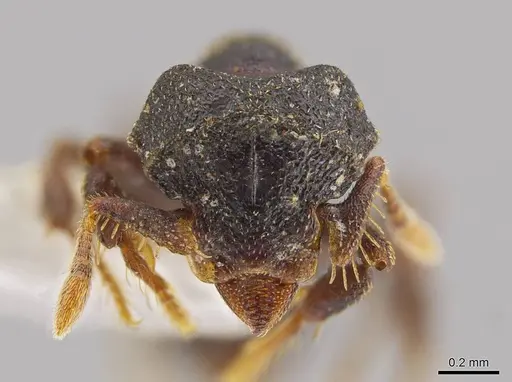
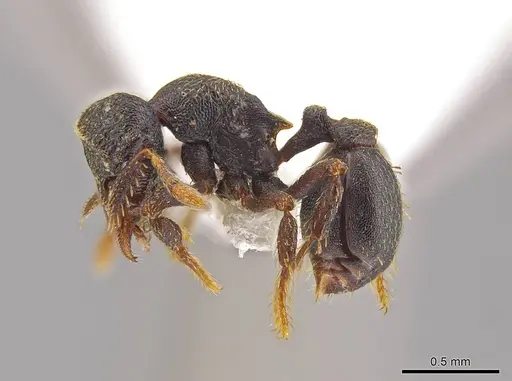
Eurhopalothrix cimu is an extremely rare ant species known only from a handful of worker specimens collected in Cuba's Sierra Maestra mountains. Workers are dark brown to black, with a distinctive transverse ridge across the face and specialized mandibles that have a double row of teeth . The genus Eurhopalothrix has 7-segmented antennae and triangular mandibles . These ants are predators that live in forest leaf litter and soil, using stealth or sit-and-wait hunting . What makes this species stand out is that it's known from just 6 workers ever collected, making it one of the rarest and least-studied ants in the world.
Quick Summary
- Difficulty: Expert
- Origin & Habitat: Cuba (endemic), found in Parque Nacional Pico Turquino, Granma province, at 1370 m elevation, in dry mixed forest [1][3]. They live in leaf litter and dead wood on the forest floor.
- Colony Type: Unknown, only worker specimens have been collected. Colony structure (single queen vs. multiple queens) has not been documented [1].
- Size & Growth:
- Queen: Unknown, queens have never been collected or described [4]
- Worker: Worker total length is unknown, based on the Eurhopalothrix genus, workers are likely around 2–3 mm
- Colony: Unknown, only 6 workers have ever been collected in a single sample [1]
- Growth: Unknown
- Development: Unknown, no breeding or development data exists for this species (No colony has ever been successfully raised in captivity. All information comes from the 6 worker specimens collected in the wild.)
- Antkeeping:
- Temperature: Unknown for this species. Based on its Cuban mountain habitat at 1370 m elevation, it likely prefers cooler conditions than typical tropical ants, possibly 18–24°C. Start at room temperature (around 20–22°C) and observe.
- Humidity: Likely needs high humidity, similar to other leaf-litter ants. Keep the nest substrate consistently moist but not waterlogged. The collection from leaf litter in a forest suggests they require damp conditions [1].
- Diapause: Unknown, no seasonal data exists. The high-elevation Cuban habitat may experience cooler winters, so a slight cooling period could be beneficial, but this is speculative.
- Nesting: In the wild, they nest in leaf litter and dead wood [1][3]. For captivity, a naturalistic setup with moist soil/leaf litter or a well-humidified Y-tong/plaster nest would be best. The nest should have tight chambers scaled to their tiny size.
- Behavior: These are extremely cryptic, slow-moving predators that rely on stealth or sit-and-wait tactics to capture small prey in leaf litter [2]. Workers are rarely found in the wild, appearing in less than 10% of litter samples and only in low numbers [2]. They have a specialized clay coating on their bodies that provides camouflage [2]. Escape prevention is critical because they are so tiny, they can slip through standard barriers easily. Their behavior in captivity is essentially unknown since no living colony has ever been studied.
- Common Issues: no living colonies exist in captivity, this species has never been kept by antkeepers, extremely rare in the wild with only 6 workers ever collected, queen and colony structure completely unknown, cannot establish a colony, no development or breeding data exists to guide care, founding behavior is entirely unconfirmed, may be claustral, semi-claustral, or have unknown requirements
Rarity and Conservation Status
Eurhopalothrix cimu is one of the rarest ant species in the world. Only 6 workers have ever been collected, all from a single location in Cuba's Sierra Maestra mountains at 1370 m elevation [1]. This species was formally described in 2013 by ant taxonomist John Longino, and it remains one of the least-known ants globally. The species name 'cimu' comes from the Taino word for 'front or forehead, ' referring to the distinctive transverse ridge on its face [1]. Given its extremely limited known range and the difficulty of finding this species even in its native habitat, any captive breeding efforts would be scientifically significant. However, no living specimens have ever been documented in captivity or studied alive.
Identification and Morphology
Workers are tiny, total body size is unknown but based on the genus they are likely around 2–3 mm. The most distinctive features include mandibles with a double row of teeth: an outer row of 10 flattened teeth and an inner row of 3 longer needle-shaped teeth [1]. The face has a prominent transverse ridge that divides it into anterior and posterior portions. Unlike some related species, this one lacks specialized spatulate setae on the face [1]. Workers are dark brown to black. The genus Eurhopalothrix is characterized by 7-segmented antennae and triangular mandibles [2]. A unique feature of this genus is that workers are often coated with a thin layer of clay, especially on the face, which provides camouflage, the specialized spatulate setae help acquire and adhere this clay layer [2].
Natural History and Foraging
This species is a predator in tropical leaf litter, using stealth or sit-and-wait hunting techniques rather than active foraging [2]. The specialized mandibles with double tooth rows are likely adaptations for capturing small prey. In the wild, they occur in less than 10% of quantitative litter samples, and even when present, they are found in very low numbers, typically making up less than 1% of ant individuals in samples [2]. This extreme rarity makes them one of the most difficult ants to study. The single collection was from a Winkler sample of sifted leaf litter and dead wood in dry mixed forest at high elevation [1][3].
Captive Care Challenges
Keeping Eurhopalothrix cimu in captivity presents extraordinary challenges. No living colony has ever been documented, meaning there is zero established husbandry knowledge. The fundamental questions remain unanswered: we don't know what their queen looks like, how they found colonies, what their founding behavior is, how fast they develop, what they eat in captivity, or what temperature and humidity ranges they need. The only data comes from 6 dead workers in a museum collection. If you somehow obtained specimens, you would essentially be pioneering all aspects of their care through careful experimentation. Given their extreme rarity and scientific value, any successful captive breeding would be a significant contribution to ant biology. For now, this species remains a scientific curiosity rather than a viable option for antkeepers. [1]
Frequently Asked Questions
Can I keep Eurhopalothrix cimu as a pet ant?
No. No living colony of this species has ever been documented in captivity. Only 6 worker specimens have ever been collected in the wild, all from a single location in Cuba. There is no established care information, and obtaining specimens would be essentially impossible since they are among the rarest ants in the world.
How big do Eurhopalothrix cimu colonies get?
Unknown. We have no data on colony size because only 6 workers have ever been collected, all from a single sample. The colony structure (single queen or multiple queens) is completely unstudied.
What do Eurhopalothrix cimu ants eat?
Based on genus-level observations, they are predators that use sit-and-wait hunting techniques to capture small prey in leaf litter [2]. They likely accept small live prey like springtails, but this is unconfirmed for this specific species. Sugar acceptance is completely unknown.
What temperature do Eurhopalothrix cimu ants need?
Unconfirmed. Based on their collection at 1370 m elevation in Cuba's mountains, they likely prefer cooler conditions than typical lowland tropical ants, possibly in the 18–24°C range. However, no specific temperature data exists for this species.
How long does it take for Eurhopalothrix cimu to go from egg to worker?
Unknown. No breeding or development data exists for this species. No colony has ever been raised in captivity, and even wild colonies have never been studied.
Are Eurhopalothrix cimu good for beginners?
No. This species is not suitable for any antkeeper, beginner or experienced. No living colony has ever been documented in captivity, and there is no care information available. The species is extremely rare in the wild with only 6 workers ever collected.
Do Eurhopalothrix cimu need hibernation?
Unknown. No seasonal data exists for this species. The high elevation Cuban habitat (1370 m) may experience cooler winters, so a slight cooling period may be beneficial, but this is entirely speculative.
Where is Eurhopalothrix cimu found?
This species is endemic to Cuba, known only from Parque Nacional Pico Turquino in Granma province at approximately 1370 m elevation [1]. It has not been found anywhere else in the world.
Can I start a colony with multiple Eurhopalothrix cimu queens?
Unknown. We don't even know what their queen looks like, only workers have ever been collected. The colony structure (single queen vs. multiple queens) is completely unstudied. There is no documented case of anyone combining queens of this species.
Report an Issue
The current care sheet is based fully on literature. See inconsistencies, or something that's incorrect? Please , it will be resolved after review from an admin. Contributing to the blogs tab also helps providing information, to make us be able to further improve the caresheets. Thank you for your support!
References

Este guia de cuidados está sob a licença CC BY-SA 4.0 .
Posts da comunidade
CASENT0639338
Ver no AntWeb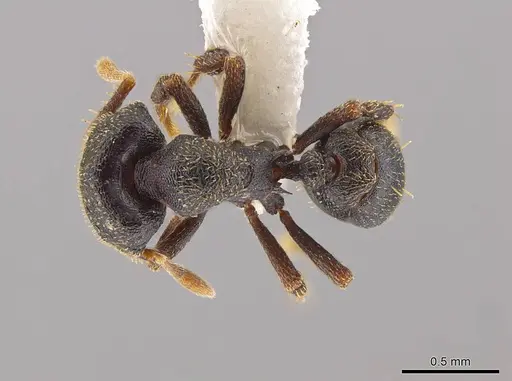
Literatura
Carregando mapa de distribuição...Carregando produtos...