
Cardiocondyla nana
- Nome científico
- Cardiocondyla nana
- Tribo
- Crematogastrini
- Subfamília
- Myrmicinae
- Autor
- Seifert, 2003
- Distribuição
- Encontrada em 0 países
Introdução
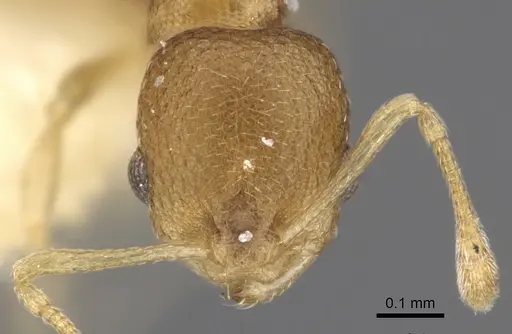
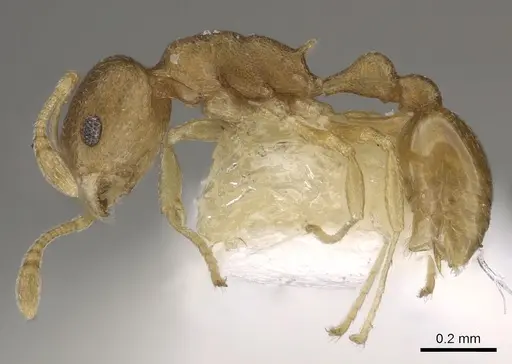
Cardiocondyla nana is an extraordinarily tiny ant and the smallest known species in its genus. Workers are light yellowish with an extremely short head, long antennae, and distinctive long spines on the back of the body . The most unique feature is the sculpture on their head: densely packed pits with a four-leaf clover pattern when magnified . This species belongs to the Cardiocondyla wroughtonii group and is known only from Brunei in Borneo, making it a rare find for antkeepers . Almost nothing is known about the biology of this species in the wild. Only a single worker (the holotype) has ever been collected and described, so there are no records of queens, colonies, or behavior . Keeping C. nana means you will be pioneering husbandry with no established guidelines.
Quick Summary
- Difficulty: Expert
- Origin & Habitat: Borneo (Brunei, Indonesia, Malaysia), lowland tropical rainforest at around 12 meters elevation [1][2]
- Colony Type: Unknown, only a single worker has ever been documented, so colony structure has not been determined [1]
- Size & Growth:
- Queen: No queens have been described, size unknown [1]
- Worker: Extremely small, the smallest known Cardiocondyla species, total length has not been published. The only measurement available is head capsule size, but body length is undocumented [1][3]
- Colony: Unknown, no colony data exists
- Growth: Unknown
- Development: Unknown, no development data exists for this species (No data exists. Related Cardiocondyla species typically develop from egg to worker in 4-8 weeks at warm temperatures, but this is a rough estimate only.)
- Antkeeping:
- Temperature: Unknown for this species. Based on its lowland Borneo origin, aim for warm conditions around 24-28°C. Monitor colony activity and adjust accordingly.
- Humidity: Unknown. As a Borneo lowland species, expect it to prefer humid conditions. Keep the nest substrate consistently moist but not waterlogged.
- Diapause: Unknown, no seasonal data exists. Borneo has minimal seasonal temperature variation, so this species may not require a diapause period.
- Nesting: No data exists on natural nesting preferences. Related Cardiocondyla species often nest in soil, under stones, or in rotting wood. A small test tube setup or Y-tong nest with tight chambers scaled to their tiny size would be appropriate.
- Behavior: Nothing is known about this species' behavior. Based on its subfamily (Myrmicinae, tribe Crematogastrini), it likely defends itself by smearing venom onto enemies using a flattened stinger. Related species are generalist foragers. Their extremely small size means escape prevention must be excellent, they can squeeze through gaps invisible to the naked eye.
- Common Issues: almost no biological data exists, you will be pioneering husbandry for this species, tiny size makes escape prevention critical, use fine mesh and check for any gaps, no known queen or colony information means founding behavior and colony structure are entirely speculative, defense mechanism likely involves venom smearing, but this is based on subfamily traits and not confirmed, without hibernation data, seasonal care requires experimentation
Discovery and Taxonomy
Cardiocondyla nana was first described in 2003 by the ant taxonomist Bernhard Seifert [3]. The holotype worker was collected in Brunei on the island of Borneo, specifically from Ulu Temburong National Park [1]. Remarkably, only one individual worker has ever been found, the holotype. This means we know the appearance of the worker (tiny, yellowish, with unique head sculpture), but we have no information about queens, males, colonies, or behavior. Every aspect of keeping this species is uncharted territory.
Size and Identification
This is the smallest known Cardiocondyla species in the world. Workers are extremely small, the only measurement published is for the head capsule, but total length has not been reported [3]. The worker has an extremely short head (the shortest relative to head width in the genus), long antennae, and notably long spines pointing backward from the rear of the thorax [1]. The most distinctive feature is the unique sculpture on the top of the head: large pits that show a four-leaf clover pattern when viewed under high magnification [1]. All body parts are light yellowish [1].
Habitat and Distribution
Cardiocondyla nana is known only from Brunei in northern Borneo, specifically from Ulu Temburong National Park at about 12 meters above sea level [1]. This is a lowland tropical rainforest environment with high humidity and warm temperatures year-round. The type locality coordinates are approximately 1.47°S,123.559°E [1]. The species has also been recorded from Indonesia and Malaysia in the broader Indomalaya region, but these records may need verification as only the Brunei specimen has been formally described [2]. The entire known range is within the tropical zone, suggesting this species is adapted to warm, humid conditions.
Keeping an Unstudied Species
Keeping Cardiocondyla nana is a pioneering endeavor since no husbandry information exists. Start with standard Cardiocondyla care as a baseline: small test tube setups for founding colonies, with a water reservoir and cotton plug. Because they are so tiny, use a test tube with a very narrow bore or consider a small Y-tong nest with chambers scaled to their minute size. Temperature should be warm (24-28°C) based on their tropical origin. Humidity should be high to mimic the damp rainforest floor. Feed small live prey like springtails or fruit flies, and offer sugar water or honey occasionally. Document everything, your observations could contribute to what little is known about this species.
Feeding and Diet
No direct data exists on what Cardiocondyla nana eats in the wild. Related Cardiocondyla species are generalist scavengers and predators that eat small insects, honeydew from aphids, and sugary substances. For this tiny species, offer very small live prey like springtails, newly hatched fruit flies, or tiny mealworm pieces. Sugar water or diluted honey can be offered as a carbohydrate source. Feed small amounts every few days and remove any uneaten food to prevent mold.
Temperature and Seasonal Care
As a Borneo lowland species, Cardiocondyla nana comes from an environment with minimal seasonal temperature variation, it experiences warm temperatures year-round. There is no data on whether this species enters any form of dormancy or diapause. Based on its origin, maintain warm temperatures between 24-28°C continuously. Do not attempt hibernation without any data to support it. If the colony shows reduced activity during cooler months, you might gradually reduce temperature slightly, but this is speculative. The key is stability, avoid temperature swings that could stress such a tiny, unstudied species.
Frequently Asked Questions
How big do Cardiocondyla nana ants get?
Workers are extremely tiny, the smallest known Cardiocondyla species in the world, but total length has not been published. No queens have been documented, so queen size is unknown.
Is Cardiocondyla nana a good species for beginners?
No. This species is rated Expert difficulty because almost no biological data exists, you will be discovering basic husbandry alongside the scientific community. Only experienced antkeepers should attempt this species.
What do Cardiocondyla nana ants eat?
No direct data exists. Based on related species, they likely eat small insects, springtails, and sugary substances. Offer small live prey and sugar water. Experiment to see what they accept.
Do Cardiocondyla nana ants sting?
Unknown, no behavior data exists. Based on subfamily traits (Myrmicinae, tribe Crematogastrini), they likely use a smear defense with venom rather than a typical sting. Given their tiny size, any venom would likely be imperceptible to humans.
What temperature do Cardiocondyla nana ants need?
Based on their Borneo origin, aim for warm conditions around 24-28°C. No specific data exists for this species.
How long does it take for Cardiocondyla nana to develop from egg to worker?
Unknown, no development data exists for this species. Related Cardiocondyla species typically take 4-8 weeks, but this is a rough estimate.
Can I keep multiple Cardiocondyla nana queens together?
Unknown, colony structure has not been documented. Only a single worker has ever been found. Do not attempt combining unrelated queens without data.
Does Cardiocondyla nana need hibernation?
Unknown, no seasonal data exists. As a Borneo lowland species with minimal temperature variation year-round, hibernation may not be required. Do not force dormancy without evidence.
What is the best nest type for Cardiocondyla nana?
No data exists. Use a small test tube setup or Y-tong nest with chambers scaled to their tiny size. Ensure excellent escape prevention as they can squeeze through microscopic gaps.
Where is Cardiocondyla nana found in the wild?
Only known from Brunei in Borneo (Ulu Temburong National Park) at low elevation. Also recorded from Indonesia and Malaysia, but the Brunei specimen is the only formally described individual.
Why is Cardiocondyla nana so special?
It is the smallest known Cardiocondyla species in the world, and almost nothing is known about its biology. Only a single worker has ever been collected. Keeping this species means contributing to scientific knowledge.
How do I prevent Cardiocondyla nana from escaping?
Escape prevention is critical due to their extremely tiny size. Use fine mesh barriers, check for any gaps in your setup, and ensure all connections are tight. They can squeeze through gaps invisible to the naked eye.
Report an Issue
The current care sheet is based fully on literature. See inconsistencies, or something that's incorrect? Please , it will be resolved after review from an admin. Contributing to the blogs tab also helps providing information, to make us be able to further improve the caresheets. Thank you for your support!
References

Este guia de cuidados está sob a licença CC BY-SA 4.0 .
Posts da comunidade
CASENT0901757
Ver no AntWeb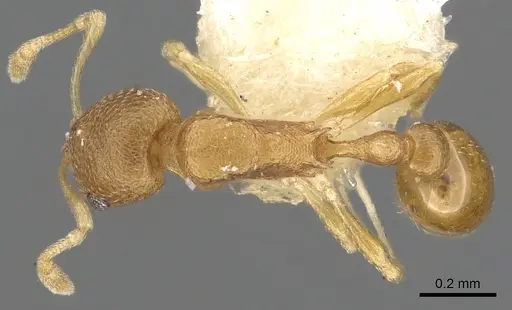
Literatura
Carregando mapa de distribuição...Carregando produtos...