
Acanthostichus laevigatus
- Nome científico
- Acanthostichus laevigatus
- Subfamília
- Dorylinae
- Autor
- MacKay, 1996
- Distribuição
- Encontrada em 0 países
Introdução
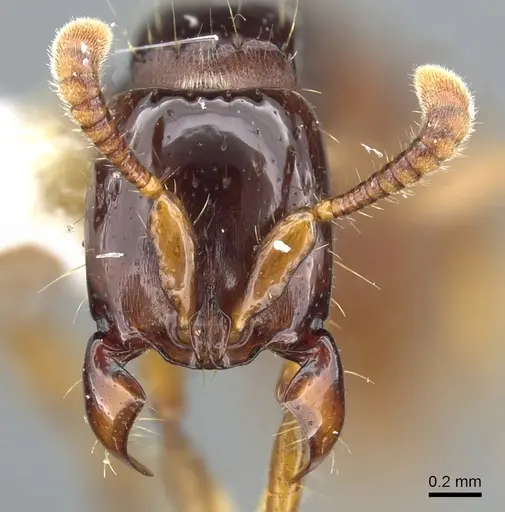
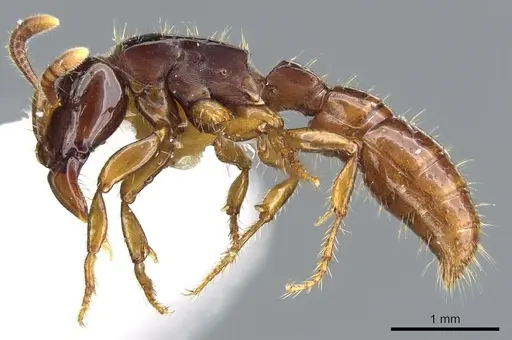
Acanthostichus laevigatus is one of the rarest ants in the world. Scientists have only ever collected seven worker ants, all from a single collection in May 1985 at El Bochinche Research Forest in Venezuela . No queens, males, broods, or living colonies have ever been found. The workers are small, dark brown ants with a distinctly smooth and polished petiolar node that shows a bluish sheen under light - this feature separates them from all other South American Acanthostichus species . As members of the Dorylinae subfamily, they likely share the legionary ant lifestyle of specialized predation, but their exact diet and behavior remain completely undocumented.
Quick Summary
- Difficulty: Expert
- Origin & Habitat: El Bochinche Research Forest in Bolivar state, Venezuela, at 200 meters elevation in tropical lowland rainforest [1][2].
- Colony Type: Unknown, only the worker caste has ever been collected [2].
- Size & Growth:
- Antkeeping:
- Temperature: Unknown, given the tropical Venezuelan origin, keep warm if attempting related species, but no specific data exists for A. laevigatus.
- Humidity: Unknown, likely requires humid conditions given the rainforest collection site.
- Diapause: Unknown, likely unnecessary given tropical origin, but unconfirmed.
- Nesting: Unknown.
- Behavior: Unknown, the species has never been observed alive in a colony context [2].
- Common Issues: species exists only as seven museum specimens, acquisition is impossible and would require collection from protected reserves., no queen has ever been collected making captive propagation impossible., biology is completely unknown, diet, nesting preferences, and behavior are undocumented., likely specialized predatory requirements based on genus position, but specifics are unknown.
A Species Known Only From Seven Workers
Acanthostichus laevigatus represents one of the most extreme cases of rarity in ant taxonomy. The entire species is known from a single holotype worker and six paratype workers collected on May 19,1985,from El Bochinche Research Forest in Venezuela [1]. No additional collections have been reported in the nearly four decades since. The type specimens reside in museums including MIZA (the holotype) and BMNH, ICNB, MCZC, MZSP, and WEMC [2]. Scientists have never observed a living colony, found queens, males, or discovered any brood.
Why This Species Cannot Be Kept
You cannot keep Acanthostichus laevigatus in captivity. This species does not exist in the antkeeping trade. Since only workers have been collected, founding a colony is impossible, you would need a queen, and nobody knows what the queens look like or where to find them. Even if a queen were discovered, the species' specific dietary and nesting requirements are unknown. Attempting to collect more specimens would require traveling to a protected reserve in Venezuela and potentially destroying habitat to find a colony that may live underground or inside termite mounds. For these reasons, this species exists only as a scientific curiosity in museum collections. [2]
What We Can Guess From Related Species
While we cannot state anything definitive about Acanthostichus laevigatus biology, we can look at its genus for clues. Acanthostichus species are legionary ants, they are specialized predators of termites. Other species in the genus raid termite colonies and may live in soil or rotting wood. However, these are guesses based on related species, not observations of A. laevigatus itself. The smooth, shiny petiole and bluish coloration suggest this species may be adapted to specific microhabitats, possibly moving through narrow soil cracks or termite galleries, but this remains speculation. [2]
Identification Features
If you encountered this species, workers are identified by their completely smooth and polished petiolar node that shows noticeable bluish reflections under light [2]. They have poorly developed lateral teeth on the clypeus and a subquadrate petiole that is slightly longer than broad. The mandibles, head, and top of the mesosoma are shining with scattered punctures, while the sides of the mesosoma have fine ridges. They are dark brown with scattered erect hairs [2].
Frequently Asked Questions
Can I keep Acanthostichus laevigatus in captivity?
No. This species is only known from seven museum specimens collected in 1985. No queens have ever been found, so founding a colony is impossible, and the species does not exist in the antkeeping trade.
What do Acanthostichus laevigatus eat?
Their diet is unknown. Other species in the genus Acanthostichus are specialized termite predators, but this has not been confirmed for A. laevigatus specifically.
How big do Acanthostichus laevigatus colonies get?
Colony size is unknown. Since only seven individual workers have ever been collected and no nests have been found, scientists have no data on how large their colonies might be.
Where does Acanthostichus laevigatus live?
They are known only from El Bochinche Research Forest in Bolivar state, Venezuela, at 200 meters elevation in tropical rainforest [1][2].
How long does Acanthostichus laevigatus take from egg to worker?
The development timeline is completely unknown. No one has ever observed their brood or timing of development.
Does Acanthostichus laevigatus need hibernation?
Diapause requirements are unknown. Given their tropical Venezuelan origin, they likely do not require hibernation, but this is unconfirmed.
Are Acanthostichus laevigatus dangerous?
Their sting or bite has never been documented. They are small ants, but without behavioral observations, their danger level is unknown.
Why is there a caresheet for a species that cannot be kept?
This profile documents a scientific mystery. Many antkeepers are interested in rare and unusual species, and this entry explains why A. laevigatus remains unavailable to hobbyists while providing the limited facts known about its morphology and discovery.
Report an Issue
The current care sheet is based fully on literature. See inconsistencies, or something that's incorrect? Please , it will be resolved after review from an admin. Contributing to the blogs tab also helps providing information, to make us be able to further improve the caresheets. Thank you for your support!
References

Este guia de cuidados está sob a licença CC BY-SA 4.0 .
Posts da comunidade
CASENT0903669
Ver no AntWeb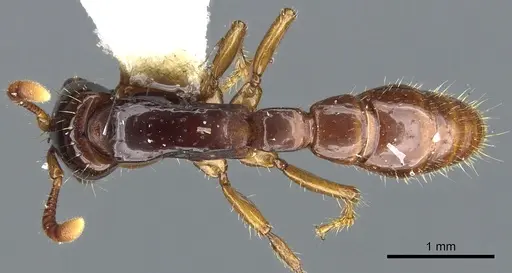
Literatura
Carregando mapa de distribuição...Carregando produtos...