
Strumigenys lachesis
- Wetenschappelijke naam
- Strumigenys lachesis
- Tribus
- Attini
- Subfamilie
- Myrmicinae
- Auteur
- Bolton, 2000
- Verspreiding
- Gevonden in 0 landen
Introductie
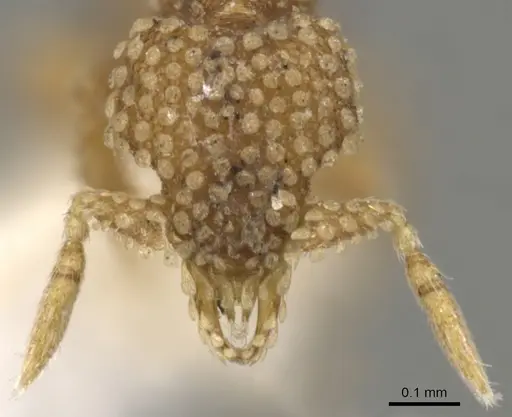
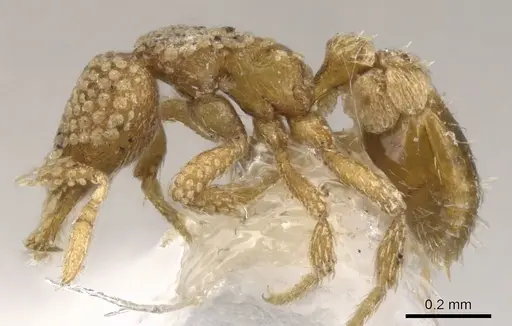
Strumigenys lachesis is a minute ant species measuring about 1.5mm in total length, belonging to the Myrmicinae subfamily and the Attini tribe. Workers are tiny with distinctive pilosity: the head is covered solely with appressed spatulate hairs (no erect simple hairs), and the dorsum of the pronotum also bears appressed spatulate hairs . This species is a member of the Strumigenys argiola group and is closely related to Strumigenys hirashimai, differing in hair patterns and smaller antennal segments . It is native to China, specifically the Palaearctic region, with records from Guangdong . Nothing is known about the specific biology of S. lachesis, but the genus Strumigenys is renowned for specialized predatory behavior - these ants are obligate predators, primarily hunting springtails and other micro-arthropods using their unusual trap-jaw mandibles . This makes them one of the more challenging ant genera to keep.
Quick Summary
- Difficulty: Expert
- Origin & Habitat: Native to China (Palaearctic region) and recorded from Guangdong. Specific habitat requirements are unconfirmed, but Strumigenys species typically inhabit forest floor environments with high humidity and abundant leaf litter [1].
- Colony Type: Colony structure is unconfirmed.
- Size & Growth:
- Queen: Unconfirmed, no queen description is available. Based on related Strumigenys species, queens are likely 2-3mm.
- Worker: 1.5mm total length (TL) [1].
- Colony: Unknown, Strumigenys colonies are typically small, likely under 200 workers at maturity.
- Growth: Slow, dacetine ants are known for very slow colony development [1].
- Development: Unconfirmed. Based on related Strumigenys species, likely 2-4 months at optimal temperature. (Colonies grow very gradually compared to many common ant species.)
- Antkeeping:
- Temperature: Keep warm and stable, roughly 22-26°C. Avoid extremes below 20°C or above 30°C. Use a gentle heating cable on one side if needed.
- Humidity: Keep the nest substrate consistently moist but not waterlogged. High humidity is essential, these ants come from humid forest floor habitats.
- Diapause: Unknown for this species. Based on its Palaearctic distribution, a winter diapause period may be required, but this is unconfirmed.
- Nesting: Use a naturalistic setup with fine, moist substrate (soil or peat) or a well-humidified plaster or 3D-printed nest scaled to their tiny size. Provide tight chambers and narrow passages. Avoid drying out the nest.
- Behavior: Strumigenys lachesis possesses a functional stinger (as with other Myrmicinae), but it is not medically significant to humans. These ants are slow-moving and docile, relying on their specialized trap-jaw mandibles to hunt micro-prey. They do not forage in typical ant fashion, instead, workers patrol slowly and snap up tiny prey like springtails [1]. Escape prevention is critical due to their minute size, standard barriers may not contain them.
- Common Issues: specialized diet requirements make them difficult to feed, they need live springtails or other micro-arthropods, not standard ant food, slow growth tests keeper patience, colonies may take months to produce first workers and years to reach moderate size, escape prevention is critical due to their tiny 1.5mm size, standard barriers may not contain them, high humidity requirements can lead to mold problems if ventilation is inadequate, no specific biological data exists for this species, all care is based on genus-level inference
Identification and Distribution
Strumigenys lachesis workers measure about 1.5mm total length [1]. They are distinguished from close relatives by their pilosity: the head is covered solely with appressed spatulate hairs without any erect simple hairs, the dorsum of the pronotum also has appressed spatulate hairs [2]. The apicodorsal mandibular tooth is short and dentiform (not spiniform), and the funicular segments 2 and 3 are very small and inconspicuous [1]. This species is native to China (Palaearctic region) and has been recorded in Guangdong [1][2]. Specific habitat data is lacking, but it likely inhabits forest leaf litter, typical of the Strumigenys genus.
Housing and Nest Setup
Provide a setup that maintains high humidity while being scaled to the tiny 1.5mm workers. A naturalistic terrarium with moist fine substrate (coco peat, soil-sand mix) or a well-humidified plaster or 3D-printed nest with tight chambers works well. The substrate should feel damp but not waterlogged. Add leaf litter or moss on the surface to provide hunting grounds and retain humidity. Due to their minute size, ensure all connections and boundaries are truly escape-proof, standard fluon may need reinforcement with fine mesh or a thin layer of oil. [1]
Feeding and Diet
This is the most challenging part. Strumigenys are obligate predators that require live micro-prey, primarily springtails (Collembola), which are their natural prey [1]. They cannot survive on sugar water or standard ant protein. You must culture a steady supply of springtails or other tiny micro-arthropods (tiny isopods, booklice, dust mites). Feed small prey items every few days, adjusting based on consumption. A well-established springtail culture is essential before acquiring this species. Some keepers offer fruit flies occasionally, but springtails should form the core diet.
Temperature and Seasonal Care
Keep temperatures warm and stable, roughly 22-26°C. Avoid prolonged temperatures below 20°C or above 30°C. Use a gentle heating cable on one side if your room is cooler. Diapause requirements are unknown, if your colony shows reduced activity in winter, you can try a brief cooler period (a few degrees lower for 6-8 weeks), but many Strumigenys remain active year-round in captivity. [1]
Behavior and Colony Dynamics
As Myrmicinae ants, Strumigenys lachesis has a functional stinger, though it is weak and not medically significant. Workers move slowly and deliberately, using their trap-jaw mandibles to snap shut on springtails and other tiny prey. They do not recruit or form trails like typical ants. Colonies stay small (likely under 200 workers) and grow very slowly. Queens probably produce only a few eggs at a time, and each worker takes months to develop. These ants are completely harmless to humans [1].
Frequently Asked Questions
Can I keep Strumigenys lachesis in a test tube?
A test tube is not ideal. They require high humidity that is difficult to maintain in a simple test tube, and their tiny 1.5mm size makes standard test tube barriers inadequate. A naturalistic setup with moist substrate or a well-humidified plaster nest is recommended instead.
What do Strumigenys lachesis eat?
They require live micro-prey, primarily springtails (Collembola). They are obligate predators and cannot survive on sugar water or standard ant protein. You will need to culture your own springtails. Some keepers offer tiny fruit flies occasionally, but springtails should be the staple diet [1].
How long does it take for Strumigenys lachesis to produce first workers?
Exact development is unconfirmed, but based on related Strumigenys species, expect 2-4 months from founding to first workers. These ants have very slow colony development compared to common species. Patience is essential, colonies may take years to reach moderate size.
Are Strumigenys lachesis good for beginners?
No. Ranked Expert difficulty due to: they require live springtail prey (must be cultured), need high humidity that can cause mold issues, have extremely slow colony growth, and their tiny size makes escape prevention challenging. Beginners should start with easier species like Lasius niger or Messor barbarus.
How big do Strumigenys lachesis colonies get?
Colony size is unconfirmed, but Strumigenys colonies typically stay small, likely under 200 workers at maturity. Even that modest number may take several years to reach.
Do Strumigenys lachesis need hibernation?
Diapause requirements are unknown. If your colony becomes less active in winter, you can try reducing temperature by a few degrees for 6-8 weeks. However, many Strumigenys species maintain year-round activity in captivity.
Why are my Strumigenys lachesis dying?
Common causes include: prey starvation (must have live springtails), low humidity (below 70% can be fatal), mold from over-wetting or poor ventilation, temperature stress (too cold below 18°C or too hot above 30°C), or escape. Review all parameters and ensure live prey availability.
Can I keep multiple queens together?
Colony structure is unconfirmed. Strumigenys are typically monogyne, but no data exists for this species. Combining unrelated queens is not recommended. If you acquire a queen, house her alone until workers emerge.
When should I move Strumigenys lachesis to a formicarium?
Move them only when the colony is well-established (20+ workers) and you can provide live prey reliably. The naturalistic approach is often better, keep them in a terrarium with moist substrate rather than a traditional formicarium. They need hunting space.
Report an Issue
The current care sheet is based fully on literature. See inconsistencies, or something that's incorrect? Please , it will be resolved after review from an admin. Contributing to the blogs tab also helps providing information, to make us be able to further improve the caresheets. Thank you for your support!
References

Dit verzorgingsblad is gelicentieerd onder CC BY-SA 4.0 .
Community-blogs
CASENT0900156
Bekijk op AntWeb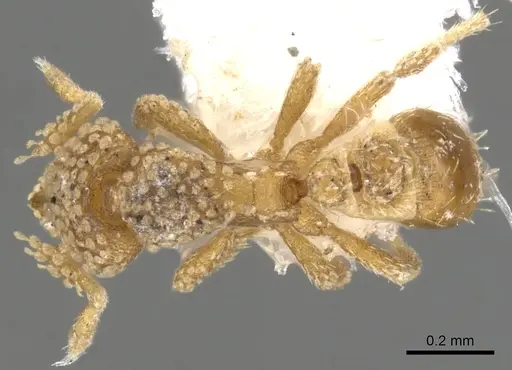
Literatuur
Verspreidingskaart laden...Producten laden...