
Simopone fulvinodis
- Wetenschappelijke naam
- Simopone fulvinodis
- Subfamilie
- Dorylinae
- Auteur
- Santschi, 1923
- Verspreiding
- Gevonden in 0 landen
Introductie
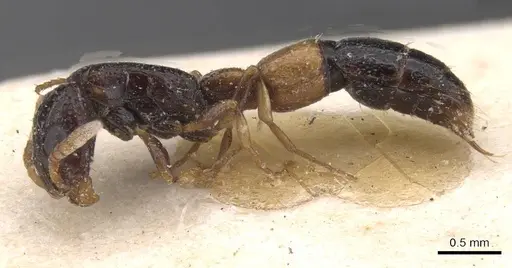
Simopone fulvinodis is a strikingly colored ant species known only from a single worker specimen collected in 1922 in the Democratic Republic of Congo . Its color pattern is unique within the genus: the head and mesosoma are dark brown, abdominal segments AII and AIII are dull yellow, and segments AIV and AV are black . The species belongs to the schoutedeni group of Simopone, a genus within the subfamily Dorylinae. Despite its striking appearance, almost nothing is known about its biology. No additional specimens have been found in over a century, making it one of the most poorly known ant species . This extreme rarity means that no behavioral, ecological, or colony data exists for S. fulvinodis, and it is not suitable for antkeeping.
Quick Summary
- Difficulty: Expert
- Origin & Habitat: Democratic Republic of Congo (Kongo Central region). The single known specimen was collected at Kidada, Kitobola in September 1922 [1]. The region features tropical forest habitats, but specific microhabitat preferences are unrecorded.
- Colony Type: Unknown, only a single worker holotype has ever been collected. No colony samples or queen specimens exist.
- Size & Growth:
- Antkeeping:
- Temperature: Unknown
- Humidity: Unknown
- Diapause: Unknown
- Nesting: Unknown
- Behavior: Unknown in captivity. Based on subfamily patterns, Dorylinae workers have functional stingers. Escape risk cannot be assessed due to lack of captive observations.
- Common Issues: No baseline husbandry data exists, any captive attempt would be entirely experimental., Single specimen known to science means we have zero ecological context., Tropical humidity requirements may be difficult to replicate reliably., Predatory diet would require live small prey, but diet is unconfirmed., Risk of inadvertently keeping conditions wrong due to complete lack of species-specific data.
Species Overview and Identification
Simopone fulvinodis is one of the most poorly known ant species in existence, literally only a single worker specimen has ever been collected and described [1]. The species was originally described by Santschi in 1923 from a specimen collected in what was then the Belgian Congo (now Democratic Republic of Congo) [1].
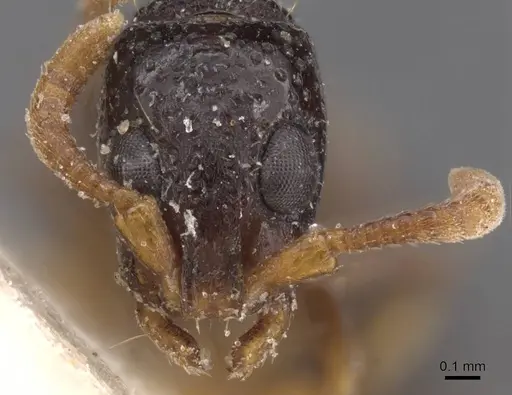
What makes this species immediately recognizable is its striking color pattern. The head capsule and mesosoma (the middle body section) are dark brown, while abdominal segments AII and AIII are a contrasting dull yellow. The remaining abdominal segments AIV and AV are black [1]. This color pattern is unique within the schoutedeni species group and actually throughout the entire genus [1]. The pilosity (hair coverage) is notably reduced compared to related species, though researchers note this might be due to abrasion on the specimen [1].
The genus Simopone belongs to the subfamily Dorylinae, which includes army ants and their relatives. However, Simopone species are not army ants, they are cryptic, ground-dwelling predators that hunt small invertebrates. The entire schoutedeni species group is restricted to the Afrotropical region, with most records coming from Central Africa.
Why This Species Cannot Be Kept
It must be stated clearly: Simopone fulvinodis should NOT be sought after or attempted to keep in captivity. There are several critical reasons why this species is not suitable for antkeeping.
First, the species is only known from a single specimen collected in 1922. No additional specimens have been found in over a century of myrmecological research in the region [1][2]. This extreme rarity suggests either the species is genuinely extinct, exists only in very localized populations, or occupies microhabitats that are rarely sampled.
Second, and more importantly for antkeepers, absolutely no biological or ecological data exists for this species. We do not know what they eat, how they nest, what temperature or humidity they require, how their colonies are structured, when they produce sexuals, or virtually anything that would be needed to keep them alive. Attempting to keep this species would be pure speculation with near-zero chance of success.
Third, there is no known source for this species. No colonies exist in ant culture, no wild colonies have been located, and the type locality has not yielded additional specimens despite targeted surveys [2]. Even if you had the expertise to attempt keeping a Simopone species, this particular species is simply not available.
Related Species That Can Be Kept
While Simopone fulvinodis itself cannot be kept, antkeepers interested in the genus Simopone or similar Dorylinae predators may want to explore other species. Unfortunately, no Simopone species have established husbandry protocols in antkeeping. The genus as a whole is extremely poorly studied, and none are known in captivity.
Some antkeepers have attempted to keep closely related genera like Cerapachys, but these are also rare and require specialized conditions. For most keepers, it is better to focus on well-documented species rather than these data-deficient Dorylinae.
The key takeaway is that if you are interested in keeping cryptic Dorylinae predators, seek species with established husbandry protocols rather than data-deficient species like S. fulvinodis.
Conservation and Legal Considerations
Simopone fulvinodis appears to be an extremely rare or possibly extinct species. The only known specimen was collected in 1922 from the Kidada region of what is now the Democratic Republic of Congo [1]. Despite significant entomological surveys in the region over the past century, no additional specimens have been recorded [2].
If this species were to be rediscovered, it would likely be of significant conservation concern given its apparent rarity. The Democratic Republic of Congo has faced substantial habitat loss due to deforestation and agricultural expansion, particularly in the Kongo Central region where the type locality lies [2].
From an antkeeping perspective, this species should not be targeted for collection even if it were found. The scientific priority would be to document the species in situ and understand its ecology before any consideration of captive collection could be made. Antkeepers should always ensure their colonies were obtained legally and do not target extremely rare or endemic species.
Frequently Asked Questions
Can I keep Simopone fulvinodis ants?
No. This species is known only from a single specimen collected in 1922,and no living colonies have ever been documented. There is no husbandry information available, and the species is likely either extinct or extremely rare. Even professional myrmecologists have not found additional specimens in over a century of searching [1][2].
What does Simopone fulvinodis look like?
Workers are tiny (size data unavailable, but head length is about 0.86 mm) with a distinctive color pattern: dark brown head and mesosoma, bright yellow abdominal segments AII and AIII, and black segments AIV and AV. This striking pattern makes the species instantly recognizable within its genus [1].
Where does Simopone fulvinodis live?
The species is only known from the Democratic Republic of Congo, specifically the Kidada region near Kitobola. The single known specimen was collected in September 1922 [1]. No additional locality records exist.
What do Simopone ants eat?
While no data exists for S. fulvinodis specifically, Simopone species are predators that hunt small invertebrates. Based on genus patterns, they likely prey on springtails, micro-arthropods, and other tiny soil-dwelling creatures.
Are Simopone fulvinodis queen size known?
No queen specimens of this species have ever been collected or described. Only a single worker (the holotype) is known to science [1].
How big do Simopone fulvinodis colonies get?
Unknown. No colony samples have ever been collected, so no estimate is possible.
What is the difficulty level for keeping Simopone fulvinodis?
This species cannot be kept, it is known only from a single specimen collected in 1922,and no living colonies exist in ant culture. Even if specimens were found, the complete lack of biological data would make successful husbandry impossible [1].
Do Simopone fulvinodis need hibernation?
Unknown. As a tropical African species, they likely do not require true hibernation, but this is entirely unconfirmed due to the lack of any ecological data on this species.
What nest type is best for Simopone fulvinodis?
No data exists. Other Simopone species typically nest in rotting wood, leaf litter, or under stones in humid forest habitats. However, without any living specimens, no captive nest recommendations can be made.
Is Simopone fulvinodis endangered?
The conservation status has not been formally assessed, but the species is known from only a single specimen collected in 1922. If it still exists, it would likely be considered critically endangered or possibly extinct given the complete absence of records despite extensive surveys [2].
Can I find Simopone fulvinodis in the wild?
Extremely unlikely. Despite being described in 1922,no additional specimens have been found in over 100 years of subsequent research in the region. The species may be extinct, or it may exist in microhabitats that are not easily sampled [2].
Report an Issue
The current care sheet is based fully on literature. See inconsistencies, or something that's incorrect? Please , it will be resolved after review from an admin. Contributing to the blogs tab also helps providing information, to make us be able to further improve the caresheets. Thank you for your support!
References

Dit verzorgingsblad is gelicentieerd onder CC BY-SA 4.0 .
Community-blogs
RMCAENT000017724
Bekijk op AntWeb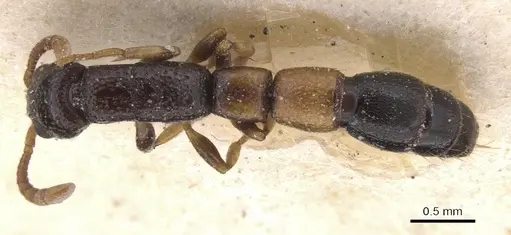
Literatuur
Verspreidingskaart laden...Producten laden...