
Recurvidris chanapaithooni
- Wetenschappelijke naam
- Recurvidris chanapaithooni
- Tribus
- Crematogastrini
- Subfamilie
- Myrmicinae
- Auteur
- Jaitrong & Wiwatwitaya, 2015
- Verspreiding
- Gevonden in 0 landen
Introductie
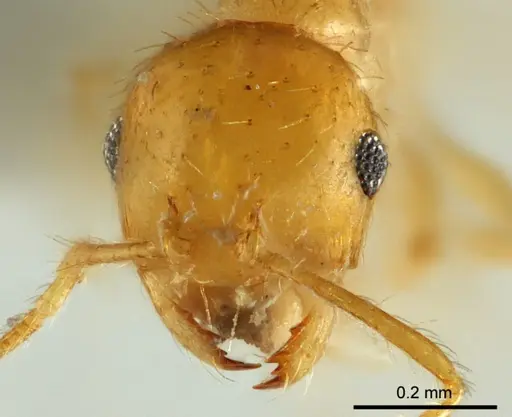
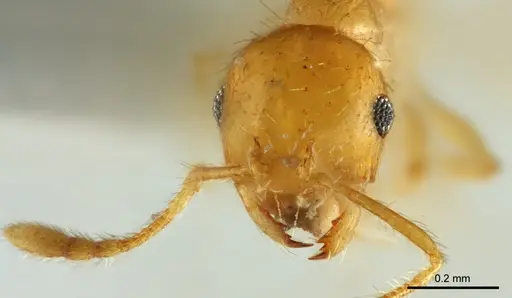
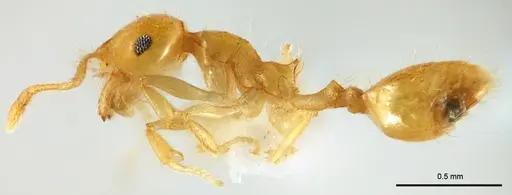
Recurvidris chanapaithooni is a tiny yellow ant species from Thailand, measuring about 2 mm in total length . Workers have a clear yellow body with four sharp teeth on their mandibles and a small tooth on the basal margin . The propodeum has two pairs of standing hairs, and the petiole features a long acute subpetiolar process underneath . This species belongs to the R. kemneri group and is closely related to R. kemneri, R. nigrans, and R. proles . It was only described in 2015 and remains one of the least studied ant species in the hobby, making it a true specialty for advanced antkeepers interested in rare tropical species.
Quick Summary
- Difficulty: Expert
- Origin & Habitat: Recurvidris chanapaithooni is found only in Thailand, specifically in Chanthaburi, Chachoengsao, and Trang Provinces [1]. It inhabits primary lowland evergreen forests and has been collected using honey baits placed on the forest floor [1]. The species is sympatric with R. recurvispinosa in eastern Thailand and R. browni in southern Thailand [1].
- Colony Type: Unknown, colony structure (single-queen or multi-queen) has not been documented for this species [1].
- Size & Growth:
- Queen: Not described, no data available
- Worker: About 2 mm total length [1]
- Colony: Unknown, no colony size data exists [1]
- Growth: Unknown
- Development: Unknown, no development data exists. Based on typical Myrmicinae patterns in tropical species, expect 4-8 weeks at warm temperatures, but this is an estimate. (This is a newly described species with no published development data. Estimates are based on genus-level patterns.)
- Antkeeping:
- Temperature: Likely needs warm temperatures, around 24-28°C, as this is a tropical lowland forest species from Thailand. Use a heating cable on one side of the nest to create a gradient.
- Humidity: High humidity is required, these ants come from evergreen forest floor habitats. Keep nest substrate consistently moist but not waterlogged. Mist occasionally and provide a water tube.
- Diapause: No, this is a tropical species from Thailand and does not require hibernation. Maintain warm temperatures year-round.
- Nesting: No specific captive data exists. Based on collection method (honey baits on forest floor), they likely nest in soil or decaying wood in humid microhabitats. A naturalistic setup with moist soil or a plaster nest works well.
- Behavior: This species is poorly documented in captivity. Workers are tiny (2 mm) and likely fast-moving. As a member of Crematogastrini, they have a modified stinger for smearing venom, but their tiny size makes them harmless to humans. Based on related species, they probably forage on the forest floor and may tend aphids for honeydew. Their small size means escape prevention must be excellent, they can squeeze through tiny gaps. Temperament is unknown but likely non-aggressive. Handle with care as they are extremely small and fragile.
- Common Issues: tiny size makes escape prevention critical, use fine mesh barriers., no captive husbandry information exists, all care is based on inference., newly described species means many biological traits remain unknown., humidity must be maintained or colonies may desiccate., limited availability makes this species difficult to acquire.
Discovery and Taxonomy
Recurvidris chanapaithooni was formally described in 2015 by Jaitrong and Wiwatwitaya, making it one of the newest ant species available in the hobby [1]. The type series was collected from Chanthaburi Province in eastern Thailand using honey bait traps on the forest floor [1]. The species name honors Mr. Sakorn Chanapaithoon, Vice President of the National Science Museum of Thailand, who supported the researcher's myrmecological work [1]. This ant belongs to the R. kemneri species group, which is characterized by having four teeth on the mandible and a small tooth on the basal margin [1]. It can be distinguished from related species by its extremely small size (total length about 2 mm), uniformly yellow body color, and the presence of two pairs of hairs on the propodeal dorsum [1][2].
Natural Habitat and Distribution
This species is endemic to Thailand, known only from three provinces: Chanthaburi in the east, Chachoengsao, and Trang in the south [1]. It inhabits primary lowland evergreen forests, a humid and warm tropical environment [1]. The species is sympatric with R. recurvispinosa in the eastern part of Thailand and with R. browni in the southern part [1]. The 2019 paper notes it is very probably sympatric with R. lekakuli in dry evergreen forest in western and/or southern Thailand [2]. In captivity, you should replicate these humid tropical forest conditions with consistent warmth and moisture.
Housing and Nesting
Since no captive husbandry data exists for this species, you must create conditions based on its natural habitat. These ants come from humid forest floor environments, so a naturalistic setup with moist substrate works best. A plaster nest or soil nest with chambers packed with moist soil mimics their natural nesting in decaying wood and soil [1]. The extremely small size of workers (only 2 mm) means you should use narrow chambers and passages scaled to their tiny bodies. Escape prevention is critical, these ants can slip through gaps that seem impossible. Use tight-fitting lids and fine mesh on any ventilation holes. A water tube attached to the nest helps maintain humidity.
Feeding and Diet
The type series was collected using honey baits, suggesting these ants are attracted to sweet substances [1]. In captivity, offer sugar water or honey diluted with water as a constant energy source. For protein, small live prey like fruit flies, pinhead crickets, or micro-arthropods should be accepted. Given their tiny size, prey items must be very small. They likely forage on the forest floor and may tend aphids or scale insects for honeydew in nature. Feed small amounts several times per week and remove uneaten prey to prevent mold. The combination of sweet bait collection and small size suggests they are generalist foragers.
Temperature and Seasonal Care
As a tropical lowland species from Thailand, Recurvidris chanapaithooni requires warm temperatures year-round. Maintain the nest area at 24-28°C, with a slight gradient allowing workers to regulate their temperature preference. A small heating cable placed on one side of the nest creates this gradient effectively. Unlike temperate species, this ant does not require hibernation or a diapause period. Room temperature alone may be insufficient in cooler climates, monitor with a thermometer and adjust heating accordingly. High humidity should be maintained alongside the warm temperatures to prevent desiccation.
Challenges and Expert-Level Care
This species is rated Expert difficulty because virtually no captive husbandry information exists. Every aspect of keeping this ant requires careful observation and experimentation. Colonies may be extremely difficult to acquire since the species was only described in 2015 and remains rare in both research and antkeeping circles. There is no data on colony development, founding behavior, queen dimensions, or typical colony size. You are essentially pioneering the husbandry of this species. Start with a small colony if available, and document your observations carefully. The tiny worker size also makes them fragile and difficult to handle during nest transfers. Only experienced antkeepers should attempt this species. [1][2]
Frequently Asked Questions
How long does it take for Recurvidris chanapaithooni to produce first workers?
Unknown, no development data exists. Based on typical Myrmicinae patterns in tropical species, expect 4-8 weeks from egg to worker at optimal warm temperatures, but this is purely an estimate.
Can I keep Recurvidris chanapaithooni in a test tube?
Yes, a test tube setup can work for founding colonies, but you must maintain high humidity. The tiny size means the water reservoir should not be too large to avoid flooding. However, a naturalistic or plaster nest may be better long-term since these ants come from humid forest floor habitats.
Do Recurvidris chanapaithooni ants sting?
They have a modified stinger used for smearing venom rather than piercing, but given their tiny size (2 mm), any effect on humans is negligible.
Are Recurvidris chanapaithooni good for beginners?
No, this species is rated Expert difficulty. It was only described in 2015 and has no captive husbandry data. Every aspect of care must be learned through experimentation. There is no information on colony development, founding behavior, or typical colony size.
What do Recurvidris chanapaithooni eat?
Based on collection using honey baits, they are attracted to sweets. Offer sugar water or honey as a constant energy source. For protein, small live prey like fruit flies or micro-arthropods should be accepted. Prey must be very small given their 2 mm worker size.
How big do Recurvidris chanapaithooni colonies get?
Unknown, no colony size data exists. Related species in the R. kemneri group typically have small colonies, but specific numbers have not been documented for this species.
Do Recurvidris chanapaithooni need hibernation?
No, this is a tropical species from Thailand and does not require hibernation. Maintain warm temperatures (24-28°C) year-round. Unlike temperate species, they do not enter diapause.
Why are my Recurvidris chanapaithooni dying?
24°C), escape through tiny gaps, or inadequate prey size. Their tiny size makes them vulnerable to drying out and predation by larger ants.
Can I keep multiple Recurvidris chanapaithooni queens together?
Unknown, colony structure has not been documented. Do not combine unrelated queens until more is known about their social structure.
When will Recurvidris chanapaithooni nuptial flights occur?
Unknown, nuptial flight timing has not been documented. As a tropical species, they likely fly during warm, humid seasons, but specific timing is unconfirmed.
Report an Issue
The current care sheet is based fully on literature. See inconsistencies, or something that's incorrect? Please , it will be resolved after review from an admin. Contributing to the blogs tab also helps providing information, to make us be able to further improve the caresheets. Thank you for your support!
References

Dit verzorgingsblad is gelicentieerd onder CC BY-SA 4.0 .
Community-blogs
THNHM-I2015-000295
Bekijk op AntWeb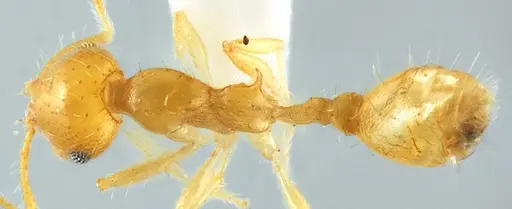
Literatuur
Verspreidingskaart laden...Producten laden...